
By Martin Z Braun | Bloomberg Markets
Stephen Gilmore’s 40-year tour of global finance has given him a front-row seat to the Russian debt crisis, the bailout of a financial giant and the rise of sovereign wealth funds. It’s also taken him to a war zone. As the International Monetary Fund’s representative in Tajikistan in the 1990s, Gilmore hunkered down in his office for three days as a militia advanced on the capital city of Dushanbe.
Read more Trump has a new, surprising take on the higher cost of living: ‘I love the inflation’
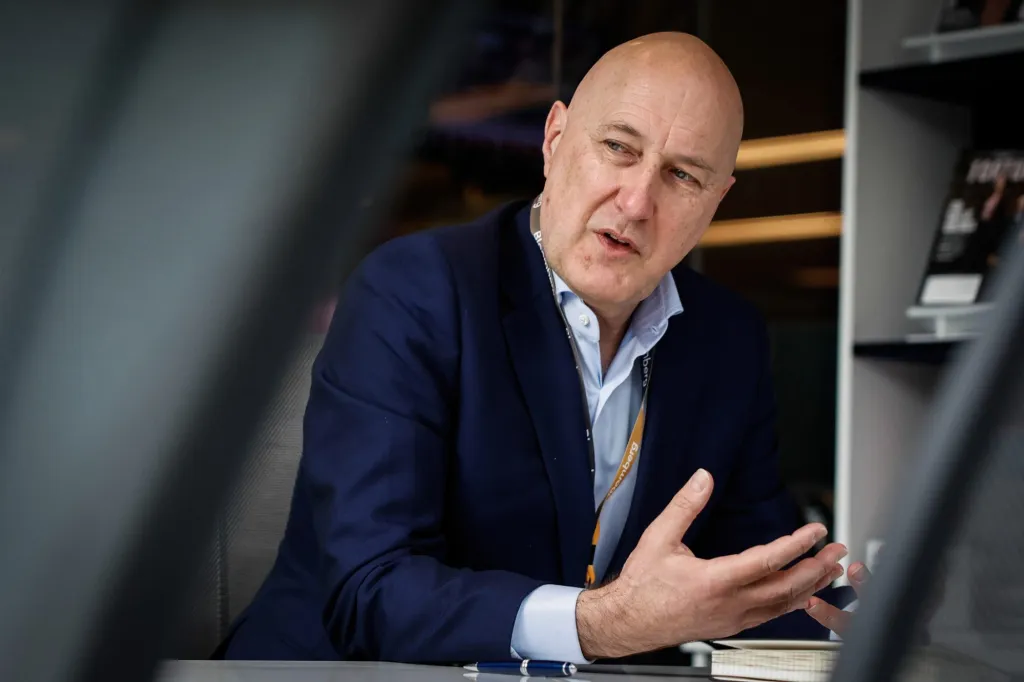
Now he has what many consider the hardest job in investing. Gilmore runs the $600 billion portfolio of the California Public Employees’ Retirement System, the largest pension fund in the US. “It takes a lot to bother him,” says Marcie Frost, chief executive officer of CalPERS and Gilmore’s boss.
Gilmore, who stepped in as chief investment officer in the summer of 2024, directs a staff of more than 300 while facing scrutiny from politicians, union leaders, environmentalists, taxpayer groups and the media. Some of that attention is because of the pension’s sheer size: CalPERS’ membership of 2.4 million retirees, beneficiaries and active employees is almost half the entire population of Gilmore’s native New Zealand, where he ran the country’s $50 billion sovereign wealth fund.
But Gilmore, 64, also came into the job with a lot to do. The pension had only 74% of the funds needed to fulfill its long-term obligations, and its 10-year average annualized return of 6.2% at the end of the 2024 fiscal year was near the bottom of pension funds with assets greater than $10 billion, according to Wilshire’s Trust Universe Comparison Service. In Gilmore’s first fiscal year, ended June 2025, the fund earned 11.6%, its best return since 2021, and its funding level has risen to almost 84%. In his 23-month tenure, he’s already outlasted his two predecessors in the role.
His biggest challenge is yet to come, as he tries to make the giant fund a more flexible investor. In November, CalPERS became the first US public pension to formally adopt the so-called total portfolio approach, a strategy used by about a dozen sovereign wealth funds in the Asia-Pacific region and Canada. The idea is to ditch the rigid allocations to stocks, bonds, private equity and real estate around which many institutional investors organize their money managers’ work. Instead, TPA calls for collaboration across the portfolio management team, with everyone keeping in mind the big picture—and the best possible returns. It goes live in July.
“It’s about optimizing the whole portfolio rather than individual asset classes,” Gilmore says. “When you’ve got a whole lot of separate teams trying to do the best thing, it may not aggregate to the best thing for the whole portfolio.” Gilmore is well versed in TPA after using it during his almost nine years as chief investment strategist at Australia’s Future Fund, then later as CIO of New Zealand’s Superannuation Fund, which is designed to help the government pay for retirements, from 2019 to 2024. NZ Super returned 9.5% in that five-year period, fourth among 50 sovereign investors, according to the consulting firm Global SWF.
A big bet
CalPERS is betting Gilmore can replicate the success he had in New Zealand with a fund that has more than 10 times the assets. There’s a lot riding on the experiment. Failure to meet its 6.8% return target increases the burden on California’s local governments to make up the difference—money that could be used for affordable housing, hiring more teachers or boosting health services. That puts CalPERS managers under a harsh spotlight. “It’s a very hard job, a very public job,” says Theresa Taylor, president of the CalPERS board.
Gilmore’s predecessor as permanent CIO, Nicole Musicco, resigned after less than two years on the job, saying she needed to spend more time with her family in Toronto. The Canadian executive got some pushback internally on her focus on sports, technology and venture capital investments, Bloomberg reported at the time.
Before Musicco, CIO Ben Meng chose to resign after state officials opened a review into whether he’d violated conflict-of-interest rules. Meng had disclosed his own investments and relied on CalPERS to flag potential conflicts, according to documents, and there was no evidence he sought personal gain. He agreed to pay a $10,000 fine in 2024 to resolve the issue. While managing the fund, he faced criticism for ending a hedging program in the weeks leading up to the Covid-19 pandemic; the decision cost the fund more than $1 billion in forgone payments. Meng said in a public meeting that the program was costly and that the fund’s other risk controls cut losses by $11 billion.
Margaret Brown, a former CalPERS board member and a vocal critic, says management churn at the top contributed to the fund’s poor performance. “When you don’t have continuity at the top, it’s hard to set a course,” she says. “With every new leadership team, we’ve gone in a different direction.”
A group headed by Brown commissioned a report that slams the fund’s investment practices, pinning “chronic underperformance” on a lack of transparency, fees paid to outside money managers and a range of other issues. A shift over the years toward opaque alternative assets such as private equity, private credit and real estate has been especially costly, according to the report, which recommends appointing an independent inspector general.
CalPERS’ Frost calls the report an “opinion piece full of baseless assertions and breathless language.” For the past two years, she says, CalPERS ranked in the top 5% of large US pension funds by performance, helped by its private equity portfolio. She also says the fund has cut fees as a percentage of total private equity investment since 2024.
Gilmore says he knows the high stakes of running the fund. “In the end you must focus on the job at hand and not be distracted by some of the unwelcome headlines,” he says.
Read more Corona del Mar man accused of defrauding bank of nearly $100 million
Walking man
The man responsible for investing one of the largest pools of capital in the world doesn’t own a car in the US. Gilmore, who earned $2.3 million last year, walks about a mile to his CalPERS office from his home in downtown Sacramento. He spends free time checking out rock bands (guitarist Jack White is a favorite), loves a good craft brewery and vacations at his hut on a New Zealand mountain pass, fishing for brown trout.
Gilmore grew up in a seaside suburb of Christchurch, the biggest city on New Zealand’s South Island. His father worked as a crane operator at the city’s port, and his mother managed the household. On summer breaks from university, Gilmore also worked at the port, painting buildings, shoveling coal on a steamship and crewing on harbor boats. After graduating with an economics degree, he took a job at New Zealand’s central bank. Then, like many Kiwis, he took time off to travel, backpacking solo through Asia.
Afterward, he landed in London with a job structuring derivatives for Chase Manhattan Bank. “That one year away from New Zealand ended up being 30 years,” says Gilmore, who’s lived in 10 cities in six countries.
He joined the IMF in 1992 as an economist in Washington. At the time, the IMF needed people with central banking experience to work with newly independent former Soviet states. Gilmore was sent to Tajikistan to help stabilize an economy in free fall. Not only was there a civil war, but inflation reached 2,000%, and the currency was rapidly depreciating. International workers faced threats and potential fallout from the fighting. “When you’re in those sorts of environments, you focus on what really matters,” he says.
Later he went to Morgan Stanley, working as an emerging-markets strategist, then to American International Group Inc.’s financial products subsidiary, where he helped create an investable EM currency index. He was there when the insurer got a federal bailout after posting massive losses on mortgage-backed securities it insured. “It’s a reminder to be thinking about what possible scenarios can occur,” Gilmore says.
After the global financial crisis, he became immersed in TPA at Australia’s newly created Future Fund, where he gained a reputation as being broad-minded and unassuming—and a strong backer of his team. “He sort of approaches the investment conundrum from a point of view of intellectual curiosity,” says Raphael Arndt, the sovereign wealth fund’s CEO. “I don’t think he’s driven by wanting a big team or a high-profile job or anything like that. I think he’s driven by the intellectual challenge.”
Instituting TPA at CalPERS will be an organizational feat. US pension managers traditionally divide portfolios into buckets, setting target allocations for stocks, bonds, alternative investments and so on. Separate asset-class teams fill each bucket and try to beat individual benchmarks. CalPERS currently has five such buckets.
Splitting up a portfolio this way can ensure diversification and help hold portfolio management teams accountable by giving them clear benchmarks to beat. The downside is that managers can end up hewing too closely to their indexes and miss the forest for the trees. Just because an investment in a toll road might be the best idea a fund’s infrastructure team can find, that doesn’t necessarily mean it offers a better risk-adjusted return than other assets. With TPA, investment teams collaborate free from allocation restraints and try to pick investments to meet the portfolio’s objectives.
Analyzing how each investment affects the entire portfolio isn’t a novel concept, says Eric Friedman, a partner at Aon Investments. “A really good chief investment officer is going to look at things holistically regardless of whether they’re doing strategic asset allocation or whether they’re doing TPA,” he says. While New Zealand Super had the third-best 10-year returns among 50 of the biggest sovereign investors from 2016 to 2025, Singapore’s GIC, which also subscribes to TPA, was ranked near the bottom, at 40th, according to Global SWF.
At CalPERS, overall performance will be gauged against a passive reference portfolio of 75% global stocks and 25% bonds, though teams will also still have asset benchmarks that will be reported to the board. Gilmore says he believes the TPA approach could add an average 0.5 to 0.6 percentage points of return over the reference portfolio annually, translating into billions of dollars over time. But extreme market volatility or underperformance could create pressure to abandon the strategy.
“If this is a failure, I imagine the press is going to rail him,” says Taylor, the president of the board. “He has the utmost confidence. That’s what’s so cool about him. He has the utmost confidence that it’s going to work. —With Amy Bainbridge
Read more At World Cup stadiums, there will be zero tolerance for drones because of the threat they pose
Braun reports on municipal finance for Bloomberg News in New York.