
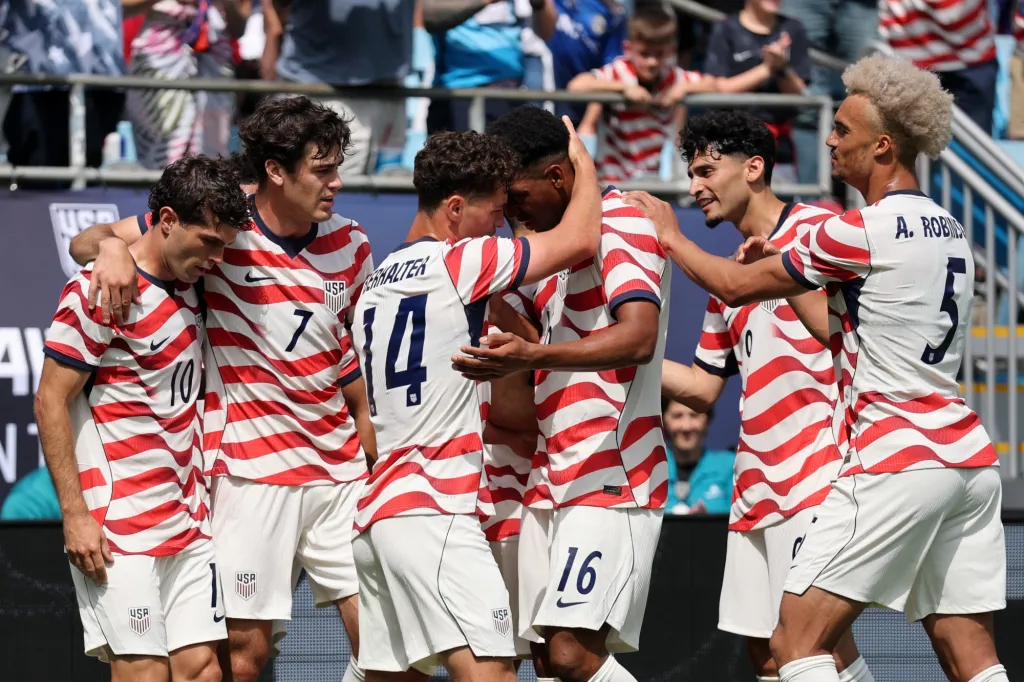
Is the U.S. men’s national team headed for a breakthrough or a breakdown?
That depends on what you define as a successful World Cup for this generation of American footballers, who kick off their tournament Friday night in Group D against Paraguay.
Read more Judge considers arguments in challenge to New Mexico’s universal childcare program
Expectations seem to be all over the map. Conventionally, the hope has been for the U.S. to just get out of its group. But former captain Landon Donovan is bothered by the fact that no American side since 2002 has won a knockout-round game and reached the quarterfinals. And head coach Mauricio Pochettino said earlier this spring that he wants players and fans alike to adopt a champion mentality.
While bookmakers give the U.S. 60-to-1 odds of winning it all, what’s clear is that putting on a good show is no longer enough. Just showing up and hanging with the rest of the world may have been the bar in 1994, but in the 32 years since this country last hosted a World Cup, the growth and success of American soccer on and off the field are such that there’s far too much on the line for moral victories.
Seeing an American on the roster of a top European club is now commonplace, unlike at the turn of the century. Today’s deep pool of Yanks abroad represents a golden generation, with starters in the English Premier League, Spanish La Liga and Italian Serie A. Many of those players, like Bournemouth’s Tyler Adams and Juventus’ Weston McKennie, were uncovered in MLS youth academies before being transferred abroad. Indeed, MLS is home not only to Lionel Messi, but to eight of the 26 players called in by Pochettino to the World Cup roster. The league certainly isn’t perfect, but it has directly contributed to the rise of the U.S. men’s national team.
On player quality alone, the U.S. has outgrown what in the past would seem like satisfactory objectives. But adding in the pressure of serving as World Cup co-hosts, the improvements in soccer infrastructure since the tournament was last here in 1994, and the opportunity to translate interest back to American players and MLS means answering a fundamental question: Does the game have a foothold here, or not?
Ceiling is as high as floor is low
Pochettino is on to something when he says the U.S. should adopt a champion mentality. While a title is surely out of reach, a deep run is not. And besides, acting like a contender has far more in common with the American sports mindset than seeking style points just for participation.
The U.S. raised eyebrows sporadically throughout the history of the World Cup. In the inaugural 13-team tournament in 1930, they finished third. They shocked England in 1950 and Portugal in 2002. In 2010, they won the group for the first time. Sprinkled in have been iconic moments for the national team program, both good and bad, including Clint Dempsey’s first-minute goal in the opener of the 2014 tournament, and failing to qualify in 2018.
Even in the leadup to this summer, the U.S. showed flashes of brilliance but lost three of its last four exhibition matches.
‘Most even group at the World Cup’
Joining the U.S. and Paraguay in Group D are Türkiye and Australia, all evenly matched nations.
“All four of those teams can be first in the group or they can be last in the group,” said German economist Joachim Klement, who has correctly predicted the last three champions.
The tournament has been expanded to 48 teams for the first time, with the knockout stage now starting in the Round of 32. That means the U.S. needs to get out of the group and win two further games to equal its 2002 quarterfinals finish.
A deep run is almost certainly predicated on finishing first or second in Group D. Finishing third could also clinch a knockout berth, as eight third-place nations advance. But this would likely set up a match out of the gate against a world power like Portugal, Germany or France.
Weaknesses: goalkeeper and back line
Matt Freese appears to be Pochettino’s starter in net despite New England Revolution goalkeeper Matt Turner bringing prior World Cup experience and leading Freese in several goalkeeping metrics in MLS this season.
This is widely seen as the weakest goalkeeper corps the U.S. has ever brought to a World Cup, with Freese still green for such a high-stakes occasion.
Read more A look at the SpaceX IPO by the numbers
Freese will need to organize a back line that has failed to keep a shutout in eight tries dating back to last September. Turner, the only living American goalkeeper with two shutouts in the same World Cup, is likely on the bench.
Crystal Palace center back Chris Richards would normally be a first-choice starter, but he continues to recover from an ankle injury. Covering for him and joining captain Tim Ream will be a rotation of Mark McKenzie, Auston Trusty and Arlington native Miles Robinson.
Strengths: elite wingers and accomplished midfielders
Pochettino uses a three-man back line and employs wing backs Sergino Dest and Antonee Robinson, both of whom are two of the most capable wide players in the world. Both players pitch in on defense, but provide the U.S. with pace, vision and clean contact on the ball in the attacking third.
Adams and McKennie are both starters with Adams in a deep-lying role to assist on defense, possession and transitions while McKennie is in a free-roaming playmaking position to support the attack.
Dest, Robinson, Adams and McKennie are the X-factors. This quartet is crucial to how the U.S. plays, providing balance, leadership, and world class quality on both sides of the ball.
Wildcards: depth and Christian Pulisic
Christian Pulisic is meant to be the U.S.’s main scoring threat. Capable of running at defenders, cutting and crossing on the flanks and going at defenders in the box, his success is the Americans’ success.
But Pulisic is also streaky. His goal in last week’s 3-2 victory against Senegal was his first this year, and every team knows it must neutralize Pulisic to halt the U.S. attack.
Joining Pulisic is a trio of strikers – Folarin Balogun, Ricardo Pepi and Haji Wright – all of whom had prolific scoring seasons in Europe last year. If Pulisic isn’t the tip of the spear, he’ll be a setup man for someone else in the attack.
The U.S. is bringing quality to the World Cup, but depth is nevertheless lacking. One injury to a key player – particularly a central midfielder like McKennie or Adams – could have drastic implications.
What does successful tournament look like?
An expanded field means reaching the quarterfinals is harder than ever. That said, achieving this is within the power of the 26 players Pochettino called in, especially as tournament co-hosts. Winning the quarterfinal would be a cherry on top and would constitute the Americans’ best result in the modern era.
A strong tournament is viewed as potential rocket fuel on the game’s growth in this country. At minimum, it would continue raising the profile of the American player globally.
On the flipside, failing to reach the Round of 16 – or reach the knockouts at all – would only embolden biases against MLS and the U.S. Soccer Federation’s methods. Interest in the game here may not be fully realized, and the men’s national team program would face major questions despite its quality on the field and advantage as a World Cup co-host.
Read more Nearly 118 million people were displaced by conflict and persecution last year, UN says