
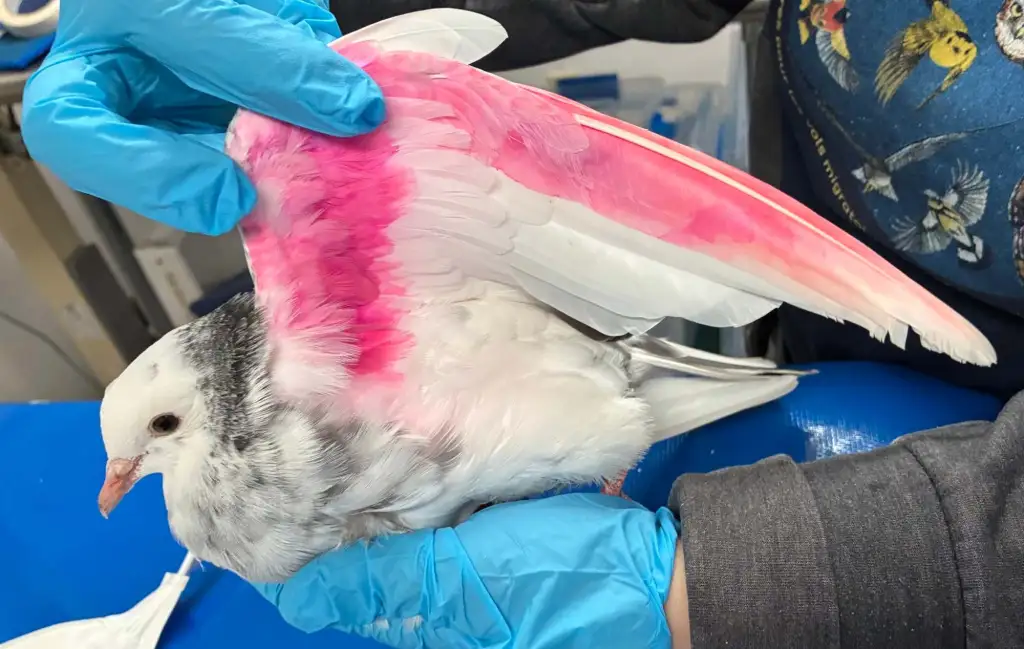
VACAVILLE, Calif. — A tired and hungry pigeon recently found in Northern California with a partially pink wing may have been dyed to assist with a gender reveal celebration, according to wildlife rescue operators.
Read more Orange High Graduation 2026: Our best photos of the ceremony
“We are heartbroken whenever we receive a bird that’s been dyed for a gender reveal celebration,” Napa Wildlife Rescue wrote in a June 3 social media post accompanying a photo of a pigeon that had been recovered with part of its body dyed pink.
The discovery prompted the organization to speak out about what it says is a concerning trend.
Wildlife advocates confirmed this week that the discovery of the dyed bird is not an isolated incident. They denounced not only the dyeing birds of different colors, but also the practice of releasing domestic birds into the wild.
“This is not fair to the bird,” said Linnaea Furlong, director of care and operations at the Napa Wildlife Rescue. “It puts them at lots of risk.”
Furlong said this was not the first time the Napa Wildlife Rescue has come across a bird dyed another color, though this is the first pink pigeon the rescue has seen in years. Jill Shepard, care director at Palomacy Pigeon and Dove Adoptions, said the nonprofit sees this kind of incident more often and estimated they take in at least two dyed birds per month.
Homemade dying processes may have a variety of harmful impacts on birds, such as creating respiratory and vision issues, according to Furlong.
Helping a bird recover begins with letting the bird bathe itself and see if the color washes off, though Furlong said the wait-and-see approach typically does not work very well. Another option is to wait for molting, but it usually takes about a year for a bird to shed its flight feathers.
Read more Huntington Beach High Graduation 2026: Our best photos of the ceremony
Recovery depends on other factors — mainly if the bird exhibits other issues when found. Many rescued pigeons arrive at rescues injured, starved or dehydrated and veterinary support is typically needed to treat these birds, rescue operators said.
These additional injuries are why advocates argue against the practice of dove releases. Shepard said many “dove releases” are actually pigeon releases, but releasing any domestic bird into the wild is dangerous.
“It’s a death sentence for these birds,” Shepard said.
Despite the prevalence of ceremonial releases, Shepard was adamant about the danger of wild releases, explaining that most domestic birds have no idea what to do when they are released.
Releasing domestic birds is akin to “letting your dog play on the freeway,” Shepard said. Doves are not meant to be released and are almost guaranteed to perish and, while pigeons are slightly more resilient, they still face significant danger in the wild, she said.
The pigeon was discovered in Vacaville, located 55 miles east of San Francisco, then taken to the Napa Wildlife Rescue and later adopted by a volunteer who has a large aviary with other pigeons, according to Furlong.
Both Shepard and Furlong emphasized the importance of contacting wildlife rescue organizations to report injured animals. Shepard explained Palomacy sees birds coming from all over the Bay Area with many being found in Sonoma and Napa counties — the group is contacted daily about lost or injured birds.
“(These birds) are lucky when they end up with a rescue or a kind person,” Shepard said.
You can reach Staff Writer Kyle Garcia Takata at [email protected].
Read more Gooooal! Safe sex billboards with soccer ball condoms greet FIFA World Cup crowds