
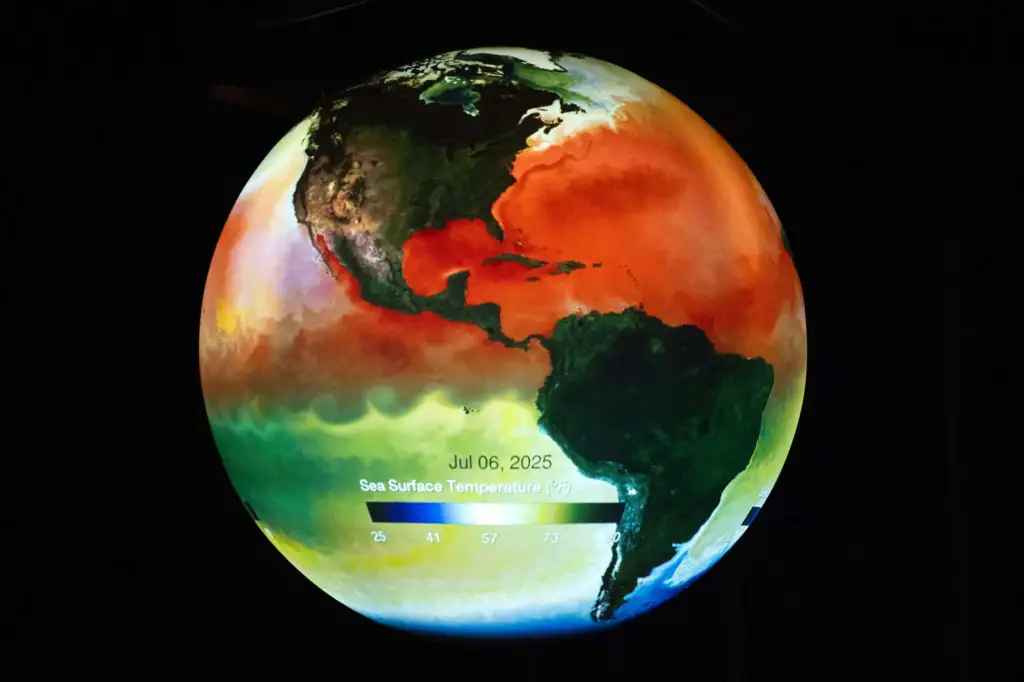
With a strong El Niño on the horizon, which is expected to worsen existing marine heat waves off the California coast into the summer months, Long Beach’s Aquarium of the Pacific is preparing to deal with potential impacts to wildlife.
Read more Horse racing: The best at Santa Anita are winning on the road
Leaders from the aquarium, alongside weather and oceanography experts from the National Oceanic and Atmospheric Administration, hosted a panel on Thursday, June 11, to discuss potential impacts of the El Niño in California, on both people and the ocean’s inhabitants.
During the event, NOAA’s National Weather Service confirmed that there is now currently an El Niño advisory in effect — meaning that El Niño conditions are already present, and are expected to strengthen across the Northern Hemisphere throughout the summer and into the winter months.
NOAA declares an El Niño when temperatures in the equatorial Pacific are 0.5 degrees Celsius above average for several months in a row, the agency said in a Thursday news release.
Under normal conditions, warm waters in the equatorial pacific are transported westward by east-west trade winds, according to NWS Los Angeles’ meteorologist-in-charge Ariel Cohen, who spoke at the aquarium’s Thursday event. But during El Niño, those trade winds slack, causing the warm water farther to the east, off the coast of Mexico, Central America, and North and South America.
That “causes jet energy in the atmosphere to bring disturbed weather southward across the southern United States,” Cohen said, “which can bring wetter than normal conditions to our area, with drier conditions farther to the north.”
El Niño can have myriad impacts on the weather, according to NOAA, which differ across the world. They can cause strong winds that suppress storm and hurricane development in the Atlantic Basin, while weaker winds can cause tropical development in the eastern and central Pacific basins; increase the likelihood of stormy weather, rain and snow in the Southern U.S.; increase risk of high tide flooding on the West Coast; and numerous other impacts to marine and ocean ecosystems.
“El Niño conditions are already present at this point, and expected to strengthen across the Northern Hemisphere into the winter time, over the next several months,” Cohen said. “In fact, there is a 63% chance that we’re looking at a very strong El Niño during the November to January time period that could rank amongst the largest El Niño events in historical record going back to 1950.”
But it’s still unclear, Cohen said, whether the El Niño will cause a wetter or drier winter here in Southern California, as the weather impacts can be unpredictable — especially this far out.
“The odds favor wetter than normal conditions, especially during a very strong El Niño pattern, (but) we’ve had dry periods during very strong El Niños,” Cohen said. “So the main message is that if we end up with a wet pattern, we certainly need to be prepared for the possibility of impacts from rain, such as flooding, storms, and strong winds, but again, there’s no guarantee.”
But alongside potential impacts to people, warming ocean waters — including two ongoing marine heat waves, such as one that began in late 2025 and is not related to the El Niño — will likely have significant impacts on the ocean’s ecosystems.
Those impacts, NOAA experts said Thursday, will likely be similar to those observed during past strong El Niño events and “The Blob,” a marine heat wave in 2015 and 2016 — which pushed sea temperatures as much as 7 degrees Fahrenheit above average.
“One of the most important things, though, for the animals in the ecosystem is not necessarily just how hot it is — that is important in some cases — but just how long they’re exposed to the heat,” said Dr. Andrew Leising, a research oceanographer with NOAA’s Southwest Fisheries Science Center.
During long-lasting marine heat waves, Leising said, the population of plankton tends to decrease, which is a major issue because it forms the base of the food web for the ocean’s ecosystem. El Niño also tends to cause a decrease in “upwelling,” a process in which cold, nutrient-rich water is brought to the surface.
El Niños, in the past, have also resulted in marine mammals and other migratory species coming closer to shore to find food; increased favorability for the creation of algal blooms; reduced productivity of California sea lions; and lowered the abundance of market squid, according to Leising.
But in combination with a marine heat wave similar to “The Blob,” El Niños can have even stronger effects on marine life, including die-offs of seal lions, seals and marine birds because of a lack of food, less food for baleen whales, closures of crab and shellfish fisheries because of algal blooms, and less ground fish habitat because of decreased oxygen levels.
Read more All-CIF Southern Section boys lacrosse teams 2026
“Warming ocean temperatures will continue to affect our ocean ecosystems as time progresses,” Nate Jaros, the aquarium’s vice president of animal care, fish and invertebrates, said Thursday. “This may bring unusual visitors to our areas, and it may also threaten some of our resident ecosystems.”
With warmer waters expanding the range of tropical and warm subtropical species, Jaros said, animals that don’t usually swim off the Southern California shore may be spotted in the coming months, including yellowfin tuna, mahi mahi, yellow-bellied sea snakes, sea horses, and in rare cases, various shark species, including makos, blues and whites.
“During past spring heat waves, coastal species like blues and makos occupy dense populations along the West Coast of the United States,” Jaros said. “Over time, climate change also affects where these animals are primarily located, including shark nurseries, which have been moving farther north in our region.”
Even whale sharks, Jaros said, have shown up off of Catalina Island during previous El Niño events.
“Periodically, we’ve seen marine animals washing up on our shores, which can happen for a number of reasons,” Jarod said, including wind patterns, sudden changes in ocean temperature or animal disorientation.”
There will likely be an increase in sea lion strandings during marine heat waves, the aquarium said, and sea birds may also experience sudden and severe population declines because their food sources are too deep in the ocean for them to reach. They often don’t return to their habitats after heat wave events.
Other crucial species, like bull kelp and white abalone, have faced serious population declines in recent years as a result of climate change and warming ocean waters. More than 90% of Northern California’s bull kelp forests, for example, were destroyed in 2014 as a result of a marine heat wave and an explosion in the sea urchin population.
The aquarium, though, has been working to help conserve and rebuild the populations of various sea creatures, including bull kelp, white abalone, sea turtles, sea otters and sunflower sea stars, among others.
The Aquarium of the Pacific also runs several programs aimed at providing emergency response for marine life, birds and mammals during crises. The institute also runs various community-driven wildlife and ecosystem monitoring programs, aimed at helping identify potentially harmful changes to the environment and preventing harm to marine species.
“The importance of coastal communities is part of their own healthiness and well-being. A healthy marine environment is good for the economy, it’s good for people who live on it,” said Jeff Flocken, the aquarium’s president and CEO. “So we want to be prepared if there are any major changes in the ecosystem that we should work to understand what’s happening and get ready for it.”
This summer, in preparation for the potential impacts the El Niño and marine heat waves will have on the ocean’s inhabitants, the aquarium will launch a public service announcement program, which aims to inform the community about who to contact if they see a coastal animal in distress.
“This new program will launch this summer and we’ll be posting those phone numbers and they’ll be readily available on our website,” Flocken said.
There are plenty of other ways for the community to get involved with marine wildlife and ocean monitoring programs offered by the aquarium, whether that’s the Pinniped Patrol — a collaboration with San Pedro’s Marine Mammal Care Center where volunteers support rapid responses to sea lion strandings — or the Southern California Plankton Watch, an effort to monitor and track crucial ocean changes and detect when algal blooms are formed.
The Aquarium has many other programs, which can be found online at aquariumofpacific.org/volunteer.
Read more OC Board of Supervisors extend contracts with Meals on Wheels OC, Age Well Senior