
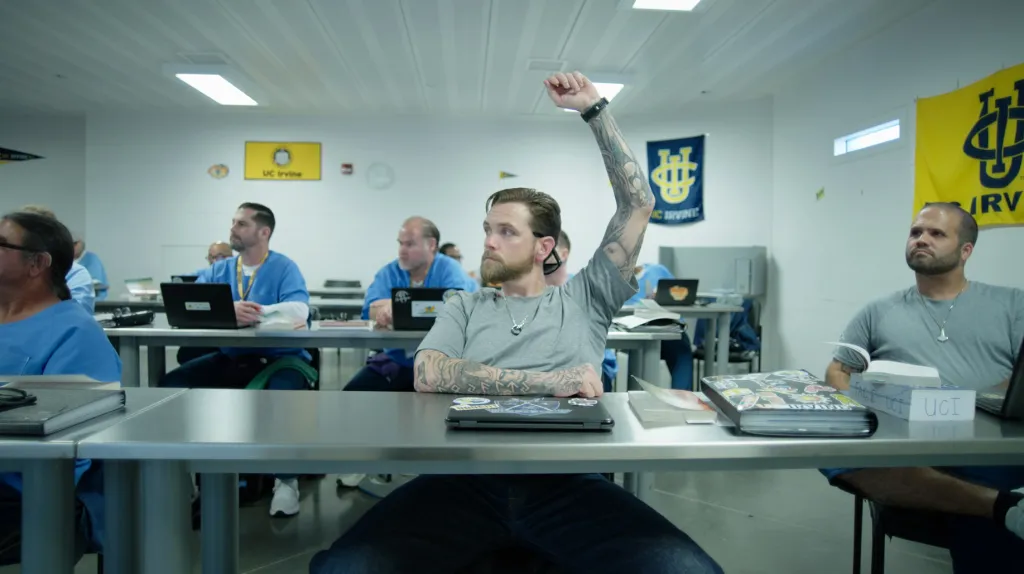
On Wednesday, June 17, a class of 25 men will line up to collect the diplomas they’ve earned, in sociology, from UC Irvine.
Read more What’s next for Chad Bianco after losing California governor’s race?
Then, after they’ve hugged family and finished some brief celebrations, guards will lead the men back to the cots where they sleep in dorm-style cells at the Richard J. Donovan Correctional Facility in San Diego.
And after that?
For the Class of ’26 at UCI’s Donovan Correctional campus, the future is an odd mix of open-ended questions (What can an inmate do with a four-year college degree? What is the purpose of education?) and rock-hard certainty. Most of these soon-to-be grads have been convicted of violent crimes. Many will be in prison for years or decades to come. Some expect to die there.
Still, for every one of those students, their new degree will carry profound meaning. People who’ve done it say the accomplishment of completing a nothing-held-back college curriculum — without the standard student perks like unfettered access to the internet, or AI, or a keg — is an opportunity to change what they see in the mirror.
Self-improvement might be simple, as motivations go, but it’s also powerful.
“Look, when I first came into college classes (community college correspondence courses, about 10 years ago), I was coming to it without a lot of confidence. In high school, or whatever, I’d never been a great or even a good student,” said Kelly McLeod, 38, a 2024 graduate, summa cum laude, from the UCI program at Donovan known as “LIFTED” (Leveraging Inspiring Futures Through Educational Degrees).
“Then, pretty quickly, I realized I could do it. I was getting good grades; really good grades, actually. And I began to reorient myself around education.
“But when I started the UC thing … that was next level,” McLeod said.
“It shook me a little. It’s different. It’s harder.”
Still, McLeod eventually found a rhythm; reading and rereading the material, talking with professors and classmates, exploring ideas. It was high-level college coursework, but with powerfully driven students and little in the way of traditional distraction.
“It made me a good writer, a critical thinker. It sharpened my skills,” McLeod said.
“I felt, and feel, I could do anything.”
These days, McLeod isn’t the only prisoner feeling that way.
Pencils out
For a lot of reasons — some ideological, some financial — four-year college is expanding rapidly within California’s network of 34 adult prisons.
In the fall of 2022, when UCI launched the LIFTED program at Donovan — offering a two-year sociology program to qualified inmates who had a GPA of 3.5 or higher for their two-year associate’s degrees — it was the only UC campus teaching incarcerated students. Cal State Los Angeles had been offering a communications degree at the state prison in Lancaster since 2016, and community colleges throughout the state had been offering face-to-face classes since the state legislated that in 2014, but prisoner access to in-person, four-year college classwork was limited by geography.
But 2022 also is the year that California set aside $1.8 billion for a five-year expansion of UC-level classes to state prisoners. And a year later, federal law fully reinstituted Pell Grant access to prisoners around the country. The combined flow of money set off a wave of college access in California prisons. UC Riverside, UC Santa Barbara, Cal Poly Humboldt, Cal State Sacramento, Cal State Dominguez Hills, Cal State Fresno and Pitzer College are among the schools that have established or are expanding programs for male and female prisoners in California.
Between those expansions, the growth of community college access and more GED high school courses to incarcerated adults, more than 13% of all California prisoners — roughly 21,000 men and women — are expected to be attending classes in the fall.
Little of this is altruistic.
Prisoners who earn a four-year college degree while incarcerated are 95% less likely than non-degreed prisoners to wind up back behind bars. That advantage drops only slightly, to 85%, for students who get community college degrees. And it’s about 40% for students who attain a GED (high school equivalency) while in prison.
The costs of those classes range from about $35,000 for four-year college degrees to less than $10,000 for students getting a GED. Meanwhile, the cost of incarceration doesn’t vary, and last year it ran to about $127,800 per inmate per year, according to state data.
If you do the math (or, if you get the answer from McLeod, who once had to learn Python computer programming using pen and paper), the numbers point to a simple conclusion: College education in prison saves taxpayers money.
Supporters say it’s a big reason why prison reform — including education behind bars — has become the rare political issue with bipartisan support.
“I really think we are in the beginning of this,” said Keramet Reiter, a UCI criminologist who started and still oversees the school’s LIFTED program.
“We made these massive investments in incarceration, and they haven’t paid off,” she added.
“So, whether you’re compelled by my argument, that everybody deserves a chance at education and redemption, or by the argument that we shouldn’t waste money … all of those things together have made this an interesting moment.”
Old school
If college for prisoners sounds familiar, maybe even a little “Shawshank”-esque, it is. From the end of World War II until the 1990s, prisons in California and around the country routinely offered high school and college classes to adult inmates.
The idea was that education would reduce recidivism and crime.
That eventually proved half right. While educating prisoners tends to keep them from coming back, it doesn’t appear to do much to prevent people from doing stuff that gets them behind bars in the first place.
From the early 1960s to 1991, violent crime in the United States more than doubled, to an annual rate of nearly 760 incidents per 100,000 people. Since then, the trend has reversed, and in 2024 —even after a mini-crime boom during and just after the pandemic — federal data showed the overall violent crime rate was down to 359 per 100,000 people.
As crime has shifted, so have Americans’ attitudes about prison, and prisoners.
The Crime Bill of 1994 — still the biggest crime law ever enacted — was signed by a Democratic president, Bill Clinton, backed by a future Democratic president (then-Sen. Joe Biden), and applauded by members of both political parties. That law poured billions of dollars into hiring police and, critically, into building new prisons.
But it also cut off federal Pell Grants for prisoners, making it virtually impossible to finance college classes behind bars. By 1997, the number of in-prison college offerings cratered, from about 800 to about eight, according to federal data.
And that became the status quo for decades, even as state and federal laws made it easier to send younger people to longer sentences in prison, and even when data showed that countries that educated prisoners had far lower rates of incarceration and the spending associated with it.
By 2020, when Reiter was trying to convince her school to start the LIFTED program, even people who support prison reform, and who say they have compassion for incarcerated people, were less than thrilled with the idea of starting an in-prison subsidiary more than 100 miles from campus.
Read more Nestory Irankunda helps Australia spoil Turkey’s World Cup return
“I was flatly against it,” said David Frank, a sociology professor and chair of UCI’s sociology department.
“I just thought it sounded virtuous, and that (professors) would raise their hands to do it because of the virtue signaling, but that it would be, ultimately, bad for them.
“Look, if you’re not a tenured professor, you should be spending every hour possible trying to get published. That’s how you get the job, right? And if you’re not committing all your time to that, during that part of your career, you’re doing the wrong thing,” Frank said.
“It felt irresponsible to let younger colleagues, who would see this as exciting, commit to something that would be against their interests.
“And it’s a weird fit, in a way, geographically,” Frank added.
“The virtue was there, of course. And everyone said ‘yes,’ of course. So the program got okayed.
“But I said ‘no.’”
Everybody learns
On most school-year Tuesdays, Frank leaves his West Hollywood home around 10:30 a.m. to begin a roughly three-hour, 150-mile drive to Donovan.
Once there, he passes through a series of in-prison security checkpoints while being led to makeshift classrooms. Those rooms are deep inside a prison that holds about 3,400 men, a commercial bakery and a dog training program.
Frank then spends a couple hours teaching about 25 students, some as young as their late 20s and others as old as mid-60s, about sociology, which is the study of how big social forces (including things like gangs, or court systems, or schools) can affect individuals. He does this unironically.
After that, Frank spends a couple more hours holding office hours, which, because his students don’t necessarily have other pressing matters, essentially become two more hours of class.
He usually gets home around 9:30 p.m.
The ordeal is, Frank said, “one of the best things in my life.”
What changed? What convinced a professor who was once ‘flatly against’ the idea of UCI’s prison-school program to now joke that he’d like to retire in San Diego so he can teach more at Donovan?
Frank blames the students.
Two years ago, when outside university evaluators went to Donovan to decide if the LIFTED program should get full accreditation, Frank, as department chair, was told to be on hand. That meant he was in the room when the evaluators asked the prisoner students a simple question: “Are you learning anything?”
“To a person, they were so eloquent and motivated. And they explained that school was an opportunity like no other in context of life in prison.
“I thought, ‘I want to be involved in this… I need to be.’”
Frank’s students aren’t easy men. Many have committed murder or rape or both. They’ve left victims damaged in ways that can’t be undone; their sentences aren’t necessarily arbitrary or even unfair by current U.S. standards of justice. And though the students have had to exhibit years of good behavior just to be there — and they’ve had to complete educational coursework that qualifies them for UC coursework — the guards never, ever stop watching to make sure a classroom conflict, even with a professor, doesn’t become physical.
But Frank said his students also are what teachers dream about: motivated, disciplined, smart.
“You’ve got 20 to 25 guys who are hungry; they’ve read everything for the whole quarter before they come to the first class. They pile into the assignments as soon as they can.”
And, Frank said, the Donovan students do what the best students everywhere do: They teach the teacher.
“You have to build trust. And you have to be humble, which is easy because I don’t know (expletive),” Frank said, laughing.
“So I begin each class by telling them they should teach me, to speak up when I say something wrong.”
The response to that, Frank said, is powerful.
“Nobody in prison listens to inmates. Nobody asks them about anything. They’re told to shut up by the system,” Frank said.
“So when you tell them to speak, they have a lot to say.”
Half a lifetime
In 2007, McLeod was convicted of beating an older man to death. They’d both been at a party; drugs were involved. McLeod was deemed old enough at the time to be sentenced to a term of 30 years to life in prison. He’s now served 19 of those years.
This week, McLeod and some other Class of ’24 Donovan grads are working on a research paper that hits close to home.
“It’s basically an academic examination of the effect of earning a bachelor’s degree on the identity of incarcerated people,” he said.
Each prison yard, according to McLeod, has its own culture. In the section of Donovan where McLeod lives, he explained that prisoners respect — sometimes even revere — prisoners who are getting degrees. Contrary to being targets for violence, prison graduates where McLeod lives are viewed as leaders and mentors.
“We get to encourage people,” he said. “I’ve gotten to be that person for a lot of other prisoners. I can talk with them about developing study habits, or what it’s like when you get frustrated, or anything.
Read more Kelsey Plum’s career night lifts Sparks past Mercury in OT
“It’s a privilege. In prison, privileges are important.”
McLeod is up for parole next year.