
A few minutes after 5 a.m. last Sunday, a charter flight carrying Iran’s World Cup team touched down at Tijuana’s international airport, the light on the horizon providing only a hint of the day – and weeks – ahead.
Read more Dodgers done in by 6-run inning as White Sox take series
Ehsan Hajsafi, Iran’s 36-year-old captain, led the team off the white plane with blue markings of the German carrier USC after an overnight flight from Turkey where the team had trained in recent weeks.
Hajsafi and his teammates wore gray slacks and fashionable white collarless shirts beneath navy blazers with gold #168 pins on their left lapels. The pins are a tribute to the 168 people, mostly children, who were killed at an elementary school in southern Iran just minutes after the U.S. and Israel launched their initial attacks on Iran on the morning of February 28. The deadly strike by a U.S. Tomahawk missile was likely the result of outdated targeting data, the New York Times reported, citing an ongoing U.S. military investigation.
Noticeably absent among the 25 teammates following Hajsafi across the tarmac was Sardar Azmoun, one of Asia’s premier players for more than a decade.
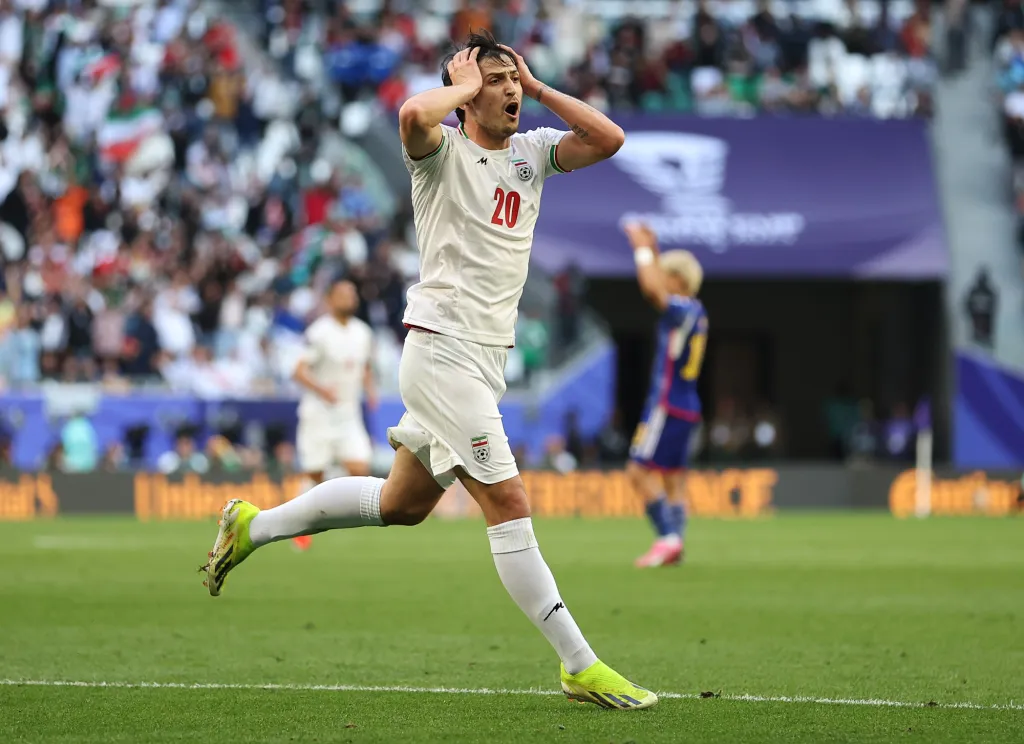
Against the backdrop of a war that has left as many as 10,000 dead across the Middle East region, after months of uncertainty surrounding its participation, Iran opens its World Cup campaign against New Zealand at SoFi Stadium Monday night without Azmoun, the country’s second leading scorer all-time, a player so highly regarded that he has been referred to as the “Iranian Messi” by the British media.
Azmoun was kicked off Iran’s national team and left off its World Cup squad in May for what Iranian authorities view as an act of disloyalty. The act? Azmoun, who plays for Shabab Al-Ahli in Dubai, recently posted a photo on social media of himself with Sheikh Mohammed bin Rashid Al Maktoum, the United Arab Emirates prime minister, considered an enemy by Iran’s ruling regime because of the UAE’s political and military alignment with the U.S. and Israel. Iranian authorities also seized his assets in the country.
“I want to speak from the bottom of my heart about some things that many people may not know, or about certain misunderstandings that may have led some to judge me too quickly,” Azmoun, 31, said, responding to the accusations of being disloyal in a social media post after the World Cup squad was announced.
“I have always played for my national team with pride,” continued Azmoun, who scored 28 goals in World Cup qualifying matches for the 2018, 2022, and 2026 tournaments, and played in all six of Iran’s matches in the 2018 and 2022 competitions. “When we won, I was proud of myself and my teammates. When we didn’t, I was more upset than anyone else in the world, just like them.
“I love football, and I love the good and deserving people of my country, Iran. People whose kindness and unwavering support have always given me energy.”
Like his former Iran teammates, Azmoun wears a tribute to the sacrifice of Iran’s children. “From the blood of the homeland’s youth, tulips have bloomed,” reads a tattoo on his left arm. The words are taken from a famous ballad during Iran’s Constitutional Revolution in the early 20th Century that a hundred years later has become a slogan of political resistance, a rallying cry at protests that have swept across the country in recent years.
The latest controversy isn’t Azmoun’s first act of defiance and his courage in taking high profile stands against government oppression in a nation known to imprison, execute or murder even its sporting heroes who have criticized the regime has elevated him to folk hero status with opponents of the Islamic Republic in and outside of Iran.
Habib Khabiri, captain of Iran’s national team, was executed in 1984 for his membership in a dissident group. Forouzan Abdi, captain of Iran’s women’s volleyball team, was among 30,000 political prisoners executed in a 1988 massacre. Wrestling champion Navid Afkari, who was active in anti-government protests, was executed by the Islamic Republic in 2020 after human rights groups said he falsely confessed to the murder of a security guard while being tortured.
Boxing champion Mohammad Javad Vafaei Sani is currently awaiting execution after being arrested by the Islamic Revolutionary Guard Corps (IRGC) and convicted of “corruption on earth” for participating in pro-democracy protests in 2019.
“His case is not an isolated tragedy. Iran has a grim history of executing athletes for their beliefs,” wrote tennis great Martina Navratilova, Olympic swimming champion Nancy Hogshead and other Olympians and international sports stars in a November 2025 letter calling on the United Nations, the International Olympic Committee and other global sports federations to act on Javad Vafaei Sani’s behalf.
Mehdi Taj, the president of Iran’s football federation (FFIRI), reportedly served as an intelligence commander with the IRGC. Taj has reportedly been denied a visa by U.S. officials. Mahmoud Khosravivafa, president of the Iranian Olympic Committee, is a former bodyguard to Iran’s Supreme Leader Ali Khamenei, who was killed on the first day of the war.
“In recent months, the Iranian authorities have executed numerous other protesters on similar bogus charges with total impunity,” the letter continued. “These political executions are a callous attempt by the authorities to frighten and silence an increasingly restive population no longer willing to accept their corrupt and oppressive rule.
“Sport is meant to inspire hope, unity, and courage. The execution of a champion for his political views is a direct assault on these values and a warning to every athlete who dares to speak out.”
A warning Azmoun has refused to heed.
He posted a pointed message of support and solidarity to the widespread “Women Life Freedom” protests across the country in September 2022 in the wake of the death of Masha Amini, who died in police custody.
Amini, a 22-year-old woman of Kurdish-Iranian descent, while visiting her brother in Tehran, was arrested on September 13, 2022, by the Guidance Patrol, the religious morality police for the Iranian government, for allegedly not wearing her hijab in accordance with government standards.
Read more Warnings extended for dangerous coastal conditions at Southern California beaches
Amini was allegedly beaten by Moral Security officers in a van while being transferred to a police station. Authorities said she suffered a heart attack at the station and fell into a coma before being transferred to a local hospital. Eyewitnesses, including women who had been detained with Amini, said her death was the result of being severely beaten by the police.
Medical scans later leaked to media outlets suggest that Amini suffered a cerebral hemorrhage or stroke due to head injuries received while in police custody.
The news of Amini’s death touched off the largest wave of protests in more than a decade. Authorities arrested nearly 20,000 people across 134 cities or towns and 132 university campuses, according to Human Rights Activists in Iran (HARAI). At least 551 people were killed as the result of government response to the protests, according to Iran Human Rights.
Azmoun’s message of support came just weeks before the 2022 World Cup in Qatar.
“At worst I’ll be dismissed from the national team,” he wrote on his Instagram account. “No problem. I’d sacrifice that for one hair on the heads of Iranian women. This story will not be deleted. They can do whatever they want. Shame on you for killing so easily; long live Iranian women.”
Azmoun also called on government authorities not to execute his friend and fellow soccer player Amir Reza Nasr Azadani, who was arrested during the Amini protests. Azadani is currently serving a 26-year prison sentence on what human rights groups characterize as bogus charges.
Iranian officials pressured Iran national team coach Carlos Queiroz to leave Azmoun off the 2022 World Cup roster. Azmoun played every single minute of Iran’s three games at the 2018 World Cup in Russia. Queiroz, the former Real Madrid head coach, who has guided four nations to the World Cup – his native Portugal (2010), South Africa (2002), Iran (2014,2018, 2022) and Ghana (2026) – refused to drop Azmoun, threatening to resign if the player was left out of the squad.
It was Queiroz who first brought Azmoun into the national team as a 19-year-old and then started him in the 2015 AFC Asian Cup where he emerged as one of the stars of the tournament.
“He has all the qualities to succeed at the highest level,” Queiroz said. “He is improving all the time. He has to keep his feet on the ground, work hard and make the right decisions. If so, he could be a real star of Iranian and Asian football for years to come.”
Around that time, Premier League giants Arsenal, Liverpool and Tottenham as well as Serie A’s AC Milan and Juventus expressed interest in the teenager.
Instead, he spent much of his club career in Russia. European clubs were the only teams pursuing the teenager.
Azmoun is a member of Iran’s Turkmen ethnic minority and had other options at the national team level. As a teenager, he was presented with what he described as a “very large financial offer” to play for another nation in international competition.
“My answer was this: ‘I am a son of Iran, and I want to play for my people and make them happy,’” he wrote on social media. “I promised myself that every time I played for Iran, I would give everything I had to bring joy to the people who follow football with love – especially the children in the most remote towns and villages who celebrate our victories.
“No matter where I play football, my identity, my heart and my pride are Iran.”
It is also how Azmoun lives. He scored eight goals for Iran in qualifying for the 2026 World Cup. But his focus was never limited to the confines of the game’s white lines. Off the pitch, he continued to stand with his countrymen, the children in those remote towns and villages in crisis and tragedy, just as they had stood with him in triumph, all of them focused a sliver of light on the horizon and the dream of a generation, a nation finally in full bloom.
In response to the country’s economic crisis, a series of nationwide anti-government protests began on December 28 and soon spread to more than 200 cities, growing into Iran’s largest uprising since the Islamic Revolution in 1979. Ali Khamenei ordered police and security forces to kill protesters. As many as 12,000, possibly 20,000 protesters were killed in the largest massacre in Iranian history, according to reports by U.S. and British media outlets and human rights groups.
On January 7, at the height of the protests, five months from the World Cup he helped deliver for Iran, Azmoun reached out to his countrymen again.
“As an athlete, I always stand by the people of the country,” he wrote on Instagram. “I wish my people well.
“We, the patient and beloved people of my country, do not have the right to be so far removed from our dreams.”
Read more World Cup: Havertz sparks Germany’s 7-1 rout of Curaçao