
By PHILIP MARCELO
RIVERHEAD, N.Y. (AP) — After decades waiting for justice, relatives of women murdered by New York’s Gilgo Beach serial killer laid into him Wednesday as he faced sentencing for his admitted crimes.
Read more Warsh to face spotlight as Federal Reserve likely to leave interest rates unchanged
“You fill me with so much repugnance, I can’t stand it,” Jasmine Robinson, a cousin of victim Jessica Taylor, told killer Rex Heuermann.
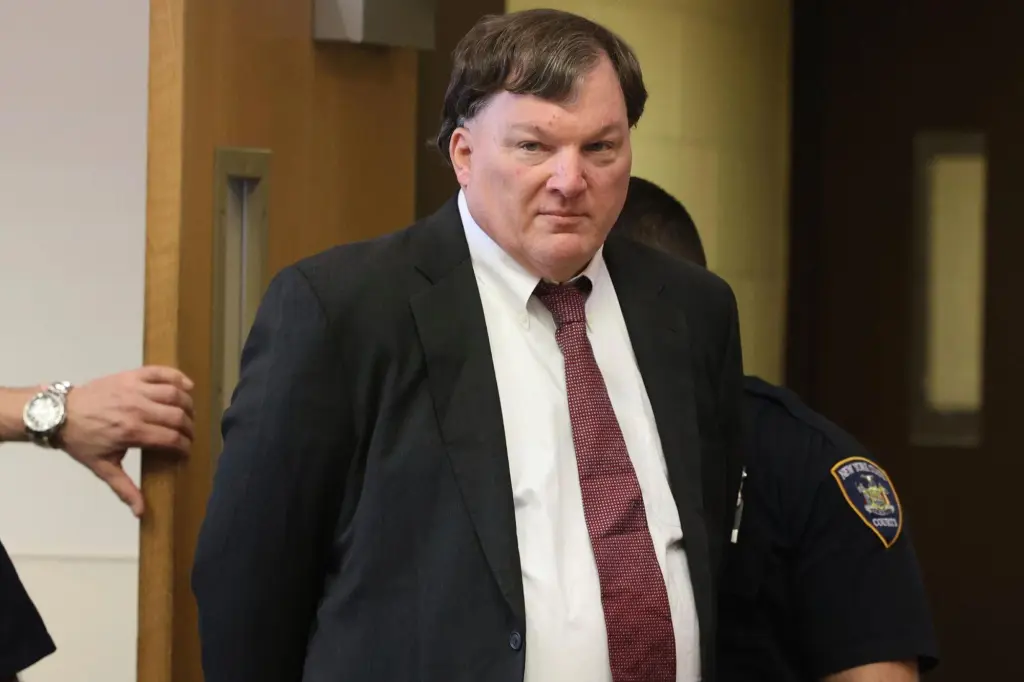
Hands clasped and resting on the defense table in an eastern Long Island courtroom, Rex Heuermann looked straight ahead and lightly tapped his fingers. The Long Island architect, who lived a secret life of violence for years before admitting he killed eight women, faces the likelihood of a life sentence.
“A million years isn’t enough,” Robinson said. “Nothing will ever make this right.”
The sentencing caps an extraordinary investigation that solved one of New York’s most perplexing mysteries — one that began as a series of seemingly unconnected, and largely unmarked disappearances of young women, but became the focus of true-crime documentaries, books and podcasts after police began discovering the victims’ skeletal remains in the sandy scrub along a coastal parkway.
“Justice has been done, but it can’t replace what has been taken,” said JoAnn Mack, the mother of victim Valerie Mack. “She had dreams, and you took them all away from her.”
Heuermann, who has remained largely silent through multiple court appearances since his 2023 arrest, will also have a chance to speak Wednesday, but it’s not immediately clear if he will. His lawyers didn’t respond to messages seeking comment.
Asa Ellerup, his ex-wife, and their two grown children have said through their lawyers that they won’t be attending the sentencing out of respect for the victim’s families.
Heuermann, 62, of Massapequa Park, pleaded guilty in April to charges that he murdered seven women: Mack, Taylor, Megan Waterman, Melissa Barthelemy, Amber Lynn Costello, Maureen Brainard-Barnes, and Sandra Costilla.
The sentencing fell on what would have been Taylor’s 43rd birthday, cousin Violet Swager noted.
“Happy birthday, Jess,” Swager said as she dismissed Heuermann as a “weak, disgusting coward.”
Heuermann also admitted in court to killing an eighth victim, Karen Vergata, though he was never charged in her death. He said he strangled his victims, many of them sex workers, and dismembered some of their bodies.
Melissa Cann, Brainard-Barnes’ sister, told the court she lived with “survivor’s guilt” for decades, wondering whether she could have done something more to protect her sister.
Read more Focused on work, needed at home: A federal caregiving policy might help
“It was a weight I carried everywhere,” she said, sobbing deeply. “The guilt changed me. I could not let myself have happiness. I convinced myself this was all my fault.”
But, she said, that guilt is “not mine to carry. It is for Rex and Rex alone.”
Most of the women disappeared between 2000 and 2010, and most of their remains were found on a desolate parkway not far from Long Island’s Gilgo Beach, some 50 miles from Manhattan.
But two of the killings took place years earlier. Costilla’s remains were found in 1993, more than 60 miles away in the Hamptons, while Vergata’s remains were found in 1996 on Fire Island, more than 20 miles east of Gilgo Beach.
The case spilled into view in 2010, when investigators started to find remains along Ocean Parkway while looking into the disappearance of another sex worker, Shannan Gilbert, whose death was ultimately ruled an accidental drowning.
The search for the killer of the other women, though, went cold for years until a renewed investigation identified Heuermann as a potential suspect in 2022.
Detectives linked him to a pickup truck that a witness reported seeing when one of the victims disappeared in 2010.
Eventually, they matched DNA from a pizza crust Heuermann had discarded in a Manhattan trash can to genetic material extracted from highly degraded hair fragments found on the women’s remains.
Investigators amassed other evidence including cellphone and tracking data showing Heuermann arranged meetings with some of the victims shortly before their disappearances.
Then in 2024, after Heuermann’s arrest, prosecutors recovered what they described as a “blueprint” for the killings from his computer files. Among the documents was a series of checklists with reminders to limit noise, clean the bodies and destroy evidence.
As part of his guilty plea, Heuermann has agreed to cooperate with the FBI’s behavioral analysis unit to help catch other serial killers.
Heuermann has spent the past three years alone in a segregated cell at the county jail, reading crime novels, occasionally being visited by his lawyers or family, and striking up a brief correspondence with the infamous “Happy Face Killer,” according to Suffolk County Sheriff Errol Toulon, who oversees the Riverhead jail.
He will serve out his term in a state prison to be determined later.
Follow Philip Marcelo at https://x.com/philmarcelo. Associated Press writer Jennifer Peltz in New York contributed.
Read more Luigi Mangione will assert psychiatric defense in murder case in UnitedHealthcare CEO’s killing