
By DOUG FERGUSON AP Golf Writer
SOUTHAMPTON, N.Y. — Whatever dread Wyndham Clark felt when he saw the tee times and the forecast for the U.S. Open gave way to hope Thursday, and he still hadn’t even arrived at Shinnecock Hills.
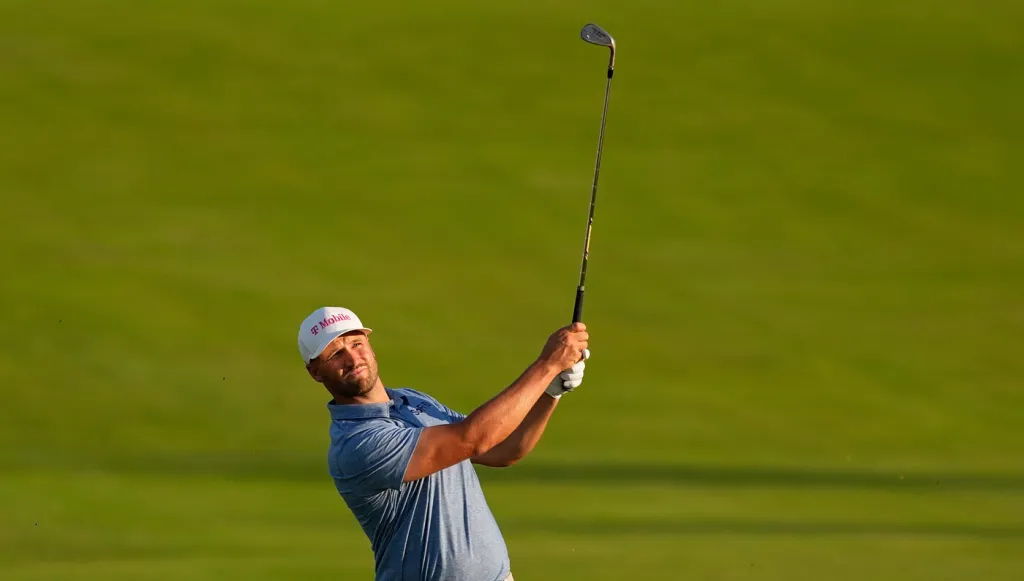
Morning fog led to a two-hour delay, and Clark had a feeling his late afternoon start would be an advantage as the wind began to subside with the setting sun. Good golf was still required, and Clark displayed every bit of that before he was stopped only by darkness.
Read more Angels can’t dig out of early hole against Gage Jump, A’s
By then, the former U.S. Open champion rode a birdie-birdie-eagle stretch to 6-under par through 16 holes and a four-shot lead.
“Everything was kind of clicking,” said Clark, who came into the U.S. Open playing as well as anyone. “We were definitely fortunate with the wind laying down. Overall a good round.”
The USGA set up a different golf course at Shinnecock Hills – slower, more receptive greens and reasonable pin positions – to keep it playable in strong wind. But when the wind subsided late in the day, Clark looked like he was playing in a different U.S. Open.
No one ever has gone lower than 66 in an opening round at Shinnecock Hills. Clark can go two shots lower if he can finish with two pars when he and 49 other players return Friday morning.
He led by four over seven players, one of them Oklahoma junior Ryder Cowan, another one the surprisingly resurgent Dustin Johnson. Four of them were former U.S. Open champions.
Rory McIlroy thought he had made a fine effort with a 69 in gusts that topped 30 mph in the middle of the day, when the scoring average was well above 74. The afternoon started tough until the wind kept subsiding, and players began taking aim at flags. The afternoon wave was playing at least a stroke easier than the early starters who faced relentless wind.
Shinnecock was still a brute of a test, but the red numbers on the white scoreboard was an unfamiliar site for this course. When play was suspended by darkness, 17 players were under par.
Cowan birdied his last hole for a 68 to join former Sooner Max McGreevy and former Oklahoma State player Sam Stevens of those who finished the round. Stevens was the only one of that trio who faced the harsh wind of the morning wave.
Johnson, in his final year of being exempt from the U.S. Open he won at Oakmont in 2016, ran off four straight birdies and was tied with Clark after 13 holes. But Johnson failed to get up-and-down for birdie on the easy par-5 fifth, where Clark made eagle. And then Johnson three-putted from short range for double bogey on the sixth to fall four shots behind.
Scottie Scheffler, who needs the U.S. Open to complete the career Grand Slam, battled all day and relied heavily on his short game to salvage a 72. It was his 10th consecutive U.S. Open round without breaking par, but at the time it left him only four shots out of the lead.
Clark, who won the U.S. Open at Los Angeles Country Club three years ago, changed the look of the leaderboard with his late flourish. He was to return Friday morning to complete the round, then head out for the second round in wind expected to be not as strong as the full blast from Thursday.
“I would say when I got my tee times on Tuesday, I was like, ‘Oh, could be a tough draw,’” Clark said. “That two-hour fog delay was very helpful, and it was really nice it laid down. So it definitely helped those last six, seven holes we played.”
His golf wasn’t too shabby, either. Clark started on No. 10 and opened with two quick birdies. He went out in 32 to get his name atop the leaderboard. And after missing an 8-foot birdie putt on No. 1 and failing to save par from a bunker on the long par-3 second, he took off.
He hit wedge to 5 feet on No. 3 for birdie, made a 20-foot birdie putt on the next and then from 207 yards with some wind at his back, he hit his second on the par-5 fifth to 3 feet for eagle.
When Johnson faltered, Clark had plenty of breathing room – and a quick turnaround.
The wind was so strong and the conditions so severe that it took Scheffler’s group nearly three hours to complete nine holes. There was a question the round could have finished even without the fog delay.
Johnson was joined by three other U.S. Open champions – Matt Fitzpatrick (2022), Gary Woodland (2019) and Jon Rahm (2021) – at 2 under, with all still having holes to play.
Rahm, who had a chance in the final hour at the PGA Championship, was bogey-free and reached 2 under by making a 60-foot birdie putt on the par-3 17th hole.
Stevens overcame a double bogey to start his round – a hole that took him over two hours to play because of the fog – and strung together six birdies for his 68.
Read more Angels’ Mike Trout placed on IL with right hamstring strain
“The greens haven’t been too firm, the fairways haven’t been too firm, so I’ve really felt like it’s pretty scorable,” said Stevens, who had only his second sub-70 round in his fourth U.S. Open. “Obviously, it’s difficult, but overall it’s an awesome place. I think the setup is great right now.”
For half of the opening round, the USGA appeared to have the ideal test. Coming off two Opens at Shinnecock when the course got out of control, it slowed greens to 10½ on the Stimpmeter – rare for any major, much less the U.S. Open – and keep plenty of water on the putting surfaces.
It was all due to the wind, which did not disappoint. The sustained wind approached 25 mph, and gusts were even stronger. And if that wasn’t enough, it shifted directions in the middle of the day.
“It was tough around here without wind, and then it was blowing pretty hard – really hard,” Keegan Bradley said after a 70. “The USGA did a great job setting the course up because if the greens were any faster or firmer, we might not be playing right now.”
But they played, it became more ideal with each passing hour late in the afternoon.
SCHEFFLER WILL NEED TO REBOUND
One of the 72 shots Scheffler hit Thursday was a lash with a fairway wood on the 16th hole. He followed up by placing his hands on his knees and squinting into the emerging sunshine while asking caddie Ted Scott if he saw where the ball ended up.
A few minutes later, everyone knew the answer. There was Scheffler jumping up and down in a bunker situated 150 yards shy of the green – and 10 feet lower than the fairway – to catch a glimpse of the flag on the putting surface ahead.
What resulted was a rare bogey 6 for the world’s top-ranked player on one of those rare par-5s in pro golf that wasn’t remotely reachable in two – thanks to it being uphill and dead into a 25 mph wind. Even after the wind died down in the afternoon, the 16th played at 0.372 strokes over par with most of the first round over, making it the fourth-hardest hole on the course.
Welcome to Shinnecock.
“You had to be hitting a great shot if you wanted to avoid a punishment,” Scheffler said after walking off the windswept golf course eight shots behind leader Clark, who played in much tamer conditions. “I think ‘good’ would put you in some tough spots.”
Scheffler found plenty of those tough spots. It began in the morning but bled well into the afternoon – a 5½-hour grind through the wind that started late because of a two-hour fog delay. One of his playing partners, defending champion J.J. Spaun, fared even worse. Spaun, a San Dimas High product, shot 77.
Scheffler made double bogey on No. 8 after teeing off into the rough, hitting his second into a bunker some 40 yards from the hole, then three-putting.
He hit a wedge from 110 yards to the middle of the 13th green, but the ball spun and rolled off the front. That led to a bogey; blame it on the soft conditions the USGA has been trying to hang on to in wake of the wind forecast.
“Overall, yeah, it was a really challenging day,” Scheffler said. “If you told me when I was staring at my par putt on 9 that I would post 2-over today, I would definitely have taken it at the time.”
He made that putt, a 6-footer, to make the turn at 3 over. He sank a 9-footer for a sand save on No. 18 to walk away with his 72. Three of his four birdies came on the back nine.
“I feel like this course can change pretty rapidly from day to day,” he said. “I think that’s also part of the challenge of the tournament is adjusting to those conditions.”
Some 90 minutes after the round, Scheffler was still on the driving range, having an animated conversation with his coach, Randy Smith, while the wind picked up for the second wave of players, many of whom would be on the course at twilight.
As much as his swing, Scheffler knows this tournament will come down to who can untangle the conditions, then deal with them the best. He walked off the course in a tie for 75th place – not out of it, but still looking for answers.
“I think it’s a little easier sometimes in a U.S. Open,” Scheffler said, “because it’s happening to everybody.”
Read more World Cup: Johan Manzambi snaps Switzerland and fans out of slumber