
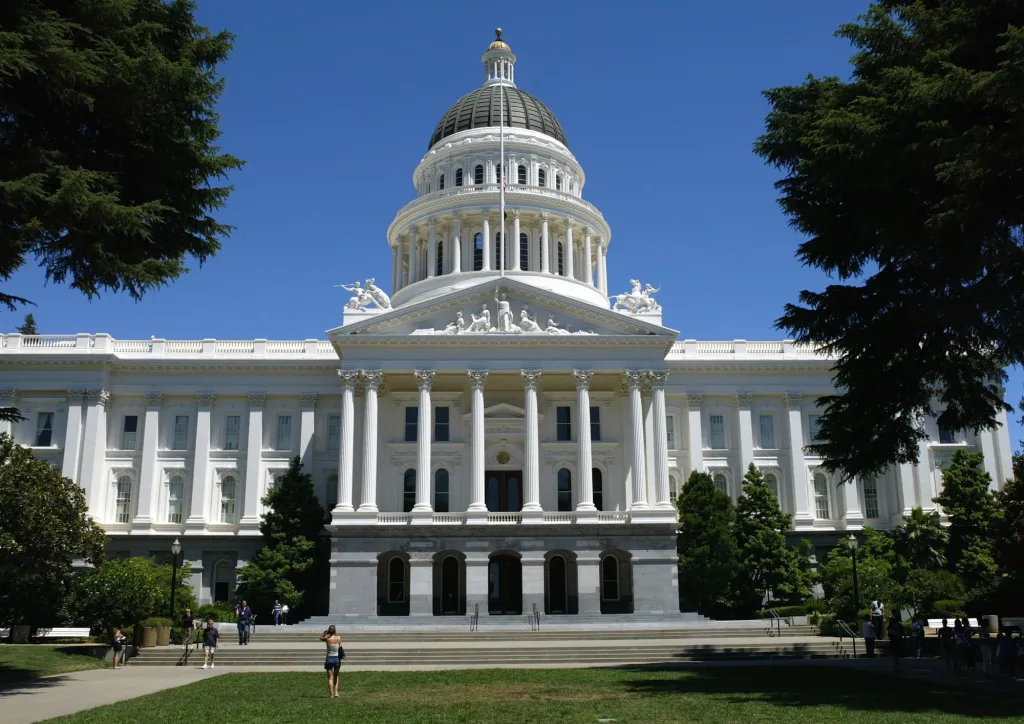
As Assemblymember Cottie Petrie-Norris puts it: Now is a pivotal moment for California’s ambitious clean electricity and carbon neutrality goals.
Read more Judge in Charlie Kirk killing case to decide if prosecutors could be punished for comments in media
And to her, that means the Legislature needs to focus on an increase in transparency and accountability in the California Public Utilities Commission’s ratemaking process, as well as an acceleration in clean energy development and grid upgrades.
The Irvine Democrat is behind three bills now up for consideration in the state Senate that she said will do just that.
One, passed by the Senate Energy, Utilities and Communications Committee last week, would require the CPUC — appointed by the governor, the commissioners on this body regulate privately owned electric, natural gas, railroad, telecommunications and water companies — to disclose the financial models used when determining return on equity for utility shareholders. Referred to more simply as ROEs, it’s the amount of profit utilities can earn on shareholder-funded infrastructure.
Assembly Bill 2463, which has received bipartisan unanimous support from legislators, would require the CPUC to relay what data sources were used in the financial models used to determine an ROE, as well as any qualitative adjustments made by the commission, the basis for those adjustments and any mathematical derivation of the final ROE.
It may sound a bit convoluted, Petrie-Norris said, but the goal is to make what is a complicated process more transparent.
“It’s super important that the Public Utilities Commission that we entrust to ensure this system works and this system is fair, it’s super important they’re doing that job effectively and representing ratepayers effectively,” Petrie-Norris said.
“It’s super wonky and in the weeds,” she said, “but the bills that make for good bumper stickers don’t usually make for real results.”
The state Senate is also set to consider two more related bills this week.
Assembly Bill 2493 is meant to speed up projects to upgrade and modernize the grid, so the state can deliver on clean energy goals and avoid delays. It would require investor-owned utilities to retain an independent third-party auditor to look into their interconnection progress. The bill would also allow the CPUC to factor in poor performance with grid interconnection and upgrades into an investor-owned utility’s ROE.
And Assembly Bill 2516 is meant to identify supply chain delays for critical grid infrastructure projects and incentivize in-state manufacturing through public-private joint ventures.
While both passed the Assembly last month, neither has the widespread bipartisan support that the transparency bill did.
Read more Jets were 300 feet apart in Boston close call that forced Delta flight to abort landing, expert says
But Petrie-Norris said some of the Trump administration’s actions have also underscored the need for her legislative package, including the massive tax cuts and spending bill last year that narrowed the window for tax incentives for new solar projects.
“We are at a pivotal moment for California,” Petrie-Norris said. “We have an incredibly ambitious clean energy and carbon neutrality goals. We are building California’s clean energy future, and we are making generational investments.
“Achieving these results depends on being able to connect new power to the grid quickly and affordably,” she added. “We want to make sure to achieve our clean energy goals, but we also know that time is money. Every one of these delays ends up costing ratepayers.”
AB 2493 and AB 2516 are expected to be heard in the Senate Energy, Utilities and Communications Committee this week.
In other news:
• A bill from Sen. Tony Strickland, R-Huntington Beach, meant to fix issues with California’s Next Generation 911 emergency system, received committee approval in the Assembly last week.
Next Generation 911 is California’s modernized emergency communications system that allows 911 centers to share and receive texts, photos and videos. Strickland’s bill would require the state’s Office of Emergency Services to provide quarterly reports to the Legislature on its development, implementation and spending until it is fully implemented.
“Emergency response is a core function of government, and 911 is the lifeline that connects the public to those critical emergency services,” Strickland said in the bill analysis. “Californians should never have to wonder whether the system will work if they find themselves in a life-or-death situation.
“This administration made big promises and spent hundreds of millions of taxpayer dollars, but failed to deliver a functioning, upgraded emergency response system,” he continued. “Instead, many 911 callers faced busy signals or were unable to get through at all. The Fix 911 Act provides transparency and legislative oversight so this never happens again.”
The bill has gotten bipartisan support in the legislative process.
• Also moving forward last week was a bill from Sen. Steven Choi, R-Irvine, that would give children diagnosed with life-threatening illnesses more fishing and hunting opportunities. It would require the California Fish and Game Commission to establish some “reasonable accommodations” for children who qualify when it comes to its licensing requirements and hunter education standards.
“SB 1021 is a simple bill rooted in compassion,” Choi said. “For families facing a child’s life-threatening illnesses, time is precious. This bill helps create opportunities to spend that time together outdoors, making memories that can last a lifetime while continuing to uphold California’s strict conservation standards and safeguards.”
Read more US strike on an alleged drug boat kills 2, leaves 6 survivors, in the eastern Pacific Ocean
This bill has also received broad bipartisan support.