
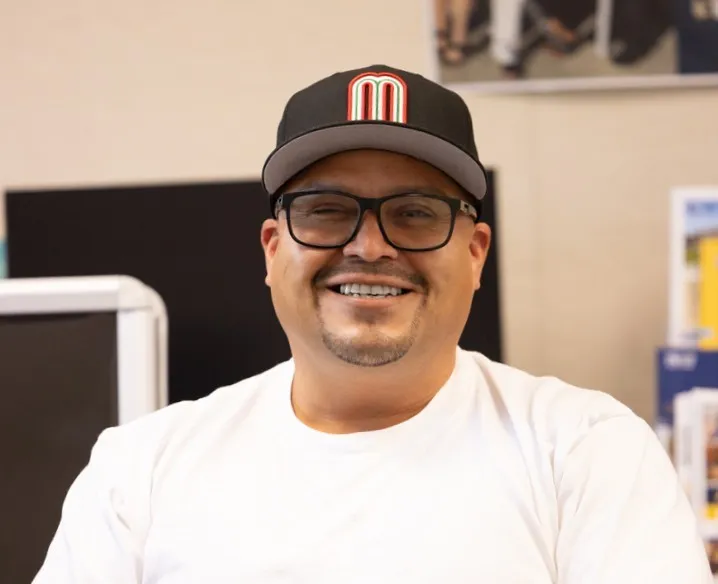
When Alex Martinez made his way across the Santiago Canyon College campus about a year ago, he had no idea the trajectory of his life was about to take a radical turn.
Read more Supreme Court reinstates murder conviction in case of Etan Patz, missing New York City boy
Martinez arrived out of sheer desperation, hoping to enroll in classes after being injured and unable to work at his physically demanding job. But the enrollment process overwhelmed him, and discouragement set in almost immediately.
Martinez, 45, scanned the campus. A single dad who had spent much of his life incarcerated, he felt out of place among students half his age. His arms and legs were covered in tattoos — a visible reminder of the life he was trying to leave behind.
“I was already going to give up,” Martinez recalled. “I didn’t know what to do, where to go. I didn’t feel like I belonged.”
Then he ran into someone he knew from his past — a maintenance worker on campus.
“He said, ‘Oh, you need to head up to Rising Scholars,’ ” Martinez said. “ ‘They’ll take care of you.’ ”
Designed to support formerly and currently incarcerated students, the Rising Scholars program provides dedicated staff, counselors, priority registration, peer mentoring, tutoring and career guidance. Nearly 100 California community colleges now offer Rising Scholars services.
At SCC, the program grew out of work the college began in 2016 inside Orange County jails, said Albert Alvano, professor and counselor in the Division of Continuing Education and director of SCC’s Rising Scholars program. That outreach led to the creation of an on-campus program in 2018, originally called Project Rise.
Today, Rising Scholars at SCC serves more than 100 active students, up from about 30 to 35 when the program became official in 2022.
Alvano, who helped launch the program, remembered the day Martinez walked in with his two sons.
“He came onto our SCC campus not really having a plan,” Alvano said. “He was getting ready to leave … a little bit overwhelmed.”
Martinez grew up in Santa Ana in what he openly describes as an abusive and chaotic home. His father was a drug dealer, and Martinez was often pulled into that world. He remembers being sent to deliver packages and knowing exactly what was inside.
He also endured physical abuse.
“I used to have to jump in for my mom and take the beatings so he could leave my mom alone,” Martinez said.
By his teens, Martinez was selling drugs, fighting at school and drifting toward the gang lifestyle.
Read more Staggering amounts of fentanyl hit streets as the DEA watched and took no action, records show
“I just wanted to belong somewhere,” he said.
He cycled through Juvenile Hall, county jail and eventually state prison, serving “three or four years at a time.”
His life began to shift when he became a father, having two boys born back-to-back, and for the first time, he felt a responsibility larger than himself. When the boys’ mother left, he suddenly found himself raising them alone.
“That’s when I said, ‘I’m going to focus on raising my kids and doing good.’ ”
He worked moving jobs, stayed out of trouble and tried to build a stable life. But when he tore his quad during the pandemic, everything collapsed. Unable to work, he turned to social services for help — and someone suggested school.
Enter Alvano and Rising Scholars.
Martinez started with noncredit classes. At first, he didn’t even know how to log on to a computer. Rising Scholars counselors sat with him until he learned. Within months, he moved into credit classes. Then he enrolled full time.
Today, he takes 16 units, arrives early each morning to study and stays after class to finish assignments before picking up his sons from school.
He volunteers at his sons’ school, coaching soccer and football, and stays after school with kids whose parents can’t pick them up.
“He’s making the right changes in his life,” Alvano said. “Someone who is committed now. And it’s about his kids.”
Martinez mentors youth, showing them his scars and his blind right eye.
“You’re still young,” he tells them. “You can bounce back before you end up like me, trying to catch up at 45.”
He plans to earn a degree in human services and become a drug and gang counselor in Santa Ana. His dream is to work with programs such as Project Kinship, a nonprofit run by men he once knew from the system that supports individuals impacted by incarceration, gangs and violence.
He imagines picking up kids from the barrios, taking them hiking, getting them into sports and showing them a different life.
“I like the way I’m going … I’m getting A’s now,” Martinez said. “I’m happy. I got my little boys, and I’m free.”
Read more FACT FOCUS: Netanyahu’s claims about Iran’s nuclear program run counter to public evidence