
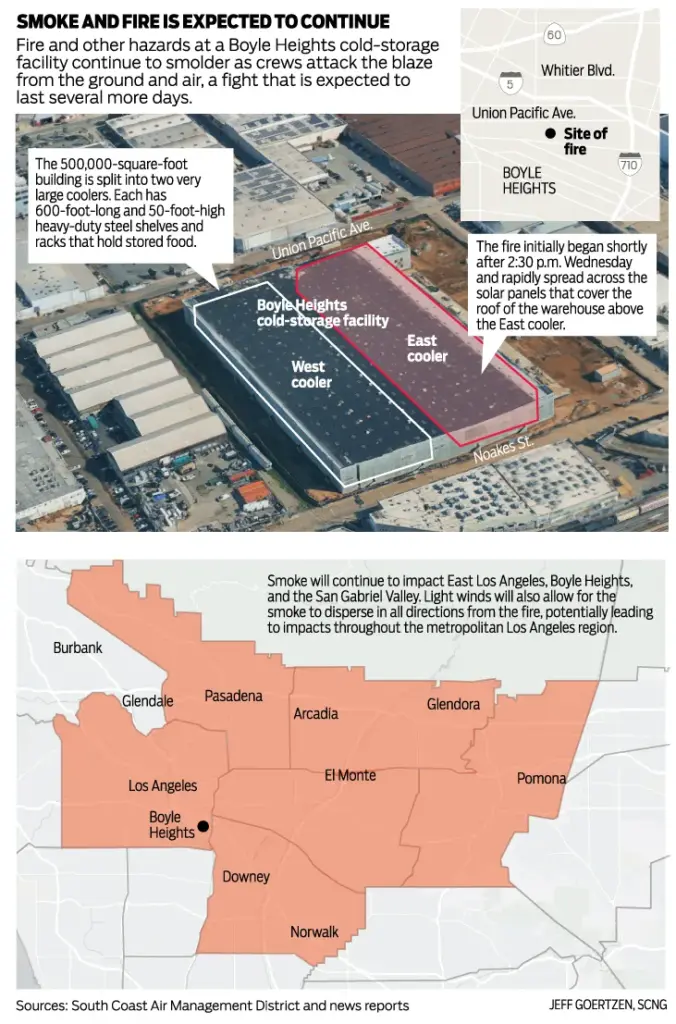
Smoke from a six-day old massive warehouse fire in Boyle Heights will be pushed easterly through Monday night and Tuesday afternoon into East Los Angeles and the San Gabriel Valley by those cooling breezes that define Southern California’s Mediterranean climate, according to a forecast from the AQMD.
Only this time, the welcome winds carry unwanted, microscopic soot and ash from the still-burning cold-storage facility that can damage the lungs and cause disease.
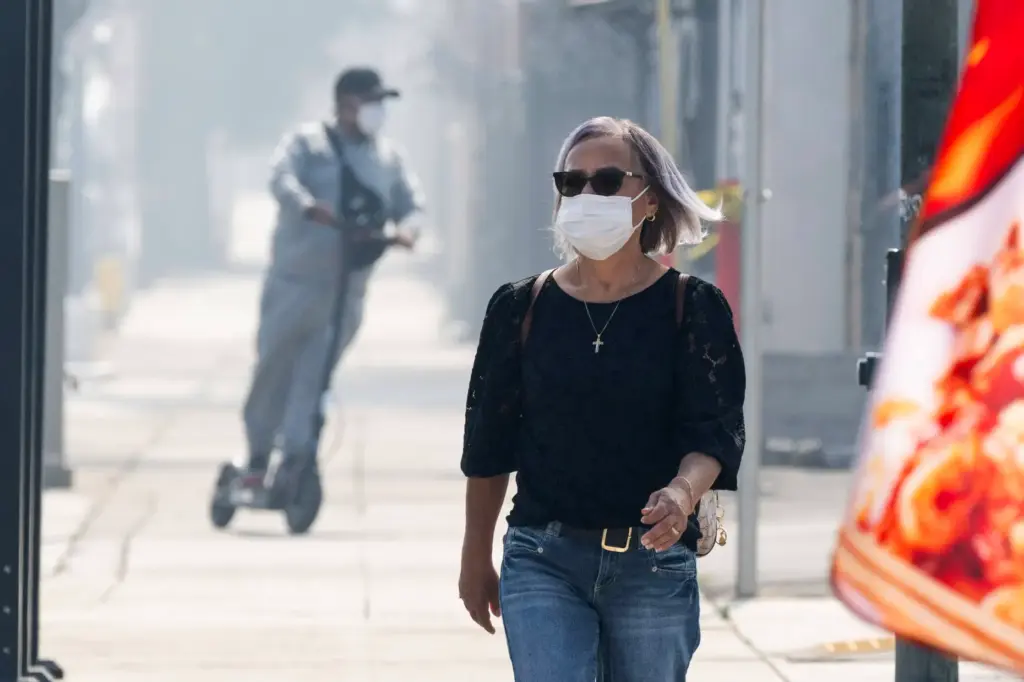 Smoke from a massive fire at a cold storage facility continues to spew across the Boyle Heights neighborhood of Los Angeles on Monday, June 22, 2026. (Photo by Drew A. Kelley, Press-Telegram/SCNG)
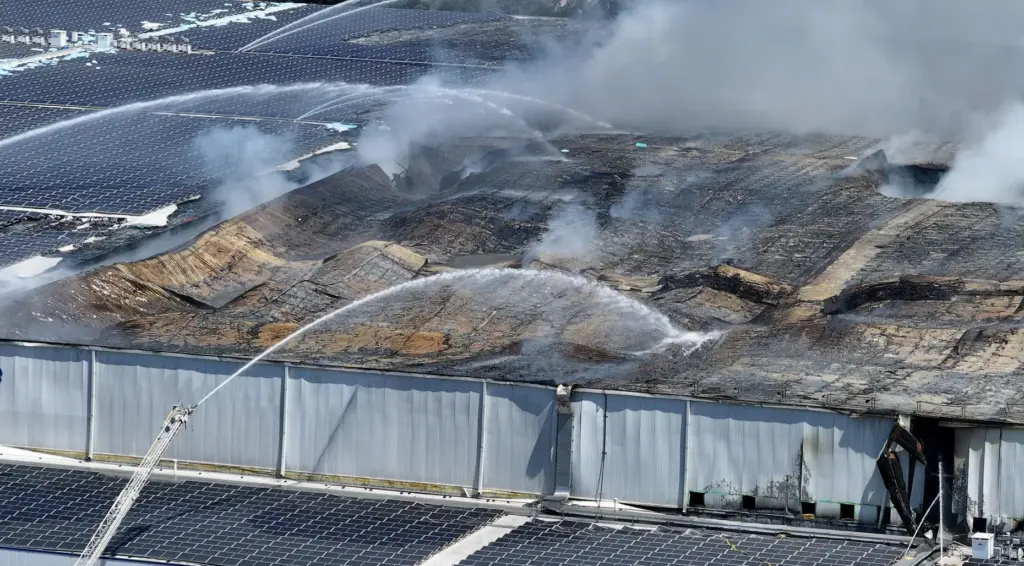 Firefighters made advances today, June 22, 2026, in their battle to extinguish the fire at a cold storage facility in Boyle Heights that’s been spewing smoke since Wednesday. The Los Angeles Fire Department cited progress over the last 24 hours, confining the fire to one side of the large Lineage Logistics warehouse at 1400 S. Los Palos St. (Photo by Dean Musgrove, Los Angeles Daily News/SCNG)
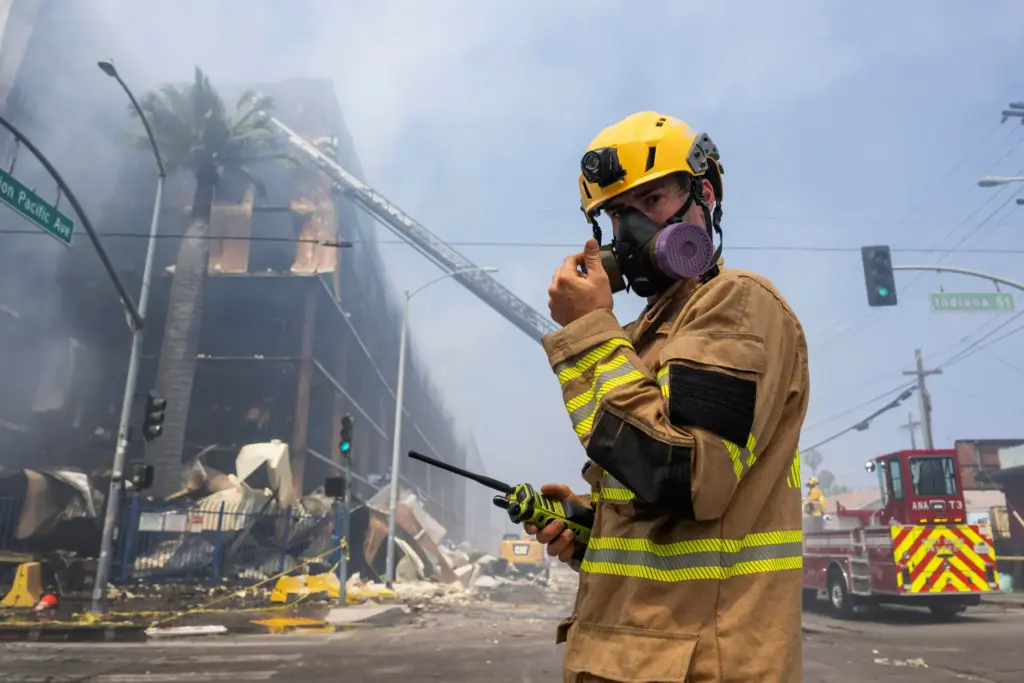 Members of the Anaheim, Ventura and Los Angeles Fire Departments work to extinguish a massive fire at a cold storage facility in Boyle Heights on Monday, June 22, 2026. (Photo by Drew A. Kelley, Press-Telegram/SCNG)
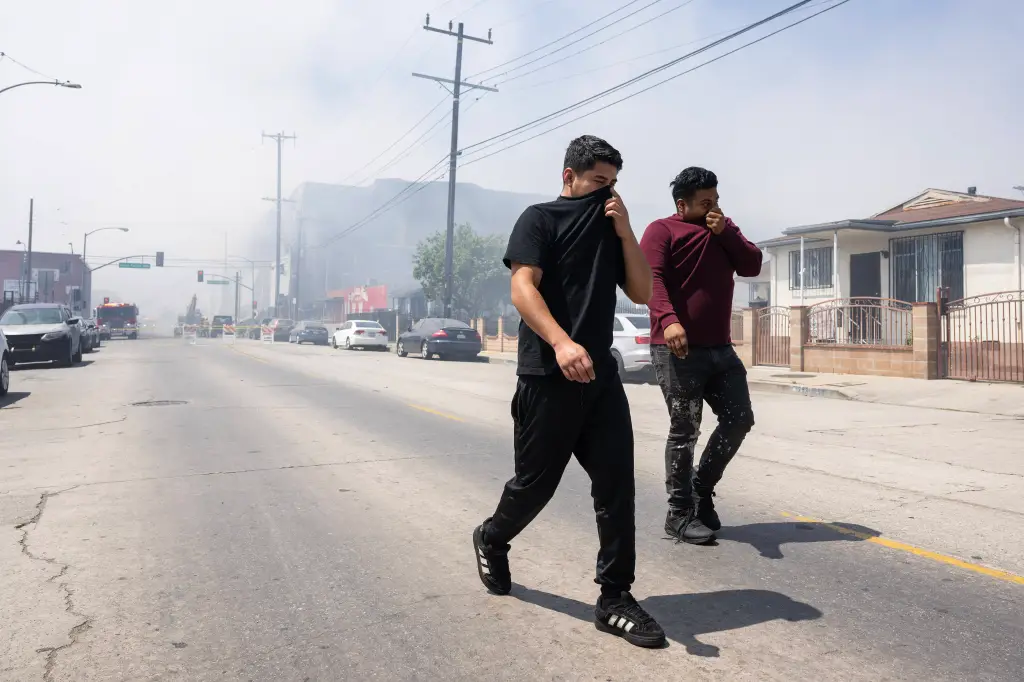
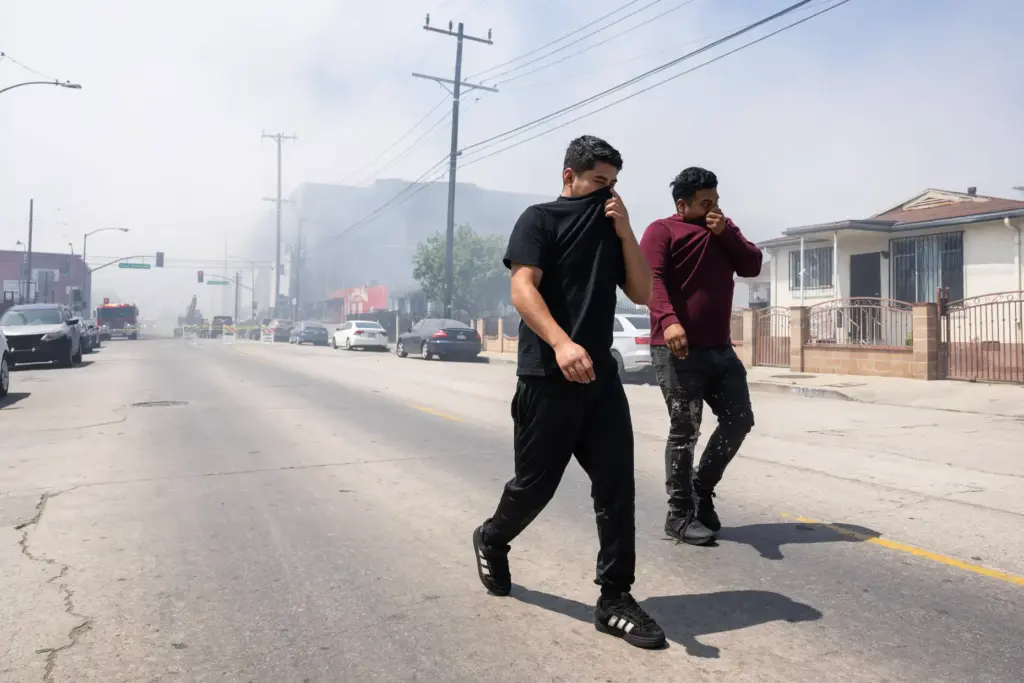 From left, Fernando Perez and Antonio Perez cover their faces as they try to avoid toxic smoke spewing from a cold storage facility in Boyle Heights on Monday, June 22, 2026. (Photo by Drew A. Kelley, Press-Telegram/SCNG)
They are part of what’s called PM2.5, a catch-all term for particle pollution 2.5 microns large — so small they bypass the nose and throat, irritate the eyes, and in worst-case scenarios, can cause cardiovascular and respiratory diseases, even lung cancer. When they’re from a warehouse fire burning refrigerant chemicals and solar panels, the toxic components and effects are unknown — and troubling.
“What makes this fire unique is the composition of these particles could be very different,” Yifang Zhu, a professor in the UCLA Department of Environmental Health Sciences, said Monday, June 22. “There is a lot of construction materials, solar panels and electronics burning. The resulting smoke can be more toxic.”
For Los Angeles, a city that knows a thing or two about fake disasters made into movies about man-eating sharks, towering buildings ablaze, devastating earthquakes and tsunamis, these mammoth industrial disasters have become all too real lately.
On May 21, a disaster was averted at GKN Aerospace in Garden Grove, where a chemical tank with thousands of gallons of methyl methacrylate began to overheat. On May 22, about 25,000 gallons of crude oil began pouring into the busy intersection of Eastern Avenue and Cesar Chavez Avenue in unincorporated East Los Angeles, reaching the L.A. River and killing birds and unleashing a major rescue operation. The Lineage cold storage plant caught fire June 17, and hasn’t stopped burning since, sending plumes of PM2.5 smoke throughout inland parts of L.A. County.
East Los Angeles and Boyle Heights — Latino-majority neighborhoods — got the brunt of the last two events. East L.A. is also where residents suffered for years from the fumes and toxic emissions from the now-bankrupt Exide Technologies plant in Vernon.
“The people of East L.A. have seen this before,” said First District L.A. County Supervisor Hilda Solis, who was at a church in the unincorporated community, helping hand out masks and air purifiers. “The people of East L.A. are much more resilient than I am; they’ve had to weather so much in the past decades and now six days ago.”
Because of those cooling, onshore breezes, the particle pollution will flow into East L.A. and all of the San Gabriel Valley, along with Downey and Norwalk to the southeast and a part of Glendale to the northwest, according to the South Coast Air Quality Management District advisory.
Though there is not a shelter-in-place order, the smoke has arrived in these areas since Sunday, including parts of the San Fernando Valley. Those areas closer to the fire burning in a set of buildings in the 1400 block of South Los Palos Street experienced “Very Unhealthy” conditions that day in Boyle Heights, while these areas had air “Unhealthy for Sensitive Groups,” (like those who are pregnant, have asthma or the elderly): most of the San Gabriel and Pomona/Walnut valleys, East San Fernando Valley, West San Fernando Valley, Santa Clarita Valley and parts of San Bernadino County. Other areas, mostly along the coast, had “Good” or “Moderate” air quality, the AQMD reported.
Monday night and all day Tuesday, the San Gabriel Valley will get it, mostly as “Unhealthy for Sensitive Groups.”
“The onshore winds blow everything to the mountains but in the San Gabriel Valley, it has nowhere to go, so it stays there. So Pasadena area will be the worst (outside of Boyle Heights and East L.A.),” Zhu said.
And that includes Altadena, where 70% of the town burned to the ground during the Eaton fire of Jan. 7 to 8, 2025.
“The mental health aspect is real, especially for those who experienced the fires previously. We are encouraging folks to stay indoors, use their purifiers, and check on vulnerable neighbors,” said Nic Arnzen, a member of the Altadena Town Council.
Read more Authorities arrest 2 more suspects in planned attack on Trump’s UFC show
Arnzen and his husband lost their home in the Eaton fire.
Deputy Chief Derrick Chapman of the L.A. County Fire Department, which has been assisting the LAFD, shared some good news during a press conference Monday.
While scientists such as Zhu and other experts were worried about the presence of anhydrous ammonia (NH₃), which is used for keeping goods very cold, burning in the fire. Chapman, however, said that the LAFD, on the third day, removed all of the ammonia to an off-site location.
Still, Zhu said the concern is, what components are in PM2.5? Each fire has different kinds of combustion, leading to different kinds of PM2.5. For example, Caltech scientists traced spikes in lead levels in PM10 and PM2.5 from the Eaton fire.
She wants to see more study of the smoke and ash, instead of just lumping it all in as PM2.5.
“For fires like this, we don’t know what has been created with high combustion,” Zhu said. “The lessons we learned from the January L.A. fires is we don’t look for (components) specifically. And for this fire, we don’t have the understanding of what we should be looking for.”
As in the Eaton fire that burned electric cars, EV batteries and solar panels, as well as older homes with interiors covered in lead paint, an industrial fire may produce smoke and ash with toxic chemicals hidden unforeseen in the tiny smoke and ash.
“We need to take precautions. We can’t take this lightly. There are lots of unknowns,” Zhu said.
For those who see hazy, smoky air or smell smoke, Dr. Muntu Davis, with the L.A. County Department of Public Health, said people should stay indoors. They can run air conditioners that circulate air but do not run swamp coolers or fans in windows that pull in outside air.
He warned that weather patterns can shift.
“It changes hour by hour. So, really pay attention to where you are and what you are seeing outside,” Davis said.
The DPH also recommend:
• Limit outside exposure. For outdoor workers, wear an N95 or P100 mask.
• Keep windows and doors closed.
• If it’s too hot indoors, go to the movies or the library. Cooling shelters will open shortly, L.A. County officials reported.
• Run your air conditioner or your air purifier
• Avoid using fireplaces, candles or vacuums.
• Clean dusty surfaces with a damp cloth and don’t smoke.
• If you experience symptoms like severe coughing, shortness of breath, wheezing, chest pain, palpitations, nausea, or unusual fatigue, contact your doctor or go to urgent care. For life-threatening symptoms, call 911.
• Residents who need assistance should call 211 for information on cooling centers, where to find masks or air purifiers.
Read more A plan to sell artifacts from the Titanic faces US government opposition