
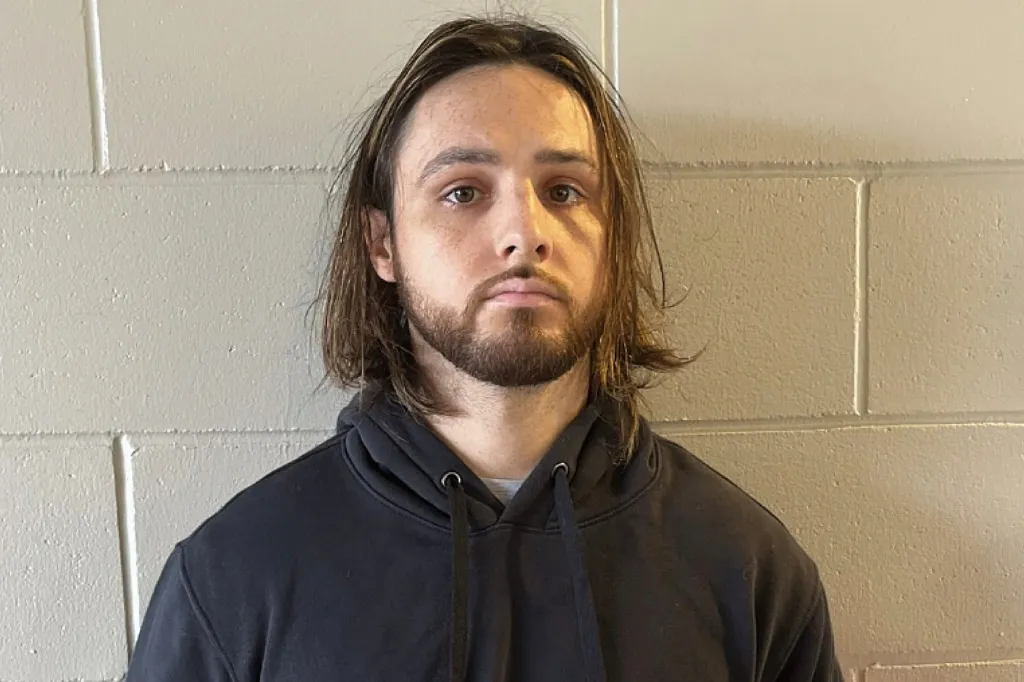
A former sheriff’s arson investigator testified Monday, June 22, that the actions early last year of Palisades fire defendant Jonathan Rinderknecht were consistent with those of someone who simply wanted to report a fire rather than of someone intent on starting such a blaze as a form of societal revenge, a theory that prosecutors have argued in Rinderknect’s ongoing federal trial in downtown Los Angeles.
Read more Authorities arrest 2 more suspects in planned attack on Trump’s UFC show
Edward Nordskog, a retired Los Angeles Sheriff’s Department arson and bomb unit investigator and arson and explosions consultant, testified Monday that he does not believe the Lachman fire — which broke out on Jan. 1, 2025, and smoldered to evolve days later into the devastating Palisades fire — was necessarily the work of an arsonist. He also testified that Rinderknecht’s behavior, including reporting the fire several times to 911 and making no attempts to conceal his identity, align with that of concerned citizens who report fires.
Nordskog also testified that he believes fireworks cannot be ruled out as the cause of the Lachman fire.
Rinderknecht faces several arson-related charges in connection with the Lachman fire, which authorities say became a holdover fire that turned into the Palisades fire.
“There’s no evidence that this was a serious attempt to start a fire, or that it was intentional,” he said.
Previously, the government called a witness who testified that Rinderknecht’s behavior around the time of the fire was consistent with revenge-driven arson, leading to excitement.
“They’re not wrong, but they’re just big and vague,” Nordskog said of the categorizations used by the FBI.
Nordskog testified that typically an arsonist motivated by societal revenge would want to inflict the most damage possible and thus would most likely not call authorities to intervene. Reporting the fire to 911, as Rinderknecht did several times, is commonly done by citizens who see a fire, save for what he called a “small subgroup” usually associated with emergency services, that will call 911 to report fires, a group that is typically looking to be a “hero”. He has not seen a case where an arsonist called 911 as many times as Rinderknecht did, he testified.
“That is a common thing done at literally every fire I have been involved with by citizens,” he said of dialing 911.
Nordskog also testified to potential issues stemming from Rinderknecht’s visit to the Hidden Buddha clearing with investigators following the Palisades fire, which took place during the day, while investigators believe the Lachman fire began near midnight. The time of day, combined with the area having been burned twice, could account for any difficulties in identifying locations or directions and would not be out of the ordinary for someone to not be able to identify burned out areas.
“You’re looking at a scene that is so different from the night you were there that it is almost useless to even try,” he said.
Read more A plan to sell artifacts from the Titanic faces US government opposition
In his review of the case, Nordskog highlighted that the Lachman fire broke out on a foggy night around midnight.
In his opinion, if a serious attempt to burn the city down was made, it would be more likely for an arsonist to hike in and set a fire during the afternoon of a hot, windy day, he testified. In this case, Rinderknecht did not take any anti-forensic measures, such as using a disguise, concealing his license plate, turning off his phone or parking where his car would not be visible, Nordskog said.
Nordskog testified that the category of excitement-motivated arson is rare.
“Historically, that’s the one that has been wrong the most,” he said of the categorization of fires motivated by excitement.
Nordskog also testified that much of Rinderknecht’s behavior referenced by the prosecution’s arson behavior expert, including anger about society and wealth inequality, applies to many people and that revenge is a very broad category, which he called “dangerous” for investigators to rely on. He also testified that in his experience, the target and suspect of most revenge-based arsons are “immediately” clear.
“Taking a very normal human action and vilifying it is very bad behavioral analysis,” he said.
Nordskog cautioned against interpreting behavioral analysis as evidence someone has committed a crime.
“You have to have physical, tangible evidence, something you can touch or look at, to link an offender to an event,” he testified.
During cross examination, a prosecutor questioned Nordskog about the ChatGPT history of the defendant, which contained angry sentiments towards the wealthy, and his messages with a former coworker, which the prosecutor described as “vile,” and how that affected the analysis.
Nordskog testified that in this case, information from the scene held more weight in his determinations.
Read more Clippers go into NBA draft with a slew of other decisions on horizon