
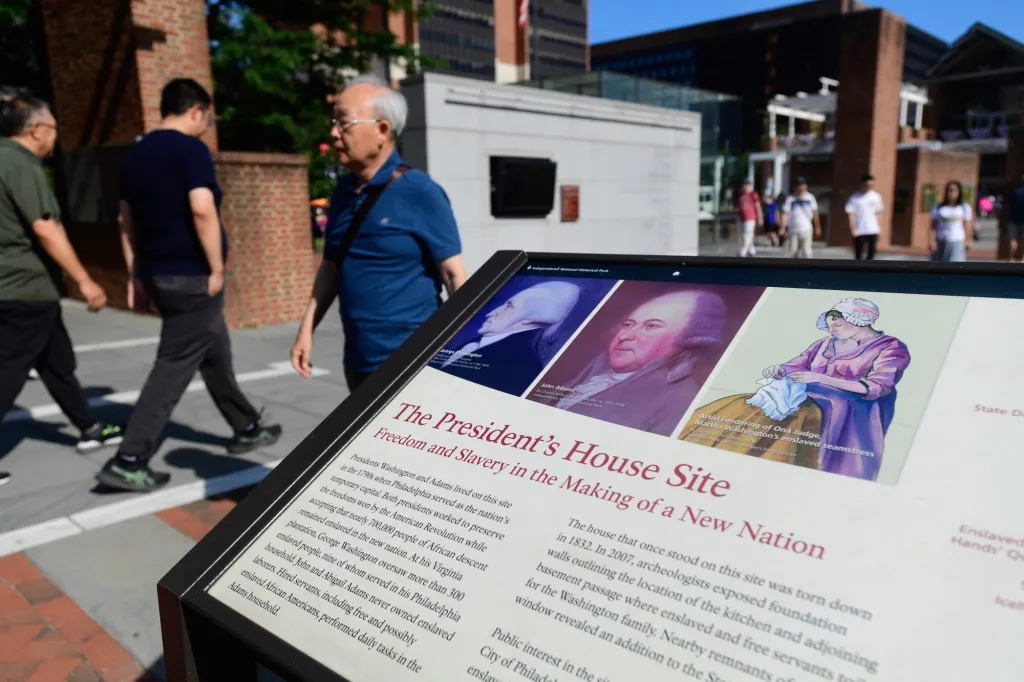
As the United States prepares to celebrate the 250th anniversary of its founding, the subject of slavery and its connection to the Founding Fathers can be a complicated topic to discuss, historians said.
Read more US says chemical maker Chemours to pay $450M to settle ‘forever chemicals’ case
How many of the Declaration of Independence’s 56 signers were slaveowners isn’t clear. A 2022 exhibition in the Washington University libraries claims one-third of the signers owned slaves, a claim also mentioned by an article published on History.com.
In 2019, Chicago documentary filmmaker Arlen Parsa claimed that 34 of the 47 of the Declaration’s signers depicted in the painting depicting the document’s signing were slaveowners. PolitiFact, which is a part of the Poynter Institute, interviewed over a dozen historians, compiled a spreadsheet detailing their research and determined that Parsa’s statement was true.
While the true number of slaveowners among the Founding Fathers remains uncertain, surviving historical records can prove with certainty that George Taylor, a signer of the Declaration of Independence, was among this group.
Taylor, who came to the New World as an indentured servant, is mainly remembered for his time running iron furnaces in Pennsylvania and New Jersey and being one of Pennsylvania’s representatives on the Continental Congress. He also helped to construct Northampton County’s first courthouse, which he then presided over from 1764 to 1772, and had a house built in Catasauqua that still stands today.
In 1780, Taylor sent one of his slaves, named Tomm, to deliver a letter to Northampton County Magistrate Robert Levers to register him and another slave — named Samm — as belonging to Taylor for life in accordance with Pennsylvania’s 1780 Act for the Gradual Abolition of Slavery. The letter is one of the artifacts stored by the Historical Society of Pennsylvania in Philadelphia.
Tim Betz, curator of exhibitions & programming for the Northampton County Historical and Genealogical Society, said Taylor’s owning of slaves is one of the few things he can confirm from his research into surviving documents from the era.
“The amount of documents I’ve seen that are actually written by George Taylor I can count off on my two hands. They include the letter registering Tomm and Samm,” Betz said. “There’s very little I know with absolute certainty about Taylor but what we know for certain is he chooses to register those men for the rest of their lives.”
Betz said talking about Taylor’s ownership of slaves can become a difficult conversation when he is mainly remembered for his contributions to both the Lehigh Valley and the founding of the United States.
“It’s hard to square the circle of how could this person who signs the Declaration of Independence and is this local hero could also be an enslaver,” Betz said. “I think it can be both true that George Taylor believed in the ideas of independence and liberty and the things that’ll become the American experiment but it’s clear that, for him, that had limits.”
Read more Trivia nights, valentine’s cards: Overlooked social connections can prevent suicide
Cory Young, an assistant professor at the University of Iowa who has spent almost a decade researching the history of slavery in Pennsylvania and catalogued his findings — including Taylor’s letter — online through the website A Just and True Return, said Taylor represents a moral dynamic that he saw as being common among those seeking independence from Great Britain while also being slaveowners, even if they understood how the former could influence the latter.
“Historians debate whether it’s really talking out both sides of your mouth to clamor against political slavery while holding people in actual human slavery, but there were plenty of people who made their peace with it,” Young said. “Their criticism in the 18th century was against a particular political relationship between a subjected people and their government as opposed to what they saw as a social institution or an economic institution of human slavery.”
Young said he found, through his research, that abolitionists of slavery disagreed on whether the Declaration of Independence, and the following U.S. Constitution, could be used to justify the end of slavery when those involved in influencing both documents were slaveowners. According to “Signers of the Constitution,” a book published in 1976 by the National Park Service, at least 12 of the 55 delegates to the 1787 Constitutional Convention were slaveowners.
However, Young said he believes continuing to reflect on the meaning of the language of both documents, especially the Declaration, shows how the United States had the potential, even from the beginning, to become a more equal nation.
“The United States may be imperfect, but when you write, ‘all men are created equal,’ into your founding documents, that becomes a touchstone against which anyone interested in staking a claim in the United States is able to do so,” Young said.
Scott Gordon, a professor of English at Lehigh University who was researching the Moravian church’s presence in Bethlehem before discovering the 1780 Pennsylvania slave registry in 2022, said he didn’t see the majority of people being unable to comprehend slavery’s presence among the Founding Fathers.
“The need to preserve these people as untainted ideals is actually, to me, the thing that’s puzzling,” Gordon said. “I don’t know why people need to do that. They’re much more interesting people, and the circumstances are much more interesting, to understand their complexities.”
Gordon said he didn’t want to see the legacies of the Founding Fathers, including Taylor, be overshadowed by the fact that some of them owned slaves, nor have that fact be why people stop learning about them.
“Our country would not be what it is without their ideas or their actions,” Gordon said. “We’re not really going to find perfect people at any time, including our own, but I think making them into perfect people is not a good practice either and I think remembering that, among other things, they held humans bound to them reminds us that they weren’t perfect people.”
Read more TikTok is reinventing healthcare. Should you trust it?