
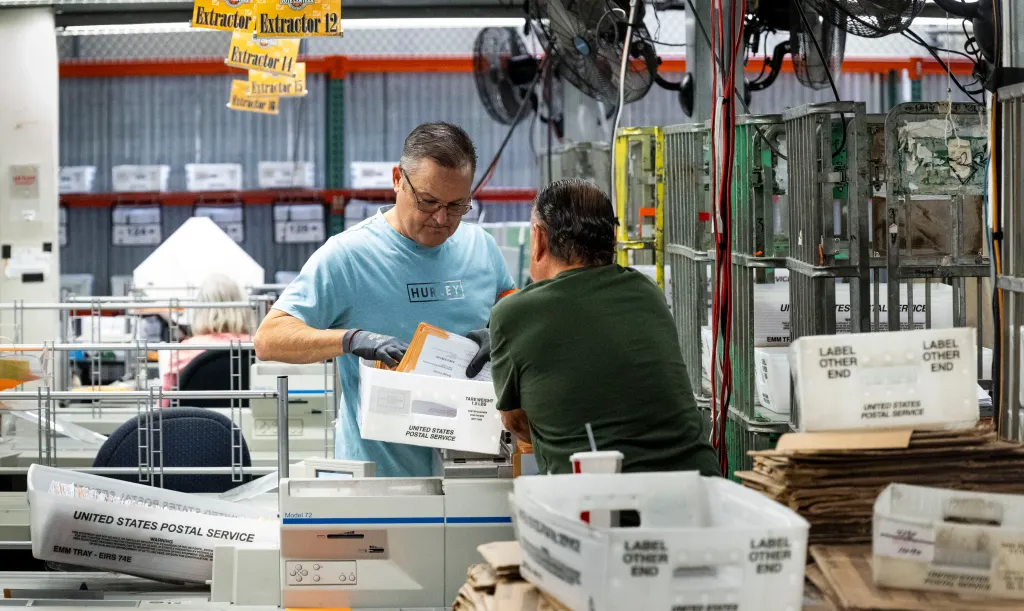
Orange County’s registrar of voters certified the results of the primary election on Friday, June 26 — the first day state law allows him to do so.
Read more Newsom urges a national ‘billionaires’ tax’ while fighting one in California
With more than 809,000 ballots cast out of the more than 1.9 million sent to registered voters, turnout in the county was 42.4%.
Nearly 87% of ballots were cast by vote by mail, while another 13.1% were voted in person or at one of the nearly 200 vote centers scattered around the county.
“Orange County received more than 268,000 Vote-By-Mail ballots on or after Election Day and processed about 2,200 provisional ballots in this election,” Registrar of Voters Bob Page said. “We reported the results from at least 95% of accepted ballots within seven days, a pace that reflects the efficiency of our elections process and the dedication of our staff.”
Page said the county completed two audits to verify the election results — one that is legally required and another that the county opts to do.
Among the county’s voters, Steve Hilton and Xavier Becerra took the top two spots in the race for governor, just as they did statewide, albeit with first and second place flipped.
Statewide, voter turnout hovered around 40.8%, based on unofficial results from the California secretary of state’s office on Friday afternoon. The secretary of state has until July 10 to certify all election results statewide, while many candidates who are moving on to the general election are already looking ahead to November.
Find the county’s election results at ocvote.gov/results.
Is California’s lengthy election process fixable?
A lot has been said — and critiqued — about how California conducts its elections, especially when it comes to how long it takes for winners to be declared.
Page has often said it’s not necessarily that the vote counting itself takes a long time, but rather the process, set by state law, that gives voters time to fix a signature issue on mailed ballots. This year, Election Day for the primary was June 2, and voters had until 5 p.m on Wednesday, June 24, to fix signature challenges.
And , a nonpartisan group that works to improve the state’s election process, says the lengthy process is fixable.
“Throughout the ballot counting process, California lags behind every other state. This is not just because of its large population, but because of drivers including vote-by-mail balloting, ballot processing procedures, statutory deadlines and reforms like independent redistricting,” the California Voter Foundation said.
The nonprofit studied three counties — Orange, Placer and San Joaquin — for its nearly 100-page report, suggesting various ideas that could speed up California’s voting process without impeding voters’ access to voting.
Among them is something Orange County already does, said Kim Alexander, president of the California Voter Foundation.
Dubbed “sign, scan, and go,” a voter is able to take the ballot they received in the mail, fill it out at home at their own convenience and bring it to a voting site without the envelope. The voter signs the voter roster — under penalty of perjury, attesting they are who they say they are — and casts the ballot right then and there.
The ballot is then scanned right there on the spot and added to the election night count, Alexander said, because it doesn’t have a signature on the envelope that would need to be checked.
Orange is one of 31 counties that provide this voting option, implementing it since March 2024, said Alexander.
“Voters are always going to keep returning ballots in envelopes on Election Day. But if we can get more voters to shift the way they return those ballots, cast them as in-person ballots, that can be a more satisfying experience for voters,” Alexander said.
“And it makes for a much more efficient process for election staff,” she added. “That’s what we’re trying to do.”
“Ballots returned in envelopes on Election Day is the biggest driver of California’s long vote count. Counties working to address that challenge are the ones able to make the most progress and accelerate their voting process.”
Other recommendations to speed up the process included electronic signature curing, letting voters quickly correct a signature issue from their phone or tablet rather than having to mail something to their county election’s office. This is also something Orange County already implemented, Alexander noted.
The California Voter Foundation also suggested the state invest $35 million in voter education, helping Californians better understand how the ballot return and counting processes work. It suggested another $55.5 million should be invested by the state into more processing capacity for equipment, staff and space.
“California has one of the most accessible voting systems in the world, but our long count overshadows our strengths,” said Alexander. “When results take weeks, it creates space for confusion and misinformation.”
One thing the study did not take into consideration: Whether a voter ID law would speed up or slow down the vote-counting process.
While some voters do need to show an ID to cast a ballot — generally this happens when someone is voting for the first time after registering to vote by mail and did not provide a driver’s license number, California identification number or the last four digits of their Social Security number — California law does not require an ID to be shown every time someone votes.
Some, including Hilton, have suggested a voter ID law could speed up the ballot-counting process.
“It’s hard to say what impact that requirement would have on ballot counting,” said Alexander. “It may result in a lot more requirements for ballot curing. If people are sending in their ballots in the mail but don’t send in some copy of their ID … I would imagine it could result in more ballots needing to be cured than we currently have.”
California voters will be asked in the fall whether the state should require residents to show an ID before voting. The California Voter Foundation does not take a position on ballot measures, Alexander said.
Read more Sheriff’s office investigates mass graves at California animal rescue facility
Find the full report at calvoter.org.