
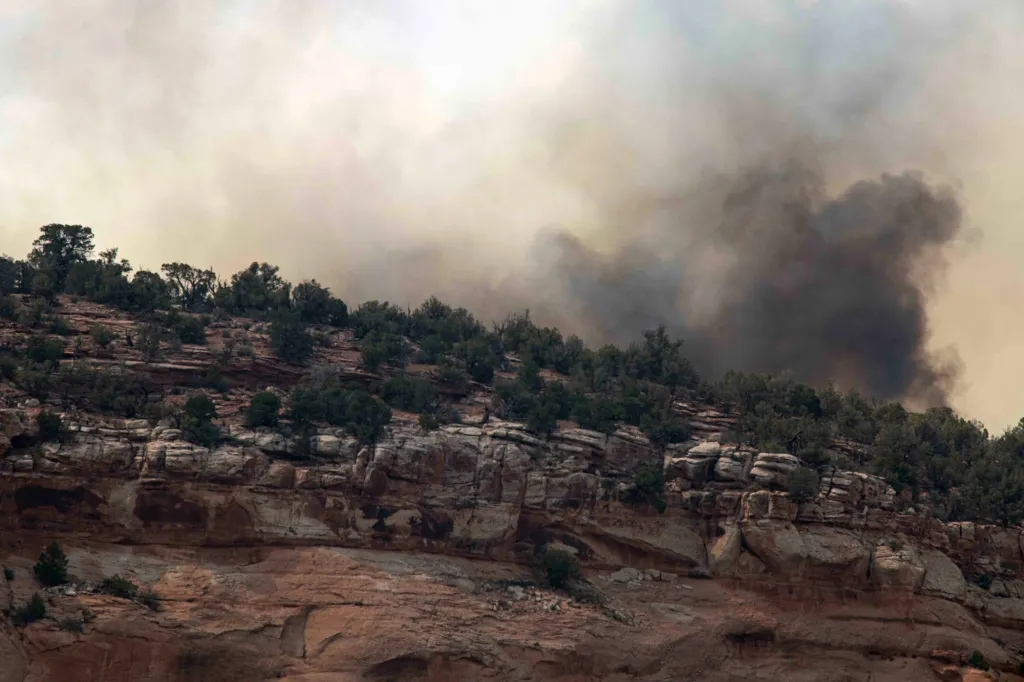
Three firefighters died and two were injured after being overtaken by flames while battling a wildfire in western Colorado, one of several that have together consumed tens of thousands of acres, federal officials reported Sunday.
Read more Alex Murdaugh’s true crime saga continues as he heads to court for hearing on murder retrial
The fatal blaze started as two small fires sparked by lightning in eastern Utah: the Snyder Mesa and Jones fires, according to the Moab Valley Fire Department. Winds pushed the flames east into western Colorado’s Mesa County, where the two fires converged and overtook the already-burning Knowles and Gore fires.
Together, the four fires formed the 28,264-acre Snyder Mesa fire, according to Utah’s wildfire dashboard.
Five federal firefighters — part of an interagency response to the Knowles and Gore fires – were caught by the rapidly spreading flames in what federal officials described as a “burnover incident,” according to the U.S. Wildland Fire Service, an agency created earlier this year to streamline firefighting and fire reduction across public lands.
A burnover is when a wildfire overtakes firefighters or their equipment, leaving them no time to escape. The five firefighters deployed their fire shelters, but the wildfire killed three and injured two, U.S. Forest Service officials said.
“The U.S. Wildland Fire Service stands united with the USDA Forest Service in grief and in our unwavering support for the loved ones left behind. Their bravery, dedication and sacrifice will never be forgotten,” the agency said in a statement on Facebook.
None of the U.S. Wildland Fire Service and U.S. Forest Service firefighters who died had been publicly identified as of Sunday. Mesa County Coroner Dean Havlik said the office is waiting for all the firefighters’ families to be notified before releasing any names.
Colorado Gov. Jared Polis declared a disaster emergency for the Snyder Mesa fire on Saturday and authorized the use of the National Guard to fight the blaze. The fire was last mapped at 28,264 acres on Sunday morning, and updated acreage estimates were not available that evening.
“I’m devastated about the loss of three heroic firefighters who died in the line of duty in Western Colorado,” Polis said in a statement. “The men and women who serve on the front lines of these fires risk their lives to keep us safe and to protect the lands and communities we love. To the loved ones of those lost, and to their fellow crew members — some who are still battling the flames — know that the State of Colorado mourns alongside you.”
Colorado officials are working closely with the Bureau of Land Management and local agencies “to deploy any and all resources needed to fight these fires… and to recover the three firefighters who were lost,” Polis said.
The Mesa County Sheriff’s Office asked people to evacuate the potential path of the fire and to turn on irrigation water to saturate the land. The Bureau of Land Management closed public access to lands it manages nearby, including the McInnis Canyons National Conservation Area.
Polis declared a second disaster emergency on Sunday for the 572-acre Gold Mountain fire burning north of Ouray, which forced residents in and near Lake Lenore, Panoramic Heights, Redstone Road and Peck’s Trailer Park to evacuate, according to county officials.
The cause of the fire remains under investigation, but Ouray County officials believe it started on private land. The city of Ouray sits roughly 96 miles southeast of Grand Junction and 25 miles north of Silverton.
Another three lighting-sparked wildfires were reported in southwestern Colorado’s San Juan National Forest on Saturday, together scorching more than 10,600 acres, according to the U.S. Forest Service. As of Sunday afternoon, the Ferris and Far Draw fires had merged into a 9,591-acre blaze, and the Doe Canyon fire had consumed roughly 1,046 acres.
Read more Markets on Wall Street poised to open higher; oil prices rise as U.S.-Iran tensions escalate
The Ferris fire burned across nearly 5,000 acres on Saturday alone, growth that San Juan Team Eight Incident Commander Brad Pietruszka called “pretty unprecedented.”
At that time, mandatory evacuations had been issued for residents north and east of the still-growing wildfires, according to the Dolores County Office of Emergency Management. The evacuation area was bordered to the north by Disappointment Road, to the south by the Glade Ranch community, to the west by the fire and to the east by Road 30.
Colorado’s recent wildfires are some of several dozen burning across the country, as consecutive days of hot, dry and windy weather intensify wildfire activity and new fire starts pop up across the region.
The National Weather Service issued a “particularly dangerous situation” red flag warning for southwestern Colorado and southeastern Utah on Sunday. Forecast warned in the alert, which remained in effect until 10 p.m. MT, that up to 55 mph wind gusts and 5% humidity would be possible throughout the day.
Some dozen fully or largely uncontained wildfires were burning on nearly 469 square miles in Utah, Colorado, Nevada and Arizona on Sunday, according to Forest Service data. Since the start of 2026, fires across the county have consumed nearly 4,688 square miles, which is more than the 10-year average.
The largest blaze, the Cottonwood fire, was burning in rugged terrain in southwest Utah. It ballooned Saturday to more than 144 square miles after marching through canyons and mountainsides, destroying part of a ski resort and other summer cabins along the way.
Authorities in Beaver County began working with fire teams on Saturday to assess the extent of the damage, but no estimates were immediately available. Utah Gov. Spencer Cox called it bleak in a post on social media, but he thanked crews for what he called “several miraculous stops and saves.”
Just like the Gold Mountain fire burning near Ouray, the cliffs and steep slopes surrounding the Cottonwood fire have made the job even harder, said Alyssa Mason, a spokesperson assigned to the fire.
“It’s hard to get dozers and other heavy equipment into that. It’s hard to get engines into that,” she said. “It doesn’t make it impossible to firefight, but it does just kind of slow things down.”
Hundreds of firefighters have arrived in the arid state to battle new starts as well as those that have been growing because of what forecasters called critical fire weather — dangerously low humidity levels, warm temperatures and gusty winds.
The danger is even greater this year because of Utah’s record-low snowpack and its warmest winter on record. Much of the West — including Colorado — is grappling with similar conditions, according to the .
Western Colorado’s wildfires sent waves of smoke across the state on Sunday, prompting state health officials to issue an air quality advisory for many western Colorado counties.
“Areas near and downwind of large fires in southwestern Colorado and southeastern Utah could have periods of moderate to heavy smoke through at least Monday morning,” an alert from the Colorado Department of Public Health and Environment stated.
Read more Comcast plans to split into two public companies by spinning off NBCUniversal and Sky
The Associated Press contributed to this report.