
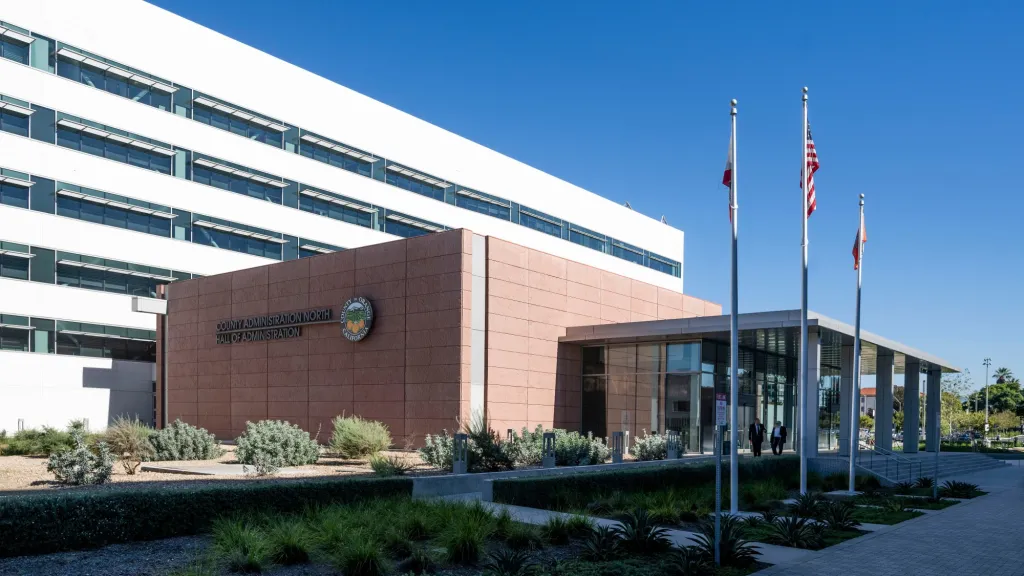
Despite a highly publicized corruption scandal that shook the OC Board of Supervisors and triggered calls for reform, Orange County residents maintain a steady level of trust in their local government and see little need for sweeping reform, according to the latest UCI-OC Poll released Tuesday.
Read more Four days to make victims fall in love: How global scammers use US tech to fleece people
Less than half of the surveyed residents said they saw corruption as a systemic problem, even while former Supervisor Andrew Do is serving a five-year federal sentence for accepting thousands of dollars in bribes while in office, the poll conducted by the UC Irvine School of Social Ecology said. Slightly more than one-third of respondents said they figure a majority of county officials are corrupt, while the same number said none or only a few are; the remaining 28% said they are unsure, according to the poll’s results.
The responses varied slightly by party affiliation: 42% of independents said at least half of county officials are likely corrupt, compared with 37% of Republicans and 30% of Democrats.
Jon Gould, the UCI-OC Poll director and dean of the social ecology school, emphasized that Orange County residents are not indifferent about local governance or unaware of political scandals. Rather, he said the poll indicates that voters think the county, despite recent setbacks, is overall moving on the right track.
“It could be that they’re content or at least not disillusioned enough that they want big change,” Gould said. “They’re not so angry they want to change things.”
The pollsurveyed 1,202 adults from March 24 to 31 to gauge public trust in government and local institutions such as police and grassroots organizations. Nearly 700 participants were registered voters, and the rest were recruited through online survey panels. The margin of error was 3.3 percentage points.
Residents recognize that deep-pocketed individuals can hold disproportionate sway in policymaking, with half of the poll respondents saying county government is run by “a few big interests,” compared to 23% who believe it works for the benefit of all people.
The poll was funded by part of a $300,000 grant from the John Randolph Haynes and Dora Haynes Foundation. After funding a similar survey from Loyola Marymount University focusing on Los Angeles County residents, the foundation wanted to expand the research to Orange County, Gould said.
Read more The largest digital camera ever built begins decade-long survey of the universe
Just under half of surveyed residents said they’re open to exploring certain reforms, such as expanding the Board of Supervisors or creating an elected county chief executive. Meanwhile, 26% said they oppose such changes, and 27% said they’re not sure. The large share of responses in the latter camps indicates that sweeping structural reform “has not yet registered as an urgent need for many residents,” the authors of the poll report said.
With regard to appetite for reform, Orange County presents a sharp contrast with Los Angeles County, where a survey from November revealed widespread disillusionment in county officials and broad public support for expanding the Board of Supervisors there and making the CEO an elected post — both of which voters approved at the ballot in 2024.
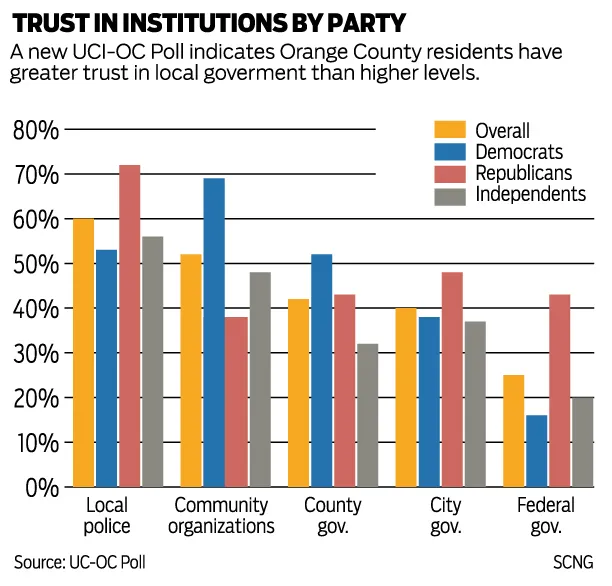
Generally, Orange County residents expressed more confidence in local institutions than the government — 60% said they trust the police department most or all of the time, and just over half said they felt the same about community groups. By contrast, 40% expressed the same confidence in the county or city government, and just a quarter said they trusted the federal government.
The difference between racial and ethnic groups is minimal when it comes to trust in local government, but steep on the subject of policing. While 70% of White residents expressed strong trust in police, 61% of Asian American residents and 47% of Latino residents said they felt the same.
The poll reveals a stark generational divide on confidence in government and local institutions. Younger people tend to have less confidence in the government and police than their parents and grandparents do. Just 31% of residents between 18 and 29 years old — the Gen Zers — said they trust the government, compared to 52% of those older than 62 — the Boomers. Yet, a majority of Gen Zers and millennials say they trust grassroots organizations, an indication that they’re not “disengaged from local civic life entirely,” the poll’s authors found.
“Young people are connected and engaged in the community,” Gould said. “What’s gratifying is that their distrust in government doesn’t lead to overall cynicism about involvement in other things.”
Read more Supreme Court will consider striking down assault weapons bans, in Connecticut and the Chicago-area