
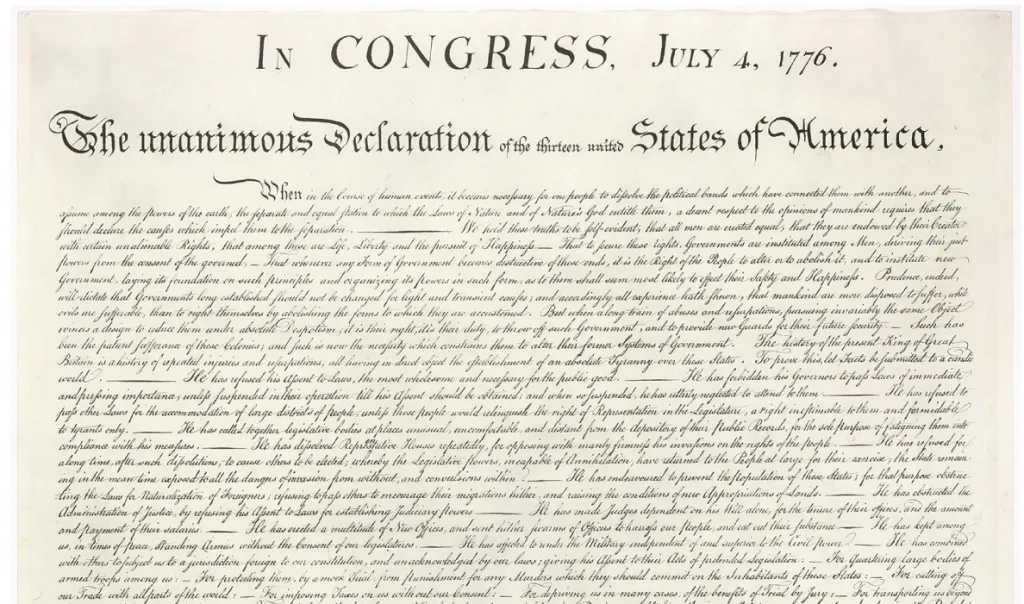
America’s birth certificate
July 4th wasn’t the day Continental Congress members decided to declare independence; they did that on July 2, 1776. It wasn’t the day they signed the document either. So what happened on July 4th? The Continental Congress approved the final wording.
Read more 99 Ranch Market owner sued for allegedly firing non-Chinese managers
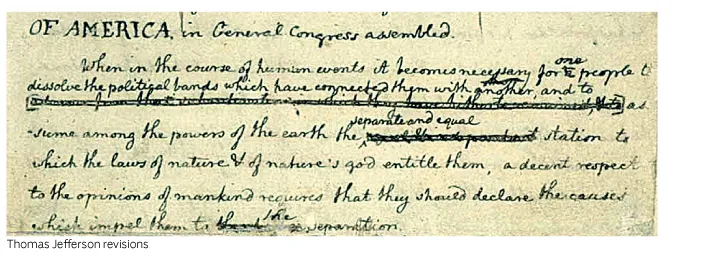
Rewrites
The Continental Congress authorized a five-man committee to draft a declaration of independence from England. That committee consisted of Benjamin Franklin, John Adams, Thomas Jefferson, Roger Sherman and Robert R. Livingston.
Jefferson was regarded as the most eloquent of the five, so he did most of the work. The committee — and then the Congress — made a total of 86 changes to his first draft.
Jefferson worked on his first draft between June 11 and June 28, 1776.
56 men signed the Declaration, two members of Congress never signed.
Eight of the signers were born in either England, Ireland, Scotland or Wales.
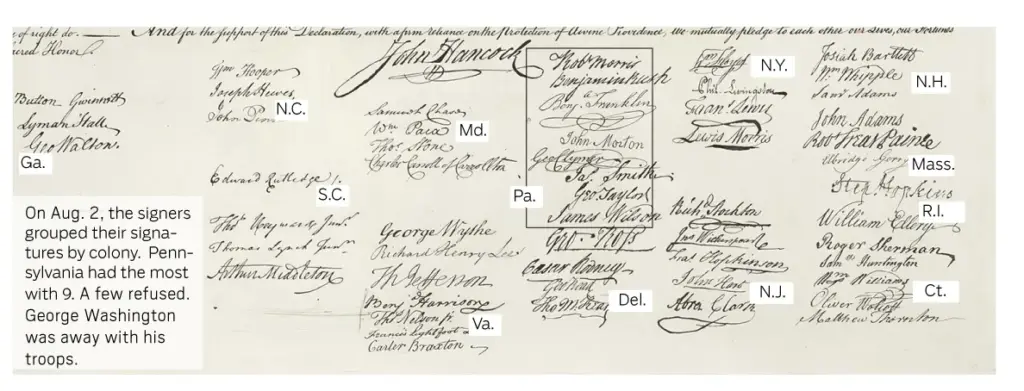
The only man to actually sign the Declaration of Independence on July 4, 1776: The president of the Continental Congress, John Hancock. Most of the rest signed on Aug. 2.
The document is 24¼ inches horizontal and 29¾ inches vertical.
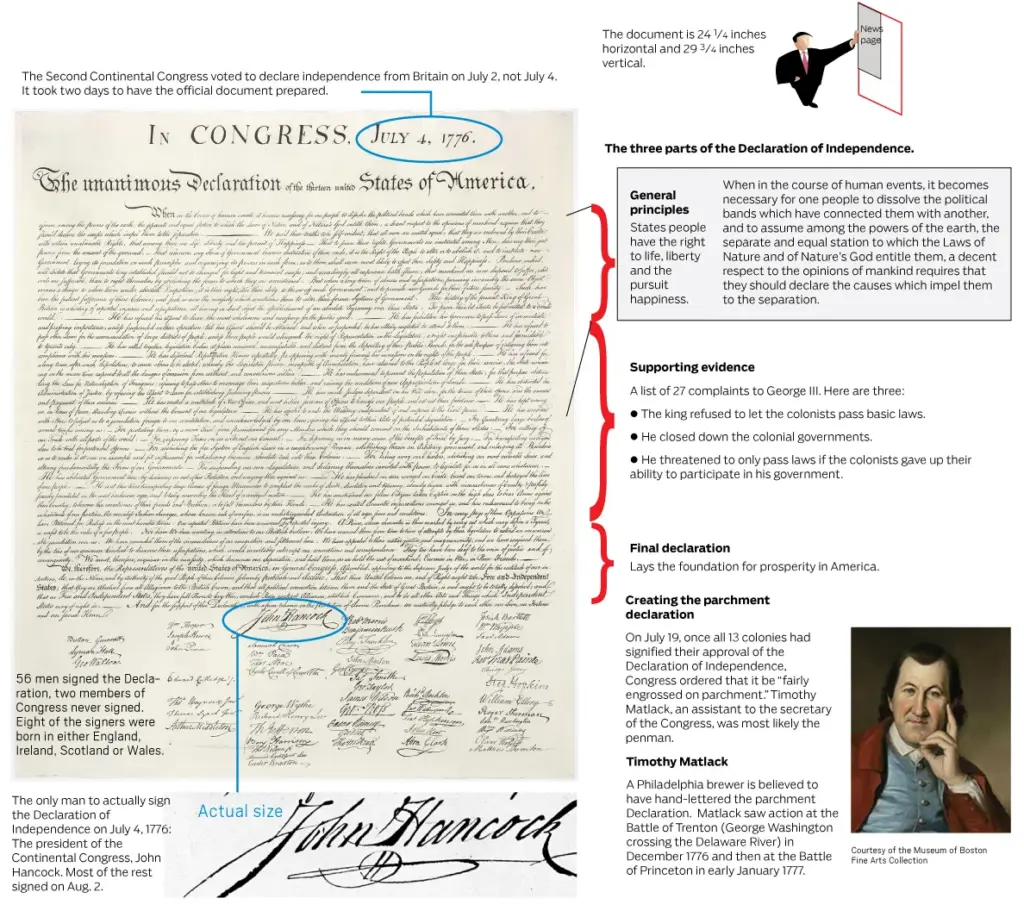
The three parts of the Declaration of Independence:
1. General principles: States people have the right to life, liberty and the pursuit happiness.
When in the course of human events, it becomes necessary for one people to dissolve the political bands which have connected them with another, and to assume among the powers of the earth, the separate and equal station to which the Laws of Nature and of Nature’s God entitle them, a decent respect to the opinions of mankind requires that they should declare the causes which impel them to the separation.
2. Supporting evidence: A list of 27 complaints to George III. Here are three:
The king refused to let the colonists pass basic laws.
He closed down the colonial governments.
He threatened to only pass laws if the colonists gave up their ability to participate in his government.
Final declaration: Lays the foundation for prosperity in America.
On Aug. 2, the signers grouped their signatures by colony. Pennsylvania had the most with 9. A few refused. George Washington was away with his troops.
Creating the parchment declaration
On July 19, once all 13 colonies had signified their approval of the Declaration of Independence, Congress ordered that it be “fairly engrossed on parchment.” Timothy Matlack, an assistant to the secretary of the Congress, was most likely the penman.
Timothy Matlack
A Philadelphia brewer is believed to have hand-lettered the parchment Declaration. Matlack saw action at the Battle of Trenton (George Washington crossing the Delaware River) in December 1776 and then at the Battle of Princeton in early January 1777.
Word getting out
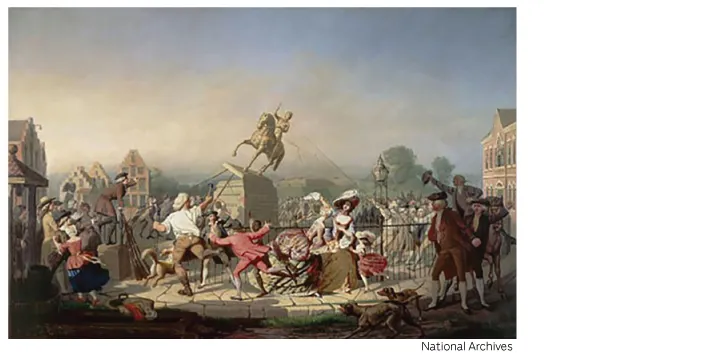
After a public reading of the Declaration of Independence at Bowling Green on July 9, 1776, New Yorkers pulled down the statue of King George III. Parts of the statue were reportedly melted down and used for bullets.
While many parades and bonfires greeted the document’s public readings on July 8, 1776, the first organized July Fourth celebration would take place in 1777 in Philadelphia and Boston.
Read more Penalty shootouts at the World Cup are a drama of ‘inhumane’ pressure
According to the Pennsylvania Evening Post on July 5, 1777: “Yesterday the 4th of July, being the anniversary of the Independence of the United States of America, was celebrated in this city with demonstrations of joy and festivity. About noon all the armed ships and gallies in the river were drawn up before the city, dressed in the gayest manner, with the colors of the United States and streamers displayed. At one o’clock, the yards being properly manned, they began the celebration of the day by a discharge of thirteen cannon from each of the ships, and one from each of the thirteen gallies, in honor of the Thirteen United States.”
In Boston, the Sons of Liberty fired off fireworks and shells over Boston Common.
What did we celebrate before July Fourth?
Before the American Revolution, King George III’s June 4 birthday was a celebration marked with bonfires, speeches and the ringing of bells. But in 1776, as patriotic fervor swept through the colonies, praising birthday celebrations turned to mock funerals for the king.
The Continental Congress voted in favor of American independence on July 2, 1776. On July 4, after making several minor changes to Thomas Jefferson’s Declaration of Independence, Congress officially adopted the document. The only man to actually sign the Declaration of Independence on July 4, 1776: The president of the Continental Congress, John Hancock.
On the morning of July 5, copies printed by John Dunlap were dispatched by members of Congress to various committees, assemblies and to the commanders of the Continental troops. Congress ordered the declaration engrossed on parchment on July 19, 1776.
Preservation
Along with George Washington’s commission as commander in chief, the declaration hung on a wall exposed to sunlight for 35 years, from 1841 to 1876 in the U.S. Patent Office. The Declaration went to Independence Hall in Philadelphia for exhibit at the Centennial National Exposition in 1876, and when it returned to Washington in 1877, it was placed on exhibit at the new State-War-Navy Building (now the Eisenhower Executive Office Building) next to the White House.
In 1892 a new steel case was constructed and the deterioration of the parchment had reached the point where it could no longer be safely exhibited. The Declaration was carefully wrapped and stored flat in the State Department library until 1921. The Declaration and the U.S. Constitution were side by side since the 1920s.
The documents arrived at the National Archives in 1952 after being preserved in helium-filled glass cases at the Library of Congress.The Declaration of Independence is now kept in a bullet-resistant, titanium and aluminum case. The case descends 22 feet when the archives close at night.
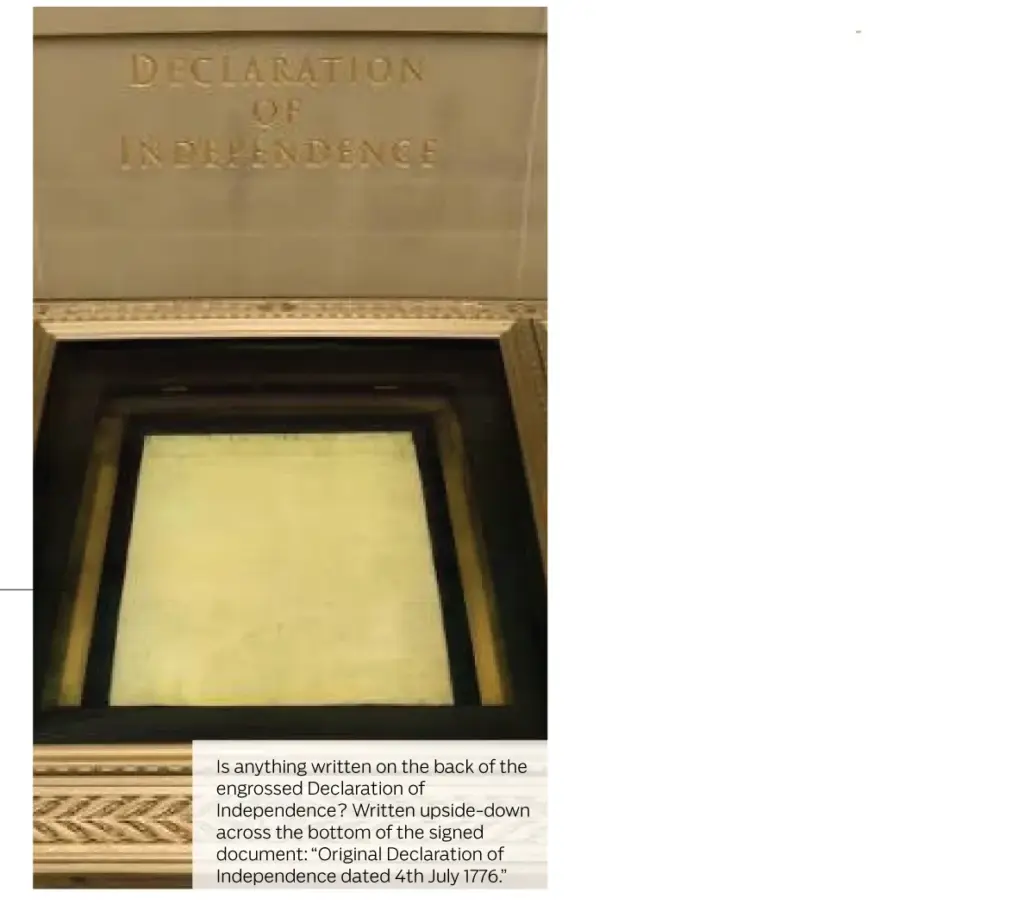
The 26 copies of the Dunlap broadside known to exist are dispersed among American and British institutions and private owners.
A first-printing copy of the declaration was found in 1991 at a Pennsylvania flea market on sale for $4. It sold for $8.1 million at auction in 2000. On Aug. 2, the journal of the Continental Congress records that “The declaration of independence being engrossed and compared at the table was signed.”
Read more Alexander: LeBron’s Lakers ledger is a lone championship
Sources: National Archives, Library of Congress, Smithsonian