
Nine years ago, Costa Mesa was Ground Zero of Ground Zero.
Read more FIFA praises World Cup referee who Trump claimed was ‘suspect’ after red card for Balogun
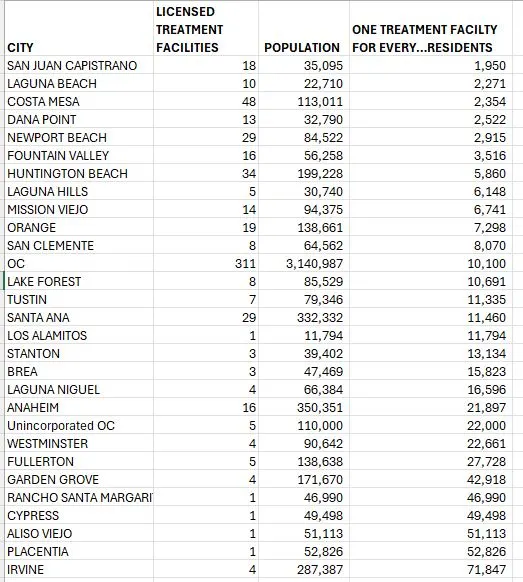
Today, though, Costa Mesa has less than half as many licensed/certified rehabs as it once had (48) and a population of 113,000, or 1 licensed rehab for every 2,354 residents.
That’s still quite a lot, but it drops to No. 3 on our rehabs-per-resident list. We’ll chalk that up to Costa Mesa’s expensive fight to regulate sober homes, which are not licensed but often are run by (or otherwise financially tied to) licensed rehabs.
There have been federal lawsuits and courtroom battles over Costa Mesa’s regulations, but the federal courts concluded that the rehabs are fine because they aim to help disabled people, not discriminate against them. (The state is trying hard to undo all that anyway, but that’s another story we’ll be getting to soon.)
If this is good news for Costa Mesa, it’s not-so-good news for little San Juan Capistrano, which moves into the No. 1 spot for rehabs-per-resident. It has 18 licensed rehabs and a population of just 35,000, which means 1 rehab for every 1,950 residents.
Laguna Beach takes the No. 2 spot; Dana Point is No. 4; Newport Beach is No. 5; and Fountain Valley is No. 6.
The county average is 1 rehab for every 10,100 residents. The state average, meanwhile, is 1 licensed rehab for every 17,340 residents.
At the far end of the spectrum here is Irvine, with 1 rehab for every 71,847 residents; Placentia, with 1 for every 52,826 residents; and Aliso Viejo, with 1 for every 51,113 residents.
Read more A toddler was found in a pool and declared dead. He’s alive and his parents could be charged
Who’s going?
Often, the patients in these facilities are imports from other states.
A recent study published in the journal Substance Use & Misuse found that out-of-state visitors to the Orange County cities with the highest concentration of addiction treatment centers were 159% more likely to overdose. That’s in direct contrast to what similar studies have found in other places: More treatment centers usually translate to fewer overdoses.
While Orange County has more than 300 licensed rehabs, or about 1 for every 10,000 residents, the only county with more is Los Angeles, which is three times larger. L.A. County has more than 800 licensed rehabs, or about 1 for every 12,000 residents. (More space. Less dense.)
San Diego County, almost identical in population to Orange County, has just 187 licensed rehabs, or about 1 for every 17,600 residents. (Again, much less dense, and much more space.)
Riverside County has 131 licensed rehabs, about 1 for every 19, 500 residents; and San Bernardino County has 66, about 1 for every 34,000 residents.
About 40 years ago, California ditched the “Certificate of Need” system, which required would-be health care providers to prove there was a local demand for their services before they could open. That requirement has been dropped, and the lack of such a system is one of many reason why Southern California became the Rehab Riviera, with far more addiction recovery centers than the region’s population can possibly support. That supply-to-need imbalance also has pushed rehab operators to import patients from around the country, to boost their profit by putting “heads in beds.”
While public treatment programs, funded with tax dollars, must meet higher quality standards and operate under stricter oversight, private treatment programs, funded with private insurance dollars, do not. We’ve spent years chronicling fraud, abuse and death in these private facilities, but state health officials stubbornly refuse to require private programs to adhere to the same standards as those imposed on public programs.
Read more Utah revokes license for boarding school where Paris Hilton says she was abused as a teen
It’s maddening. Expensive. And deadly.