
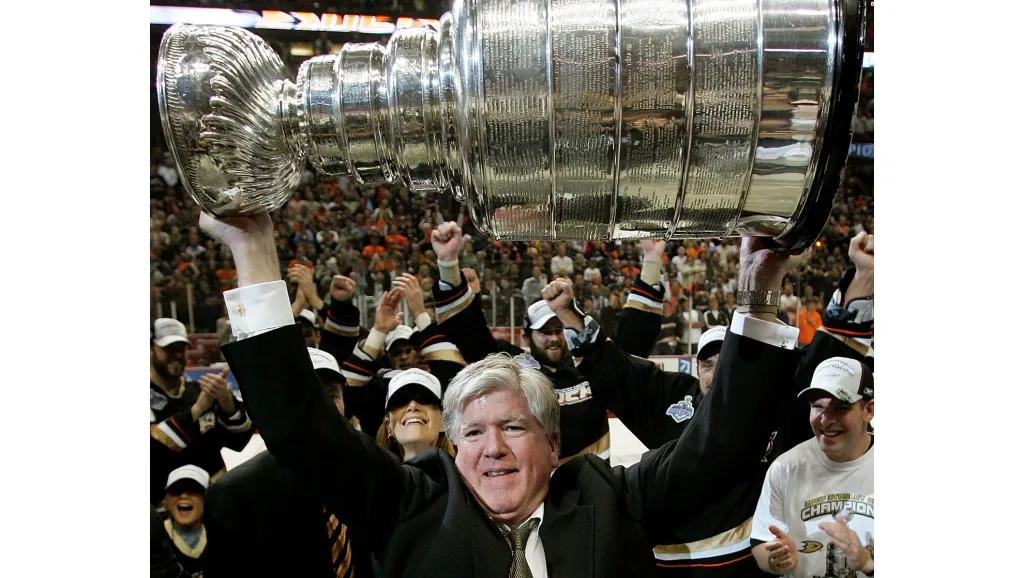
The Hockey Hall of Fame in Toronto houses some artifacts of the greatest moment in Anaheim Ducks’ history, June 6, 2007, when that team brought California its first Stanley Cup.
Read more Obamacare premiums surged this year. A new analysis shows it’s likely to happen again in 2027
There’s a photo representation depicting the presentation of a Stanley Cup ring to the Hall, noting that the Ducks were the first winners to do so. There are the Hall of Fame resumes of Scott Niedermayer, Chris Pronger and Teemu Selanne, players from that team who have been inducted into the Hall. And there is the Cup itself, on display in the shrine’s Great Hall with the names of those responsible etched into the silver band.
Come Nov. 9, one more representative from that team will go into the Hall. Brian Burke, who took over as general manager following the 2004-05 lockout that shut down the NHL for a full season and assembled that championship team, was selected as part of the Class of ’26 in the builder category, appropriately. He will go in along with NHL greats Patrice Bergeron, Carey Price, Pekka Rinne and Keith Tkachuk and women’s hockey pioneer Cindy Curley.
Burke, 71, said in a recent phone conversation that, as a member himself of the Hall’s Selection Committee, he was informed that he had been nominated, which meant he had a choice: “You decline, or you accept and recuse yourself from the process.
“So I decided to be honored. I recused myself. And then you’re completely out of the process. You don’t know who nominated you. You’re not in any of the discussions. You’re not in any votes.”
When the announcements were due on June 22, there were a few moments of tension.
“I thought those calls would start around 1 (p.m.), because I know how the Selection Committee works. So, 1:30, I’m like, (expletive), I’m not going in,” he said with a laugh. “Then the call came about 1:45. Mike Gartner (chairman of the Hall) and Ron Francis (chairman of the selection committee) called, and I was so ecstatic.
“… How does it feel? It feels wonderful. I mean, I never expected this. No one does, but I never expected it. I’m from Minnesota. I grew up one of 10 kids, didn’t start playing hockey until I was 13. So none of this was something that I ever dreamed of.”
He’s earned it, making up for any lost time with a full life in this sport. He was a player (at Providence College and then briefly in the American Hockey League), a player agent, the NHL’s executive vice president and director of hockey operations for six seasons, and a GM with the Hartford Whalers (now Carolina Hurricanes), Vancouver Canucks, Toronto Maple Leafs, Calgary Flames and Pittsburgh Penguins as well as the Ducks. Most recently, he was executive director of the Professional Women’s Hockey League players association.
Added to that, he got his law degree from Providence and later taught law classes at the University of British Columbia. He was on the board of Rugby Canada, received the Canadian Forces Medallion in 2013 for his support of the military, established the You Can Play initiative and has been an advocate for the LGBTQ+ community, in honor of his late son, Brendan.
He is in the U.S. Hockey Hall of Fame, the British Columbia Hockey Hall of Fame and the Providence College Athletic Hall of Fame. Not only is his name on the Stanley Cup, but he also has an Olympic silver medal as GM of the 2010 U.S. team that lost a classic overtime gold medal game to Canada in Vancouver.
Yet when I asked him what he might consider the highlight of his career, he said: “Oh, I don’t know. That’s a great question. Maybe winning the Calder Cup as a player (with the Maine Mariners in 1978), which was quite a thing as a player for me, (who) started so late, had so little time to develop into a player.”
Those of us in Southern California, and particularly in Orange County, would consider the 2007 Stanley Cup title and the process of building that champion high on the Burke resume, and probably No. 1. It started with a job interview for the only GM vacancy available coming out of the lockout, and at the outset it wasn’t a job he was particularly fired up about.
“I wasn’t that interested in the job until I met the Samuelis,” he said, referring to Henry and Susan Samueli, who had bought the then-Mighty Ducks of Anaheim from the Walt Disney Company earlier in 2005.
“I thought it was a West Coast market, small market. I was going to wait for something bigger, was my thinking, until I met the Samuelis. They were so nice. They were such positive people, so smart. And I desperately wanted the job even before the interview was over.
“I knew the team was close to winning.”
That was a period of transition for the team and the league, which had come out of its labor issues with a hard salary cap that gave NHL commissioner Gary Bettman the “cost certainty” he had sought for years.
In Anaheim, that period of transition with new owners meant a name change (to, simply, Ducks) and a change in team colors from teal and plum to a more intimidating black and gold with orange trim, though the original scowling duck logo again adorns the sweaters and the team from Orange County has leaned even further into the color orange in recent seasons.
Not only was there a new identity, but a new blueprint.
“In the process of interviewing with the Samuelis, I laid that out for them, the way my teams played,” Burke recalled. “I like physical teams. I like teams where my players have room to move. And we felt we inherited two really good players in Corey Perry and Ryan Getzlaf.
Read more Spencer Pratt meets with President Trump in White House
“… We could play any way they (opponents) wanted to play.”
An early priority was to strengthen the defensive corps. Burke’s first move was to sign Scott Niedermayer, who had won three Stanley Cup titles with the New Jersey Devils. One of those was against the Ducks and his brother Rob, in 2003, and Scott, by then a free agent, was enticed by the opportunity to play with Rob rather than against him. As their mother Carol put it after the two had been reunited, “Everything has come full circle.”
The next big move was to re-sign Selanne, who had been traded by the Ducks to the San Jose Sharks five years earlier.
That first season, the Ducks finished third in their division but made it to the Western Conference finals before losing to Edmonton in five games. The Oilers, with Pronger playing an outsized role on their defense, lost to Carolina in the Stanley Cup Final that year.
After that season, Burke had a staff meeting. “Bob Murray (the assistant GM), all the scouts, coaches, (head coach) Randy Carlyle,” he said. “We said, ‘Are we legit? Are we a legit contender? Or do we just ride really good goaltending from Jiggy (J.S. Giguere) and get to the conference final? We all thought, well, no, we’re legit. We just need one thing. I said, ‘Okay, what do we need?’ And everyone said, ‘Chris Pronger.’
“So I’m like, ‘Oh, this will be easy. No one else knows about him,’” Burke added with a laugh.
The information was already out there: After one season in Edmonton, Pronger wanted out. Burke – who had originally drafted Pronger for Hartford with the second overall pick in 1993 – called his Edmonton counterpart, Kevin Lowe, and they agreed to discuss a potential deal at the draft in Vancouver. At that point, as Burke recalled, Oilers assistant GM Scott Howson went to four draft tables, including Anaheim’s, and dropped off an envelope at each one with a trade proposal.
“I opened it up and it said, ‘Joffrey Lupul, Ladi Smid and a first-round pick for Chris Pronger,’” Burke recalled. “So I said to Bob Murray, ‘We would do that, wouldn’t we?’ He said, ‘Yeah, let’s do it.’ I said, ‘Let’s make ’em wait a couple of minutes. Don’t look too eager.’ We waited like 10 minutes and said we would do it.”
It wasn’t that simple, because a salary cap issue couldn’t be resolved until July 1, the start of the league’s new business year. But Burke and Lowe shook on it, and when it was made official, Lowe told Burke, “I feel like I’m punching your ticket to the conference finals.”
“I said, ‘Yes, you are,’” Burke said. “And if you do that, we’ll give you another first (-rounder).”
Which is exactly what happened. Scott Niedermayer and Pronger – each providing leadership in different but effective ways – anchored the back end along with Francois Beauchemin and Sean O’Donnell. Giguere was money in goal, with a 2.26 goals-against average in the regular season and 1.97 in 18 playoff games. Selanne had 48 goals and 94 points on a line with Andy McDonald and Chris Kunitz, Getzlaf and Perry made up a dynamic line with Dustin Penner, and the checking line of Sami Pahlsson, Rob Niedermayer and Travis Moen was, said Burke, “the best third line in the history of the game, maybe, certainly one of the top ones ever.”
Those Ducks polished off Minnesota and Vancouver in five games each, knocked off Detroit in six in the conference finals, and were about to vanquish Ottawa and secure the Cup in Game 5 at Honda Center, with a 5-2 lead in the final minutes and a capacity crowd already at full roar.
“The GM of the Senators (John Muckler) came down with about four or five minutes to go to congratulate us,” Burke said. “And we were all like, ‘He’s jinxing us. What’s he doing?’ … We’re all mad at him. And we looked at the clock and were like, ‘Ah, we should be OK.’”
The end, the celebration and presentation of the Stanley Cup and captain (and Conn Smythe Award winner) Scott Niedermayer handing it first to his brother, Rob, was “a blur,” Burke said. Except for this, in the locker room, with all kinds of beverages being drunk from the Cup.
“They all start chanting, ‘Burkie needs a drink … Burkie needs a drink,’” he recalled. “Of course, they soak me. Cold Miller Lite and champagne and wine. And it’s the worst drink ever – but it’s the best drink I’ve ever had in my life.”
Hopefully, the toasts on Induction Weekend in Toronto will be a bit more restrained.
Read more Israeli strike kills World Cup screening organizer in Gaza just before kickoff