
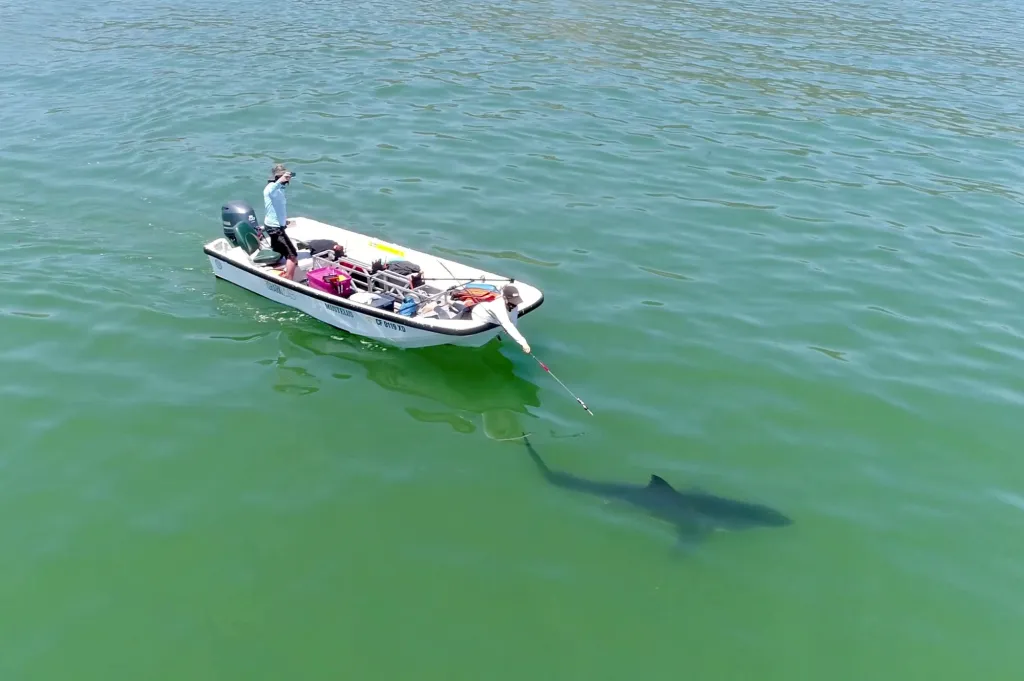
The Shark Lab has dedicated its efforts to educating the public about growing shark populations off local waters, while using high-tech equipment to research, track and tag great whites to learn more about the mysterious species and help keep people safe in the water.
But just as the Cal State Long Beach program celebrates its 60th anniversary, it is facing troubled waters with its funding expected to soon run out.
“Public safety is always what this program has been about,” longtime Shark Lab Director Chris Lowe said. “We’re trying to protect the animals, yet protect people at the same time.”
Much of the Shark Lab’s recent work has been funded by a 2018 state grant for $3.75 million, Lowe said, but that money has been exhausted. A private donation from the Paul M. Angell Foundation gave an additional $800,000 that will get Shark Lab through September.
While the Shark Lab wouldn’t completely dissolve if it can’t find additional outside funding, the California Beach Shark Safety Program it has built in recent years would disappear, Lowe said. The program has been providing additional research on shark biology and behaviour, education to both lifeguards and California school children and outreach about ocean safety.
There are 25 employees dedicated to the program; five are full-time, and the rest are part-time.
“All those jobs go away, there’s no money to pay them,” Lowe said. “If we just fund research, it’s no good if we can’t get it to the public or lifeguards. That’s why the outreach programs are so important.”
Educational outreach such as Shark Shacks, comic books that aim at children’s education, social media outreach and lifeguard training would all shut down, he said.
There have been 394 great white sharks that have been tagged through the program, with 248 active tags that have been pinging off of more than 100 acoustic receivers along the California coastline. Drones have also been a tool, giving a bird’s-eye view of how often humans and sharks are in the water together.
The tagging would stop, with no funding for researchers to pull and analyze the data that gets sent to lifeguards monthly, and no travel budget to continue the program, he said.
Annual operating cost is $900,000, and Lowe said he hoped to get $1.6 million in state funding approved this year, which doesn’t appear to have been successful, so they could expand efforts into Monterey, where a nursery has brought sharks big and small to the region.
He’s hoping that a donor or grant could extend what they’ve built not just for one year, but at least two or three years.
“It’s hard to keep staff. It’s hard to hire staff for one year and keep them trained. What I really need is funding for a couple of years,” he said. “One year keeps us alive, but I’m constantly having to rehire new people. The fieldwork requires skill. While I won’t turn down a year of funding, it would give me breathing room to have at least two years of funding.”
Warmer-than-normal waters this summer season may be luring great whites to the region, experts have said.
Shark bites have been rare in California, but headlines of an attack could incite fear and impact beach visits, meaning an impact on local economies, Lowe argued.
“We have one fatality in Southern California during beach season, and it will have endless media,” he said.
After a shark bite in 2017 off Camp Pendleton, an economic study by the Huntington Beach Chamber of Commerce indicated the beach town lost $7 million in hotel reservations following the international attention the headlines drew, he said.
“It’s not a problem, until it is,” Lowe said. “The whole purpose of this program is to have a better understanding. We don’t just do the research, just to do the research. This is why we do the education with it.”
Read more South Florida’s Palm Beach airport renamed President Donald J. Trump International
With its research, the Shark Lab has also helped local lifeguarding agencies develop protocols for how to respond to shark sightings, with a matrix that closes the beach based on a shark’s size and behavior.
Australia spends $32 million annually on shark mitigation: culling sharks to make people feel safe, tagging them and supporting research, education and outreach. South Africa spent $12 million, Lowe said. “So when you look at those numbers in other places and wonder why there’s no state or federal funding in the U.S. for this sort of thing — is that really good foresight, is that good planning?”
The Shark Lab launched in 1966 and is the oldest of its kind in the country, created in a time when there were nearly no sharks to study because they had been overfished, Lowe said.
“Now that they’ve been protected and the water is cleaner, sharks have come back,” he said.
Much has changed in the past decade as researchers have learned more about the shark species frequently spotted off the coast.
“The biggest misconception is that shark research is well funded,” Lowe said, citing the popular “Shark Week” on the Discovery Channel and television programs for public assumptions. “It leads the public to believe there’s a lot of funding, that makes it hard for me to do my job.”
The Shark Lab is currently partnering with Monterey Bay Aquarium Research Institute to use high-tech “shark robots” to search the sea for sharks. The work is being funded by The Seaver Institute.
The shark robots swim around using a hydrophone, with solar batteries, wifi, satellite and 360-degree cameras to monitor for great white sharks. They can also do e-DNA testing, or environmental DNA, that detects shedded cells in the water to show when untagged sharks are present.
“In the next few years, we can do a ‘23 and Me’ for white sharks,” Lowe added.
That will give more information about what sharks are doing along our coast: when they are here, do they come back, what specific sharks are lingering, when do they go to other beaches and when are they around people?
All of it is doable, he said, but it all takes money.
“We need funding, whether it’s a private donor or corporate sponsorship. We still have hope the state might provide some funding to keep us going,” Lowe said.
Nationally, more attention is being put on shark-bite mitigation.
A national emergency alert system, similar to Amber Alert, was approved recently by federal legislators who pushed for more warnings when someone is bitten by a shark.
It is being put into place following a shark attack off Florida in 2024 that left Lulu Gribbin, then 15, without a hand and part of her right leg.
That same day, just 90 minutes earlier, another person had been bitten 3 miles away. Had she known about that attack, she wouldn’t have gone in the water, Gribbin told the Associated Press.
The legislation for the mobile phone alerts, dubbed “Lulu’s Law,” requires the Federal Communications Commission to allow the emergency messages. But it is up to the states to implement the warnings.
For California, such a system may not be needed with proper education and public safety measures in place, Lowe argues.
“Far more people drown from rip currents than would ever be injured by a shark, but what we do need to do is to educate people about their environments,” he said. “The more knowledgeable people are about all aspects of it, the safer they can use that environment and share it with the animals out there. That needs to be the goal, nationally.”
Read more Daxon: The Brea Mall continues to grow