
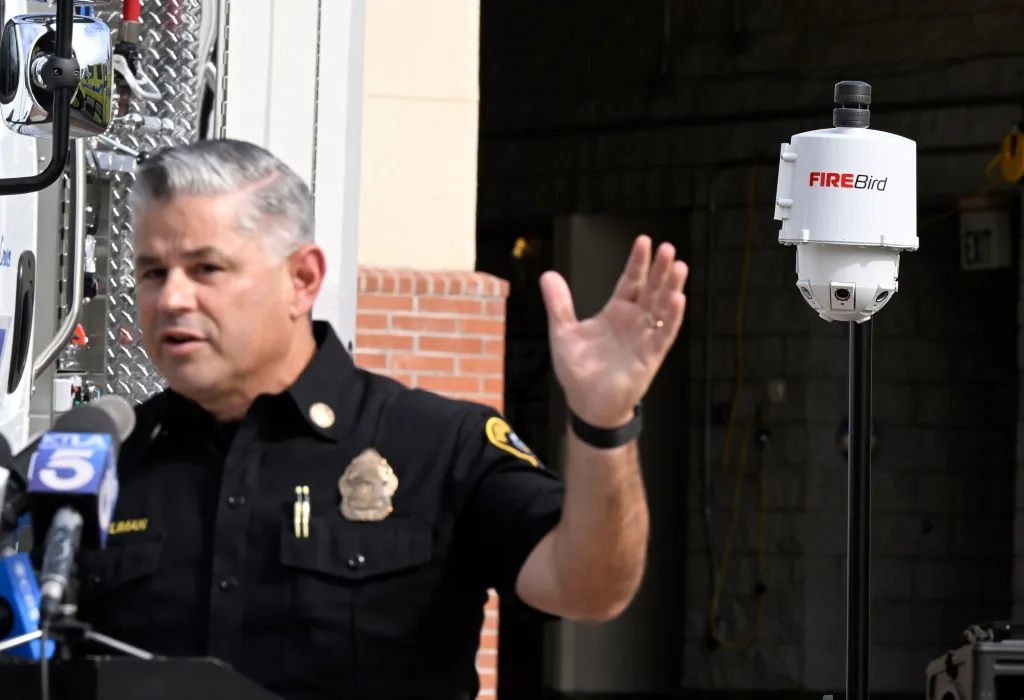
The Rancho Cucamonga Fire District on Monday, July 20, launched an AI-assisted system that officials say can detect small brush fires 100 yards away and deliver pictures of the flames, their location and even a weather report in three seconds to public safety dispatchers.
Read more Why moths are very valuable as pollinators in our area
Mike McCliman, fire chief in the city of 177,000 residents, said FIREBird will help firefighters shave crucial moments off responses to wildfires that can quickly be launched out of control by strong winds.
“Every minute counts,” McCliman said at a news conference at the Banyan Street fire station. “Our biggest concern is the Santa Ana winds that come right out of the Cajon Pass. They usually blow from east to west, and depending on the type and the direction, the fire could burn down into the city or burn directly across the city.”
Azusa-based Lindsey FireSense, which provides equipment to electric utilities, has been developing the device since 2019, CEO Jack McCall said. Firefighters in Rancho Cucamonga, San Bernardino County and elsewhere tested prototypes, and, after several months of installation, the 30 systems placed in what McCliman called the Front Country at the base of the San Gabriel Mountains went live on Monday.
McCall said Rancho Cucamonga is the first in the state to deploy FIREBird.
“I live in Rancho Cucamonga myself,” he said. “I feel very fortunate that the system is here, and I know that if there is a fire that’s going to break out, there is nothing that is going to report it more quickly than this system. I’m putting my own house at risk with the system, as well.”
The solar-powered devices, which operate day and night, use a wildfire-specific thermal detector that looks for the wavelengths of heat that are most attributed to wildfires, McCall said. FIREBirds’ cameras have 360-degree views. The photos will help dispatchers confirm whether there is an actual fire. If so, they will immediately send a fire engine, battalion chief and investigator.
Battalion chiefs can view the photos on their phones, and firefighters en route can see the images as well on their tablets and call for more equipment if needed.
Read more World Cup winners and losers: A look back at summer’s soccer spectacle
“We can detect fires as small as 3-by-3 feet out to past the distance of a football field, and somewhat larger fires out to probably half a mile or more,” McCall said. “It works really well.”
The sensors are affixed to utility poles, Southern California Edison towers and other poles, about 20 to 60 feet high. Their range overlaps to assure optimal coverage, McCliman said. Deputy Fire Chief of Operations Augie Barreda headed up the deployment.
Fire District officials asked the City Council to approve pursuing the system. Mayor L. Dennis Michael credited Assemblyman Chris Holden, who represented the northern portion of the city and who was chairman of the Appropriations Committee before terming out in 2024, with securing a $1.9 million grant from the state. It paid for equipment, engineering, permitting, installation fees, maintenance, communications and other expenses.
“We are making meaningful investments that help protect lives, homes, businesses, and our community’s future,” Michael said.
McCliman has been in the fire service for 27 years and, like many other chiefs, embraces technological advances. He said Rancho Cucamonga was the second department in North America to acquire an electric fire engine and the first with a HeloPod, a 3,700-gallon tank that firefighting helicopters can dip into.
“Rancho Cucamonga is not shy to be an innovator on anything,” the chief said. “For us, this is just the norm.”
Read more Mount Olympus, home of the ancient Greek gods, vies for World Heritage status