
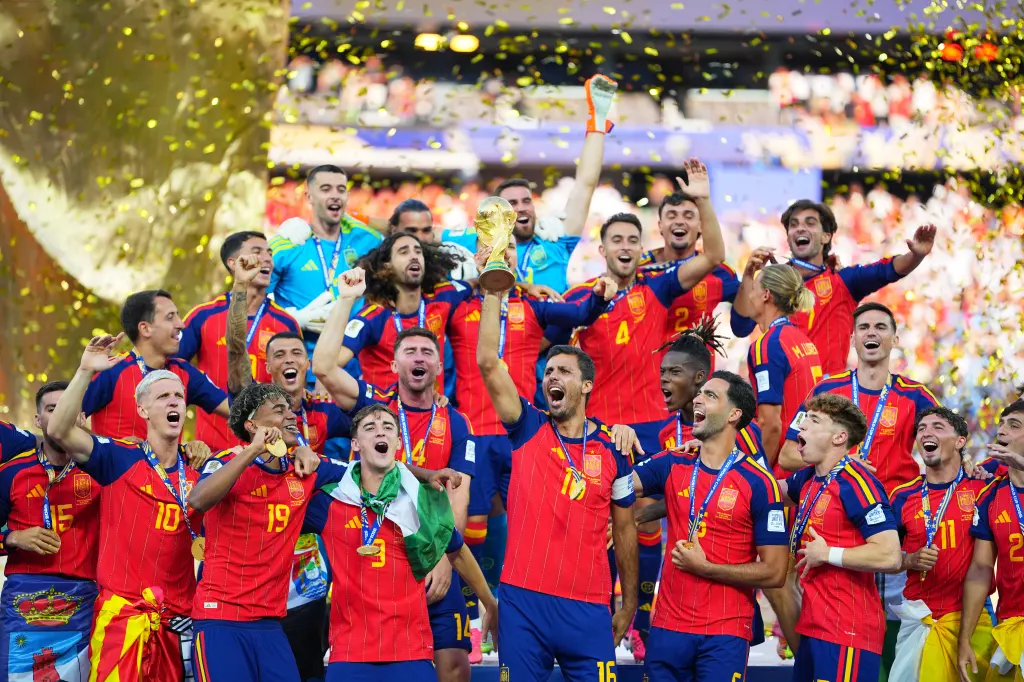
EAST RUTHERFORD, N.J. — Soccer withdrawal officially began Monday morning, with the realization that after a record 104 matches in 39 days, the largest World Cup in history is over.
Read more Mount Olympus, home of the ancient Greek gods, vies for World Heritage status
No more imperious Spanish passing sequences.
No more studs-up Argentine tackles.
No more Messi.
No more Ronaldo.
No more Viking rows.
No more Cape Verde magic.
No more hydration breaks.
No more VAR reviews.
No more, thankfully, Gianni Infantino and Alexi Lalas.
Here’s a look at winners and losers over the past seven-plus weeks in 16 venues in three countries:
Winner: FIFA
If the overarching goal was to make money in the planet’s epicenter of capitalism, it was insanely successful. The total take from Qatar four years ago was $7.6 billion. The expanded 48-team tournament in the United States, Canada and Mexico is expected to reap $13 billion, up from initial projections of $11 billion.
The additional teams significantly diluted the quality of soccer as well as the usual first-round drama, but fans didn’t seem to mind.
There’s even more money to come. The television ratings were astronomical, in no small part because Lionel Messi reached the final, and FIFA has hinted it will soon open rights negotiations for the next two men’s World Cups. And President Gianni Infantino has hinted that he’s open to expanding the tournament to 64 teams.
Loser: FIFA
If you didn’t already think FIFA is a greedy, corrupt, morally bankrupt organization, you probably do now.
It was bad enough that Infantino awarded President Donald J. Trump the inaugural FIFA Peace Prize at the draw in December only for Trump to bomb one of the World Cup entrants a few months later. Then a red-card suspension against U.S. forward Folarin Balogun was magically erased the day before the round of 16 clash against Belgium after Trump phoned his pal Infantino to see if he could do anything about it.
Infantino insisted the decision came from an independent, 18-member disciplinary committee — except reports emerged that the committee chair, Mohammad al-Kamali from the United Arab Emirates, unilaterally lifted Balogun’s ban without consulting the other 17.
Then Argentine players unfurled a Falkland Islands banner on the field after beating England in direct violation of FIFA’s prohibition of political statements, an offense that in the past brought an immediate two-match ban. FIFA coughed and looked the other way.
And you wonder why an alarming number of people thought the tournament was rigged for Messi and Argentina, the cash cow, to advance.
Winner: Spain
No one has gone back-to-back in the men’s World Cup since Brazil in 1958 and 1962. But Spain clearly sits on the sport’s throne and might for a while, with a coach, a roster and a system that seem eminently repeatable.
You could argue, in fact, that this Spain team wasn’t as potent as the one that won the 2024 European Championships with a healthy Nico Williams providing a counterbalance on the left wing to Lamine Yamal on the right. If La Roja develops a clinical finisher like Kylian Mbappe or Erling Haaland, watch out. And remember, Spain hosts the next World Cup with Portugal and Morocco.
We’re not just talking about the men, either. On Sunday, Spain became the only nation in history to be reigning men’s and women’s champion, and the women will enter the 2027 World Cup next summer in Brazil as favorites.
Loser: Argentina
It took a while, but through the haze of dramatic comebacks and Messi’s wizardry, people finally saw La Albiceleste’s true colors. They weren’t white and sky blue but shades of the dark arts.
There were the incessant challenges that, as Spain defender Amyeric Laporte put it, “leave a mark on their opponents” and that went largely unpunished throughout the tournament.
There was Enzo Fernandez’s second yellow card for a violent tackle in the waning minutes of regulation Sunday that changed the match and sealed Argentina’s fate.
And then there was what happened after the final whistle, when several Argentine players instigated in street-thug skirmishes.
Spain took the high road and formed a guard of honor for the Argentines to walk through on their way to receive their runner-up medals. That was reciprocated with the Argentines turning their back en masse on the Spaniards as they lifted the trophy in a final act of classless defiance.
Winner: New rules
The focus was on increasing the pace of play, awarding the other team a corner kick if a goal kick wasn’t taken in timely fashion, forcing players who receive on-field medical attention to wait one minute on the sideline before re-entering.
Both worked. According to FIFA’s Technical Study Group, goal kicks that took more than 30 seconds went from 25% in 2022 to 12% in 2026. Incidents of players lying on the field requesting medical attention were reduced by more than one-third.
Loser: Hydration and halftime
Whatever benefits those rules provided were erased by the three-minute hydration breaks midway through each half, whether or not the game was played outdoors in torrid heat or indoors in a climate-controlled dome. And Sunday’s 27-minute halftime show further interrupted the rhythm of an already disjointed match.
Both, though, are probably here to stay. The hydration breaks merely increase the broadcast rights fees with more commercial slots to sell, and the halftime show massages Infantino’s ego.
Winner: Cape Verde
The African island nation of 530,000 was the only team Spain couldn’t beat, tying the eventual champions 0-0 in the opener behind 40-year-old goalkeeper Vozinha, and later took Argentina deep into stoppage time with arguably the goal of the tournament by Sidny Lopes Cabral.
Read more Police seek people responsible for break-in at Eagles’ running back Saquon Barkley’s home
Along for the ride was San Diego FC goalkeeper CJ dos Santos, who served as Vozinha’s deputy.
“It’s still kind of hard to believe that it happened, especially the way that it did,” dos Santos said. “We started out the tournament with 500,000 in the country rooting for us, and then it turned out to be maybe even billions around the world.”
Loser: Brazil
The five-time champions with accomplished Italian coach Carlo Ancelotti crashed out in the round of 16 against Norway, their earliest exit in 36 years. And they probably deserved to go out even earlier, needing a late goal to beat Japan in the round of 32 after being outplayed most of the match.
Neymar, once their enchanting talisman, cut a pathetic image, talking trash to Norwegian players as he took a meaningless penalty kick late in stoppage time and getting a yellow card, then busting into tears at the final whistle.
Wrote Globoesporte’s Cahe Mota of Ancelotti’s curious decision to bunker and counterattack against Norway: “The Selecao bet big on a style that does not match its tradition and they did not know how to be lethal when they had chances. You can’t even regret it. You can’t say there was injustice.”
Winner: Rebecca Lowe
General sports fans learned what folks waking up early to watch NBC’s Premier League telecasts have known for years: Rebecca Lowe is the best studio host in U.S. sports.
Fox “borrowed” her for the World Cup, which proved to be a wise decision. So was adding France’s Thierry Henry, whose sophisticated and insightful commentary added to the coverage.
Loser: Alexi Lalas
The former U.S. national team defender was as out of his depth with Henry and Zlatan Ibrahimovic in the studio as he would have been on the field, as they constantly reminded him.
Aaron Timms of England’s Guardian newspaper penned a particularly unforgiving takedown, writing: “For Fox to turn a man as partisan, bullying and unlikeable as Lalas into American soccer’s figurehead is the media equivalent of getting John Wayne Gacy to perform at a children’s birthday party.”
Winner: Europe
For all the cries that the Old Continent is losing its touch with the beautiful game, six of the eight quarterfinalists were European — seven if you count Morocco, which lies eight miles from Spain and features a roster largely of European-born players. The lone exception was Argentina, which had Messi and, conspiracy theorists will tell you, the might of FIFA behind it.
And Europe did this with four-time champion Italy failing to qualify, Germany and the Netherlands crashing out in the round of 32, and a promising Turkish side hitting a goal drought at the wrong time in group play.
Loser: Everyone else
Aside from Argentina, it was a rough World Cup for the other five continental confederations.
Concacaf couldn’t get anyone past the round of 16 despite home-field advantage and, in the case of Mexico, home-elevation advantage. Africa got nine of 10 entrants into the knockout stage, then watched seven lose in the round of 32 — several after surrendering late leads. South America had the disappointments of past champions Brazil and Uruguay.
Then there was Asia, which had only two of its nine entrants — Japan and Australia —survive group play, and no one reach the round of 16. They won only three of 27 group matches, and five teams finished bottom of their groups.
Winner: Erling Haaland
The Norwegian forward scored seven goals in five World Cup matches, but it was what he did off the field that endeared him to fans globally and helped soften his image as a bull-in-china-shop striker.
He got off the plane in Oslo after returning from the States carrying a stuffed raccoon that holding an empty wild berry gin bottle. He purchased it at Wild Bill’s Western Store in Dallas, along with snakeskin boots and a personalized cowboy hat with his jersey number.
Haaland later posted a video of himself shirtless hitting biodegradable golf balls from the deck of a yacht while listening to country music. Needless to say, his Instagram followers have skyrocketed.
Loser: Cristiano Ronaldo
The 41-year-old Portuguese superstar scored twice in a 5-0 win against, yes, Uzbekistan and declared, “I’m back.” He became the first player to score at six World Cups, a notable achievement, but it was overshadowed by Messi’s magical tournament — eight goals, four assists, a run to the final — and his team’s own underachievement.
One of Europe’s most talented rosters blew its chance at a deep run when it failed to win its group and was dumped into the more difficult side of the bracket, ultimately exiting in the round of 16 against Spain. And it would have been earlier had it not been for a controversial VAR decision that negated a late Croatian goal in the round of 32.
Winner: United States
For all the fears of empty stadiums, transportation nightmares, visa snafus, inclement weather, urban crime and ugly Americanism, the country turned out to be pretty darn good hosts. It was a fair cultural exchange: Foreign fans discovered ranch dressing, and Americans learned about Norway’s Viking row.
It took 32 years for the World Cup to return here. It won’t take another 32.
Loser: U.S. national team
What started with so much promise and galvanized a national sporting public that often is indifferent to soccer ended in shambles, once again, with an ugly 4-1 defeat against Belgium that smacked of karma after the Balogun red-card shenanigans. The men’s national team, alas, made no further progress than it did the last time the World Cup was here, in 1994.
Read more 2 more convictions thrown out in 2020 plot to kidnap Michigan governor
The question now becomes whether the sport as a whole continues to grow.