
Federal investigators remain tightlipped about the raids conducted across Southern California last week, but experts and local politicians are drawing parallels between this latest probe and ongoing efforts by federal authorities to curb Chinese government influence in the region.
The FBI has not disclosed the focus of the investigation, and court records remain sealed. No one has been charged.
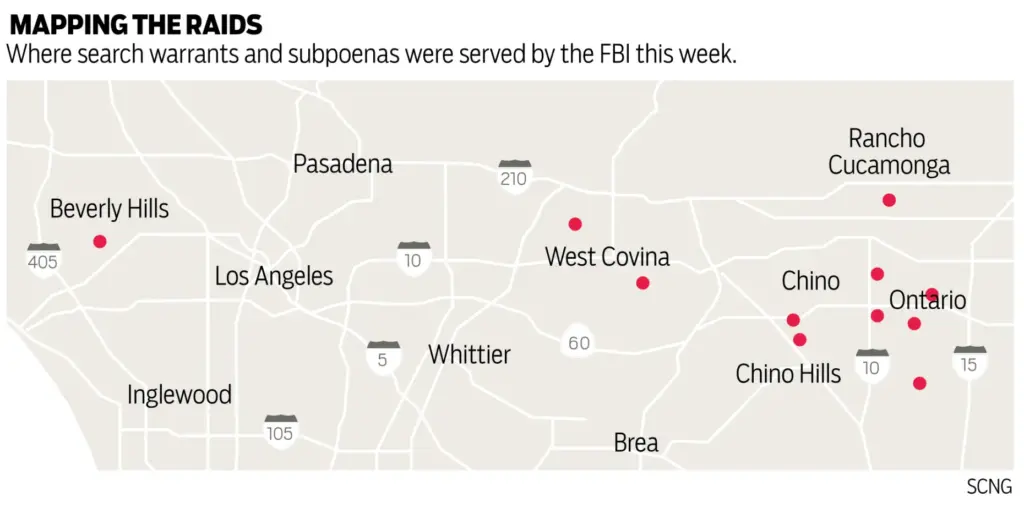
The raids targeted homes and offices across Southern California, including properties tied to Ontario Councilmember Alan Wapner, San Bernardino County Supervisor Curt Hagman, attorney Frank Lizarraga, Parkcrest Construction and James Su, the founder and president of EDI Media Inc., which bills itself as the largest Chinese-American multimedia company in the U.S.
None of those identified in the probe has returned calls to comment.
A federal grand jury has been convened for the investigation and subpoenas issued at the Ontario International Airport and Ontario City Hall. Wapner and Hagman serve on the airport authority.
Audrye Wong, a senior fellow at the American Enterprise Institute who researches Chinese foreign influence operations, said that while she could not comment specifically on the San Bernardino County investigation, cases involving local elected officials, business leaders and individuals connected to Chinese state-linked organizations fit a broader pattern that federal authorities have increasingly scrutinized in recent years. Recent examples include include investigations involving former Arcadia Mayor Eileen Wang and allegations surrounding efforts to promote Chinese electric bus manufacturer BYD in Lancaster.
“I would say this is probably a case of some local corruption or illicit wrongdoing by these local officials, with a dose of opportunistic foreign influence,” Wong said, emphasizing she was speaking generally. “It’s also a story of local politicians and their interests and sometimes how foreign actors like China try to tap into those interests as an avenue for foreign influence.”
Su was previously forced to register as and was part of a 2015 Reuters investigation that alleged a subsidiary of the state-run Chinese Radio International controlled a majority stake in his radio company, G&E Studio.
At the time, Su told Reuters he complies with all U.S. laws and that he is a businessman, not an agent for China.
Su’s attorney, Andrew Cowan, did not respond to a request for comment on Friday. The Federal Communications Commission and the Justice Department investigated G&E in response to Reuters’ reporting, but the probe did not result in criminal prosecution.
Wong pointed to Su’s publicly documented ties to Chinese state media and organizations connected to Beijing’s overseas influence efforts as a potential explanation for government scrutiny on his relationships with public officials.
“Clearly, he has very close documented links with Chinese state media, where he was basically operating as a foreign agent, trying to use his company to help disseminate Chinese propaganda in America,” said Wong, a former USC professor and author of the book “Subversion and Seduction: China’s Economic Statecraft.”
Su’s affiliations with organizations connected to China’s United Front system — a broad network of groups and institutions used by Beijing to advance its interests abroad — are relevant when examining potential influence efforts, she added.
Arcadia mayor’s downfall
In May, federal authorities charged Wang, then mayor of Arcadia, with one count of acting in the United States as an illegal agent of a foreign government. Wang, along with Yaoning “Mike” Sun, 65, of Chino Hills, operated the U.S. News Center, a website claiming to be a news source for local Chinese Americans.
From 2020 through 2022, Wang and Sun received and executed “directives” to post content on the website from government officials within the People’s Republic of China, according to her plea agreement.
As part of the deal, Wang admitted she did not notify the attorney general she was acting as an agent of the PRC and did not disclose on her website that some of the content had been posted at the direction of the Chinese government. She entered a guilty plea in May and is expected to be sentenced in October.
The investigation that led to Wang’s plea deal began years earlier and took down at least two others before reaching her.
Sun, Wang’s former fiancé and campaign manager, was sentenced to 48 months in prison in 2025. Their alleged handler, John Chen, a high-level member of the PRC’s intelligence apparatus, got 20 months in prison in 2024 for acting as an unregistered agent and bribery.
“Let this serve as a clear warning: Individuals who act on behalf of foreign governments to influence our democracy will be identified, investigated, and brought to justice,” said Assistant Director Roman Rozhavsky, of the FBI’s Counterintelligence and Espionage unit, in a statement announcing Wang’s charge.
Playing ‘the long game’
Dennis Craig Wilder, a professor at Georgetown University and former senior U.S. intelligence official, told the Southern California News Group in 2024 that propping up campaigns is a classic tactic used by the PRC.
“Some call it the thousand-grains-of-sand approach to intelligence activities and they do play the long game,” he said. “They are willing to invest the resources in operations targeting young politicians that may not pay off for decades.”
Wilder added that novice politicians often do not understand the espionage threat and, therefore, are relatively easy to manipulate into pro-China activities that appear on the surface to be benign. There could be hundreds of co-optees at the local levels seeking influence on behalf of the party, he said.
Pushing Chinese ‘messaging’
Su founded the West Covina-based EDI Media and is president of the Chinese-language publication iCity News. A defunct and undated portion of the EDI Media website, written in English, states the company serves the “development and continuation of the American and Chinese relations” and that it promotes “Chinese and American diplomatic relations through the economical, the cultural exchanges and collaborations.”
Wong described the publication’s content as “reflective of Chinese propaganda.”
“That media outlet certainly has close links to Chinese state media, and the coverage tends to follow similar lines of propaganda and messaging,” she said.
Su donated $1,000 to Wang’s first campaign for office in Arcadia in 2022. Her campaign paid his company about $2,600 for airtime, according to campaign finance records.
Articles on iCityNews effusively promoted Wang, a newcomer to politics, and dedicated little space to her opponent in that race, former Councilmember Sheng Chang, who is a Taiwanese immigrant.
Chang declined to comment when reached Friday, July 31.
Hagman similarly received positive coverage on the website. One article glowingly covered a reelection campaign rally sponsored by Chinese-American businesses and community organizations, with Su serving as a speaker.
Another focused on an economic forum attended by Hagman, Wang and members of the PRC consulate in 2025.
Su apparently has had ties with Hagman dating back at least a dozen years. The EDI Media’s website claims that as a state assemblymember, Hagman sponsored a resolution declaring Dec. 26, 2012, as “James Su Day” in California, but the existence of that resolution could not be verified.
In 2017, EDI Media hosted a photography exhibition promoting Shanghai at the Ontario International Airport. Su and his company donated $7,500 to Hagman between 2017 and this year, records showed.
Read more Cut the number of choices you make each day. Your brain will thank you
In a May op-ed piece for The National Interest, Wong cited Wang’s guilty plea and the conviction of Lu Jianwang for operating a covert Chinese police station in Brooklyn as examples of “Beijing’s wide-ranging influence activities down to the local levels of politics and the role of entrepreneurial hustlers that can be mobilized by the Chinese government.”
China’s foreign influence efforts operate through a broad network of legal, covert and community-based activities, requiring a coordinated U.S. response that targets illicit influence while protecting Chinese Americans from discrimination, Wong said.
Lancaster connection
In April, FBI agents carried out raids in Lancaster, targeting City Hall and councilmembers’ homes as part of a probe into the Chinese-backed BYD bus company’s operations in the city.
In an interview Thursday, July 30, Mayor R. Rex Parris said that a common theme between the FBI raids in Lancaster City Hall and councilmember homes in his high desert community and last week’s sweeps is the same: Chinese influence to get insider access to local projects in exchange for money and gifts.
“I don’t have any doubt that the Chinese government is exercising influence inappropriately,” said Parris, noting that BYD and other targets were mentioned in a warrant letter provided to him by another city official after the Lancaster raids — though he declined to identify them. A warrant letter is a legal notification of a prearrest warning.
No one has been charged in the Lancaster probe either.
“If somebody took some money, they shouldn’t have, they need to be held accountable. If the Chinese are doing something in Lancaster, I want them to investigate,” Parris said. “But they build buses, for heaven’s sakes. We’ve got a huge factory here. They should look, but I don’t think they should destroy people’s reputations.”
In an interview Friday, U.S. Rep. Norma Torres, D-Pomona, said she received a heads-up about the more recent raids in San Bernardino County from the FBI, but she has yet to request a full briefing. She was unable to address whether the raids had any ties to influence from China and cautioned against opining until more details are available.
“I think the FBI is still gathering data, and now that they have been able to go out and serve the interested parties with warrants, I hope to be able to get the full information out of the FBI,” Torres said.
Mystery link in Beverly Hills
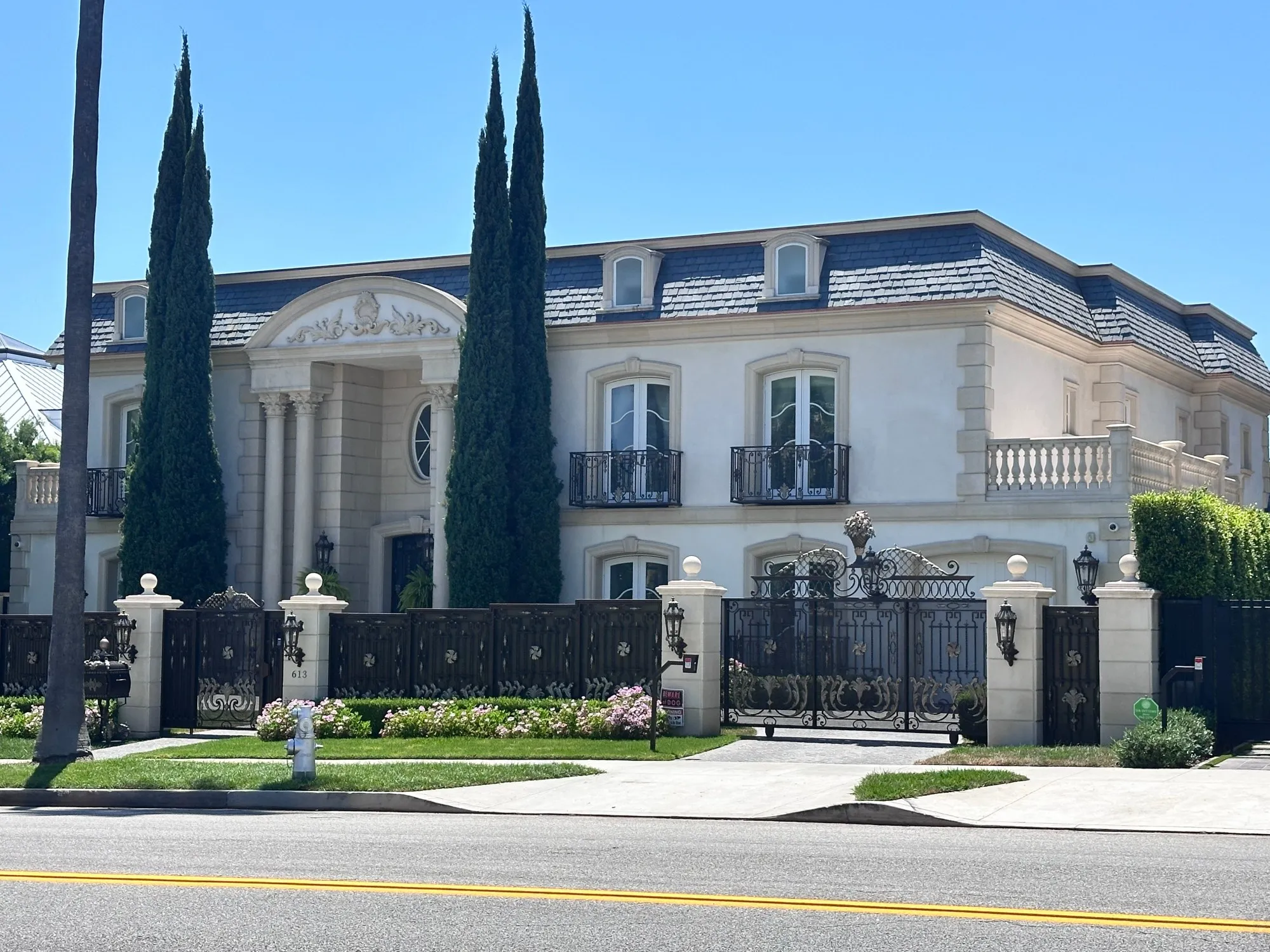
The FBI’s searches included a Beverly Hills mansion with no clear ties to the other parties. The home, once owned by a prominent member of the Barzani family in Kurdistan, was reportedly sold to a family from mainland China for $24.6 million in 2023, according to TradedLA.
It remains unclear who lives on the property today, or why it was targeted.
Public records list the buyers as Rosy East Limited, a company based out of the British Virgin Islands, and Apollo Capital XI LLC. An individual named Tong Wu signed on behalf of both companies.
Apollo Capital XI later purchased a $9 million office building on Vineyard Avenue in Ontario called the “Ontario Airport Center Executive Suites.”
The FBI did not carry out a search warrant at that location, according to a spokesperson. Records show Lizarraga previously had an office at that location and “Wapner for Mayor” was listed on the directory as of Friday.
Two women, one of whom appeared to be Wapner’s wife, answered the door Friday, but declined to comment before slamming the door shut. A portable speaker tied to the knob played white noise, muffling the sounds from inside the office.
The campaign office is located down the hall from “Apollo Investment Management LLC,” another company sharing the same ownership as the buyer of the Beverly Hills mansion.
Wu has registered a long list of LLCs in California that have bought up more than $50 million in properties across the country, including the $24.6 million mansion and a similarly priced ranch in the gated city of Rolling Hills. Public records listed other multimillion-dollar properties in Greenwich, New York City and Pasadena.
Campaign finance reports showed Wu, using addresses in New York and Connecticut, donated $580,000 to more than 75 Democrats and committees across the country in a roughly one-month period in 2022. One of the addresses used for the donations was associated with a U.S. branch of a Beijing-based art auction house.
That same year, Wu made a $100,000 donation to The Huntington in San Marino that helped sponsor eight performances of an opera about a Chinese American family’s immigrant experience in California.
Other companies registered by Wu appeared to be related to electric vehicles and aviation. Many obtained their California business licenses in the past year and used names that closely resembled more well known companies, without any apparent connections to those entities.
All of the companies used the same suite in the Vineyard Avenue office building as their mailing address. No one answered at Apollo’s office and Wu did not respond to a message left in English and Chinese.
Parkcrest Construction, one of the locations raided by the FBI, was granted a 30-year lease for 40 acres of vacant land at the Chino Airport by the San Bernardino County Board of Supervisors in August 2025, according to the Chino Champion newspaper. Founder Andrea “Andy” Sehremelis planned to use the land for a truck storage facility and electric vehicle charging station.
Hagman abstained from the vote because founder Sehremelis a month earlier had donated $1,000 to his campaign, the Champion reported. Hagman said at the time that he would return the money.
Campaign finance records show Sehremelis donated $11,400 to Hagman from 2018 to 2024. He also gave $20,500 to Wapner’s campaign from 2022 to 2025, according to records.
Contracts an enticing target
Wong said local governments have become an enticing target for foreign actors because local officials oversee major infrastructure projects, award public contracts and often prioritize economic development over national security considerations.
“If these local officials see China as a really important economic partner that can bring in manufacturing jobs and help build important infrastructure, that in turn can make these officials more predisposed to echoing certain talking points or policy positions that the CCP likes to push,” she said.
Transportation hubs such as airports warrant particular attention because they rely on complex supply chains, technology systems and logistics networks that can be vulnerable if foreign governments gain influence over critical infrastructure, Wong said.
She said foreign actors could potentially use relationships involving airports to gather information about regional transportation operations and logistics systems. Wong also noted concerns at the federal level about reliance on Chinese-made technology and suppliers, saying software or other components provided by Chinese companies could create potential vulnerabilities that might be exploited during a geopolitical conflict.
“It’s about information gathering, potential coercion and potential espionage,” she said.
Read more Teagan O’Dell places third in 200 IM at U.S. swimming nationals in Irvine
Staff Writers Jeff Horseman and Tony Saavedra contributed to this article.