
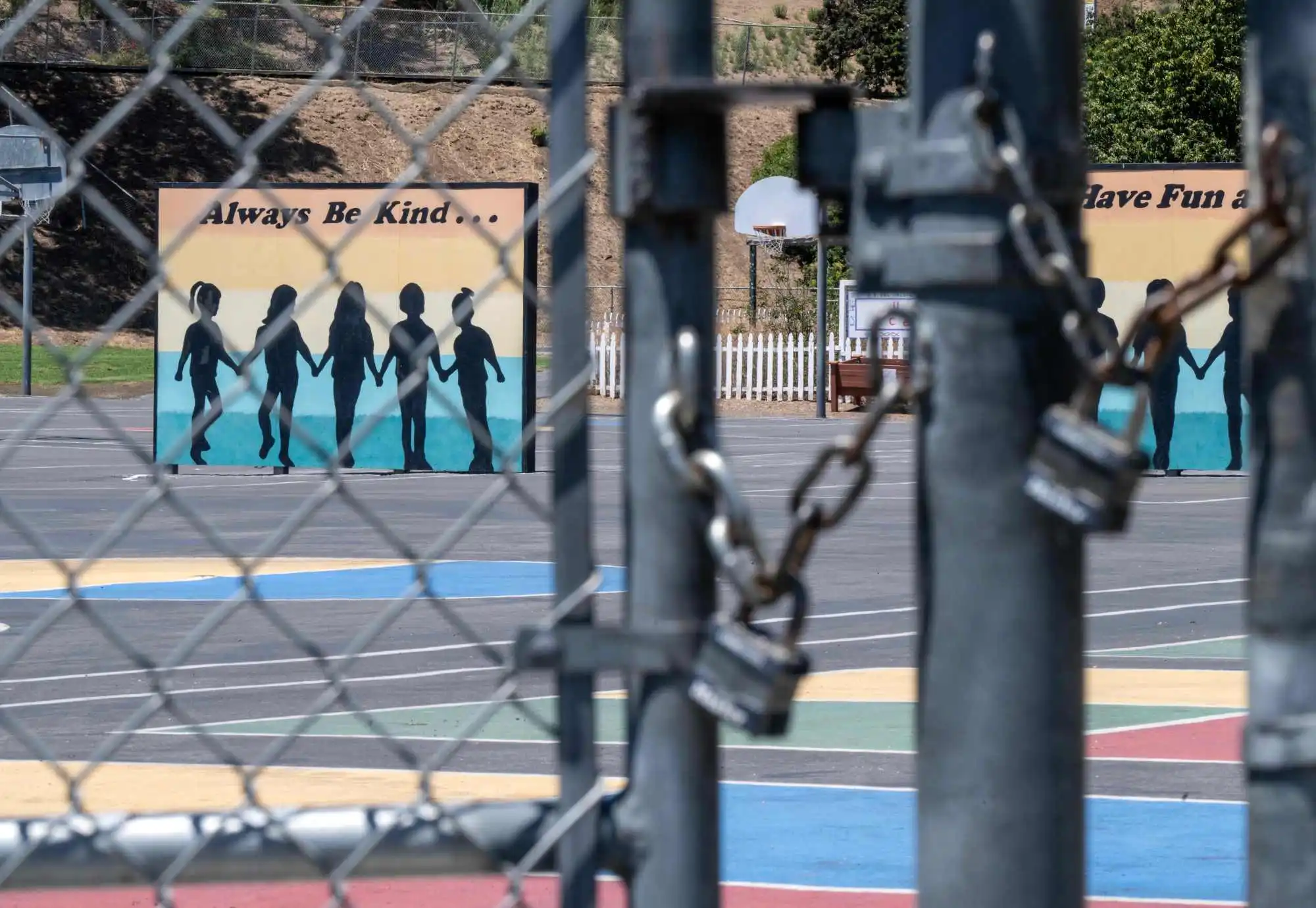
Students returning to school may not have noticed it.
As the years pass, they hang out with the same friends or play on the same sports teams. But something’s been changing.
Read more Cut the number of choices you make each day. Your brain will thank you
There are fewer students.
While charter school enrollment in the 2025-26 school year across California has increased by nearly 27% compared to the 2015-16 school year, the total number of students enrolled in non-charter public schools has decreased by more than 11% statewide since the 2015-16 school year, according to data from the California Department of Education.
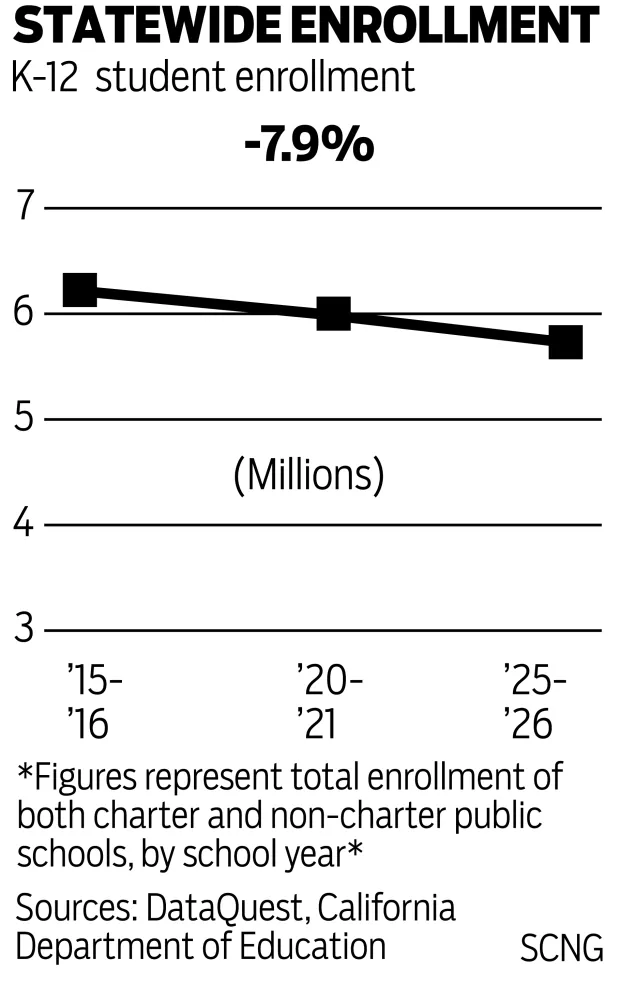
Combined, there were nearly 8% fewer students who attended all California public schools at the start of last school year (the most recently available data) than there were a decade prior. That’s a drop of almost half a million pupils.
This is a trend seen across the U.S.
K-12 enrollment nationwide has dropped by at least 1.4 million students since pre-pandemic highs in the 2019 school year, according to the most recent stats available from the National Center for Education Statistics, a federal government agency that collects and analyzes education data.
This is especially prevalent in Orange and Los Angeles counties, where declining enrollment has outpaced the statewide average. Compared to 2015-16, the most recent school year in each county has seen enrollment drop by over 14% and 18%, respectively.
And while the Inland Empire has fared better, the Department of Education’s data shows there are nearly 24,000 fewer students enrolled in schools across San Bernardino and Riverside counties. In Riverside County, enrollment has dropped by about 2.1%, while the student body in San Bernardino County schools has dropped by nearly 3.6%
But it varies by district, too.
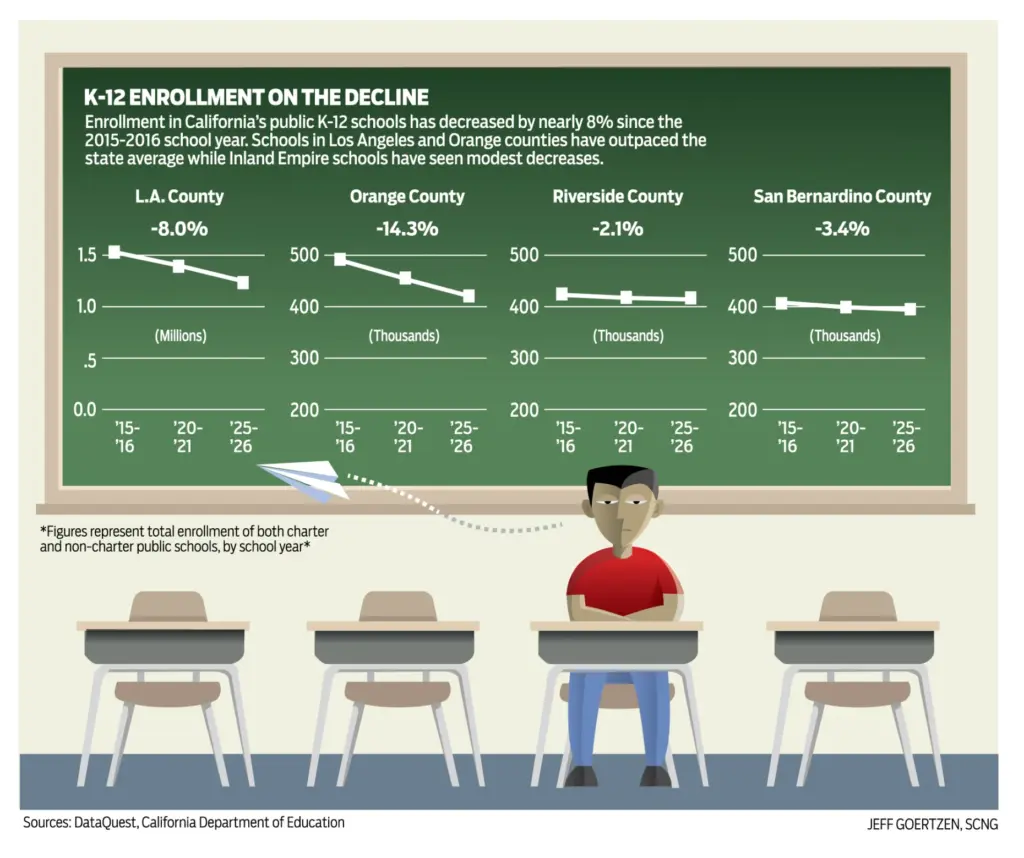
In Orange County’s Santa Ana Unified School District, for example, enrollment has decreased by more than 35% over the past 10 years, significantly outpacing the county average, while Irvine Unified has actually seen enrollment increase by nearly 19% since the 2015-16 school year.
Though some school districts are faring better than others, external factors outside of a district’s control — how many children are born, the number of homes being built, natural disasters or federal immigration policy, to name a few — have exacerbated declining enrollment across Southern California.
This has put an ever-increasing amount of pressure on the administrators and decision-makers in these districts, charged with providing the best levels of education possible, while balancing budgets and limiting school closures.
California is in the midst of a ‘baby bust’
Sure, students transferring to charter or private institutions have contributed to the decline of enrollment in traditional public schools. But the primary contributing factor is actually a declining birth rate.
Birth rate is measured by the total number of childbirths per 1,000 people, over a specific period of time.
Generally, a population needs to have about 2.1 children born per woman to keep a population from declining, often called the replacement level.
California, according to a May report from the Public Policy Institute of California, is in the midst of a “baby bust”: The state’s total fertility rate has dropped from 2.21 children per woman in 2007 to 1.48 in 2023.
And while California’s falling birth rate is largely driven by a drop in teen birth rates — which have cratered by 86% since 1991 — this issue, like declining enrollment, is not specific to the Golden State. Birth rates have fallen in all states since 2008, according to the PPIC report, though California’s decline “is slightly greater than the national average.”
But the falling teen birth rate is not the only reason for the overall birth rate’s decline, says Paul Hanselman, associate professor of sociology and director of UC Irvine’s Demographic and Social Analysis program.
“The big pattern is the Great Recession,” said Hanselman.
Peak birth rates were seen around 2008, Hanselman said, but have been declining since.
“There’s a lot of explanations, but economic explanations in terms of challenges of having kids is a big part of the story, and it doesn’t feel like we’ve gone back,” he said.
When looking at enrollment data, a good indication of the declining birth rate can be seen in the number of first graders that begin school in a district each year, Hanselman said. That’s a better indicator than kindergarten, he said, since it’s fairly common for parents to choose a non-traditional public school for their kids for that year.
For example, within the Los Angeles Unified School District — California’s largest district in terms of number of students enrolled — 7.6% of the district’s 2015-16 student body were first graders. But in the most recent school year, just 6.7% of students enrolled across the district were entering the first grade.
Overall, Los Angeles Unified had 140,000 fewer students enrolled in schools this most recent academic year compared to a decade ago.
Over in Orange County, Garden Grove Unified also pegs declining birth rates as the No. 1 factor for its decrease in enrollment over the past 10 school years, said Gabriela Mafi, the district’s superintendent. There, enrollment has dropped by more than 20%.
“It’s not a new problem,” Mafi said.
Mafi first started as a principal within Garden Grove Unified in 2002 and took over as superintendent of the district 11 years later. She said total enrollment had only dropped by about 4,000 students over that period.
Fast-forward another 11 years, and total enrollment dropped about 10,000 by the time the 2024-25 school year began. That’s when the impacts of the declining birth rate really became noticeable, she said.
The trend continues over in Torrance Unified School District, where enrollment has dropped by nearly 8% in the most recent school year compared to 10 years ago.
Last school year, 5.8% of Torrance’s student body were kindergartners and 8.9% were seniors. Back up a decade, and kindergartners represented 7.6% of the student body, while seniors made up 9.2%.
Finances play a role in enrollment, too
Julie Van Winkle, a longtime Los Angeles Unified teacher who now serves as vice president of United Teachers Los Angeles, said she has seen families she taught leave Los Angeles for areas where they found housing more affordable, including the Inland Empire and Antelope Valley.
“The cost of living is a real thing,” Van Winkle said.
And that’s true for teachers, too. David Goldberg, president of the California Teachers Association union, said a recent survey of their 300,000+ members across the state found that roughly 80% of them can’t live where they work.
Mafi, of Garden Grove Unified, said the lack of affordable housing has exacerbated the ongoing enrollment issue in her school district, too.
In the areas where Garden Grove Unified operates, she said, new homebuilding is not occurring. And while some new apartments and condos have been put up, she said, single-family homes are what “the majority of our district” lives in.
Read more Teagan O’Dell places third in 200 IM at U.S. swimming nationals in Irvine
Couple that with an aging population in the area, she said, and that means single-family homes are increasingly occupied by folks who are no longer raising children, and fewer new families are starting or moving into the area.
But another is the cost of living in Orange County, she said. Families may abandon Orange County for other places that are a bit cheaper to live, Mafi said.
But other areas and school districts are anomalies in the larger scope of enrollment.
Nearby Irvine Unified, for example, has actually seen enrollment increase by nearly 19% since 2015-16. Last school year, more than 38,400 students were enrolled across Irvine Unified campuses, the vast majority in non-charter schools.
Residential development in Irvine has boomed in recent years, and plans continue that push. Late last year, to cite just one example, the City Council completed a land swap with Great Park housing developer FivePoint so 1,300 market-rate homes can be built on 26 acres, and it also approved blueprints for the 81-acre Gateway Village project, which will accommodate 1,138 residential units.
Irvine has also added schools: Portola High School in 2016, and Solis Park School in 2022, to name just two.
Another outlier is Downey Unified, in southeast Los Angeles County: While enrollment decreased by a little over 3% from the 2014-15 to the 2017-18 school year, since then, it has increased by nearly 3%.
Though enrollment isn’t increasing nearly as much as Irvine Unified, Downey Unified is growing its student population despite a shrinking number of households with children. According to U.S. Census data, there were nearly 3,000 fewer households with one or more child in 2024, the most recent data available, than there were in 2017.
While some communities are aging and have fewer families moving in, therefore fewer children entering school, “others continue to add housing, attract new families or experience different local demographic patterns,” said Ian Hanigan, spokesperson for the Orange County Department of Education.
“Those differences can produce very different enrollment trends, even within the same county,” Hanigan said.
 Armstrong Elementary School in Diamond Bar, which will merge with another campus next school year, is seen Monday, July 27, 2026. (Photo by Terry Pierson, The Press-Enterprise/SCNG)
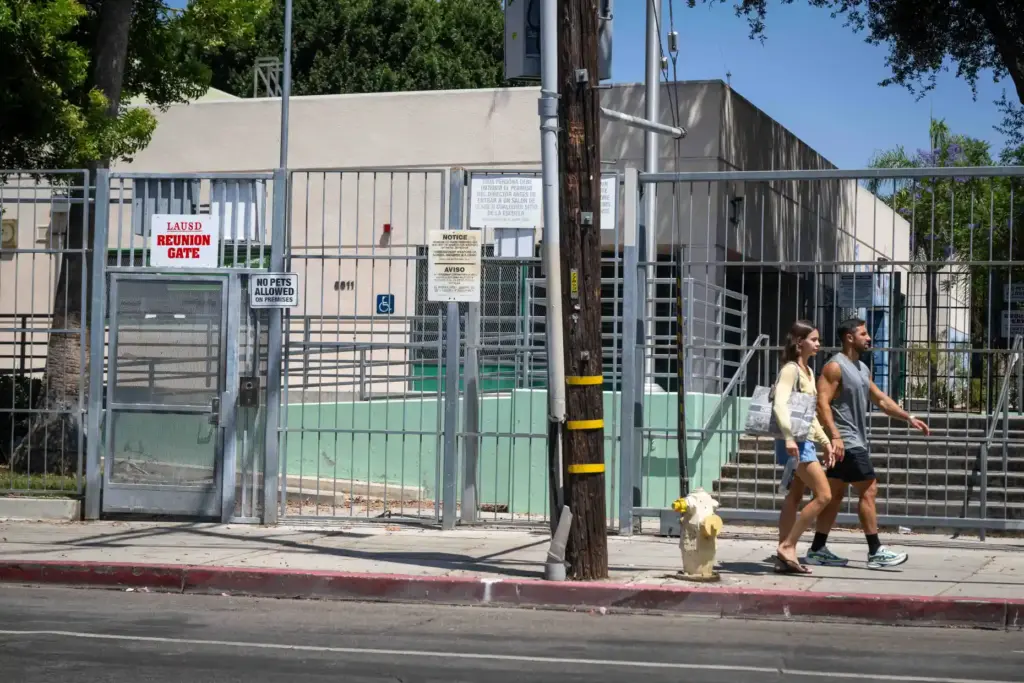 People walk past LAUSD’s Selma Elementary campus in Hollywood on Wednesday, July 29, 2026. The school opened in 1910 and served as a neighborhood school for more than a century before closing in 2021 due to declining enrollment. It was recently home to Larchmont Charter School. (Photo by Sarah Reingewirtz, Los Angeles Daily News/SCNG)
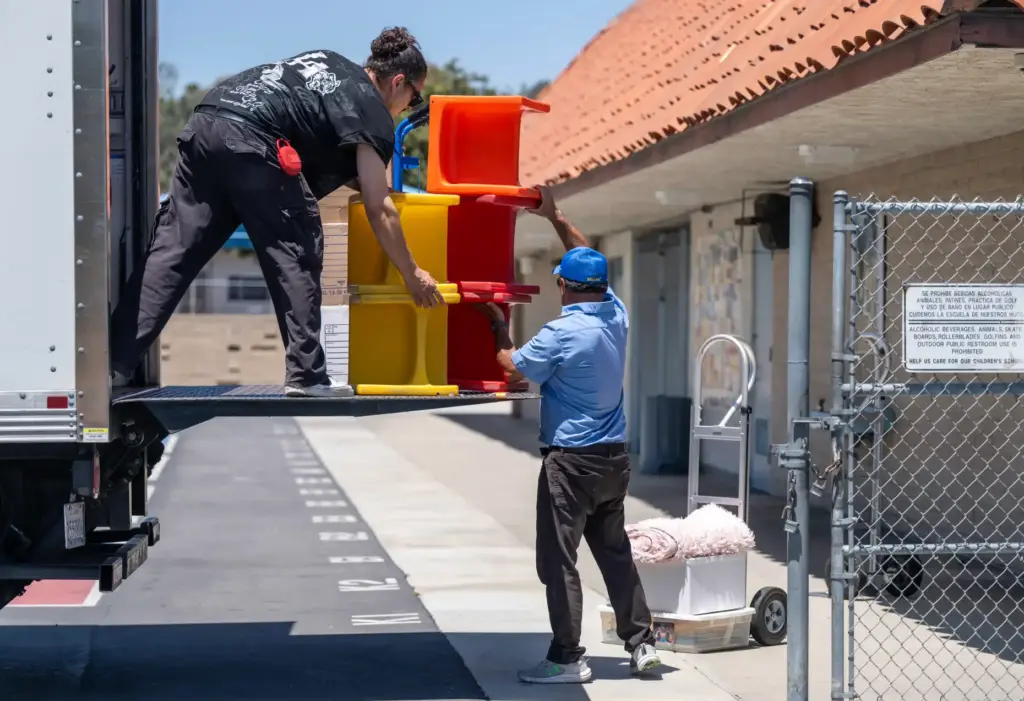 Custodial staff move age-appropriate furniture from a truck into a classroom at the former Del Obispo Elementary School campus, which will be transitioned into an early childhood center following a vote by the Capistrano Unified School District board, in San Juan Capistrano on Thursday, July 30, 2026. (Photo by Jeff Antenore, Orange County Register/SCNG)
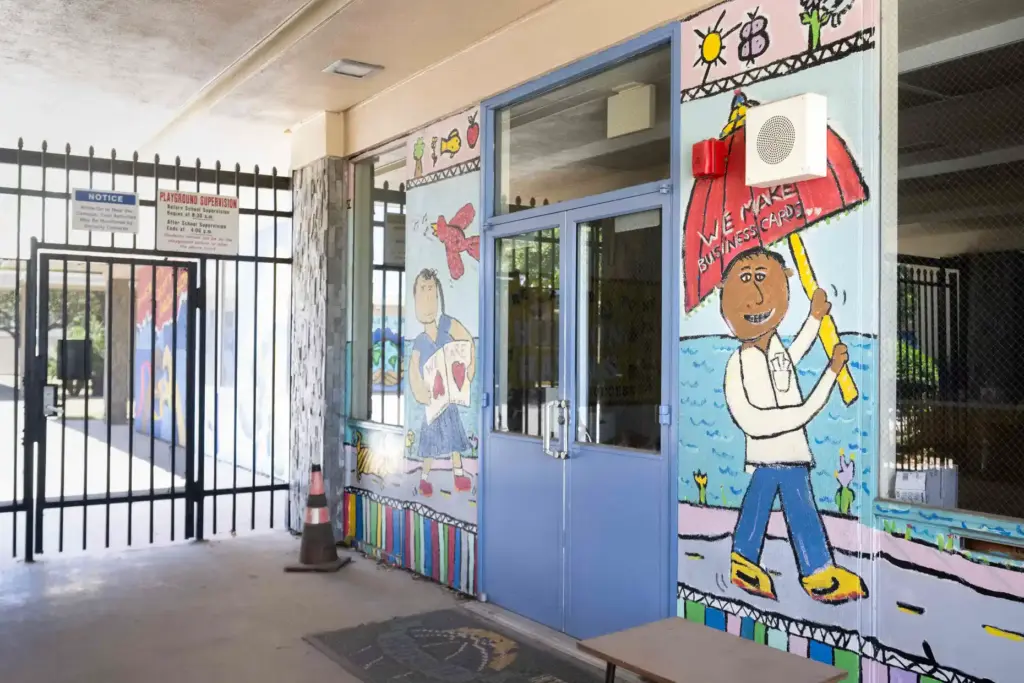 The exterior of Hudson Elementary School in Long Beach on Friday, July 31, 2026. The LBUSD Board of Education voted to close Hudson Elementary at the end of the 2024-25 academic school year, citing declining enrollment. (Photo by Drew A. Kelley, Press-Telegram/SCNG)
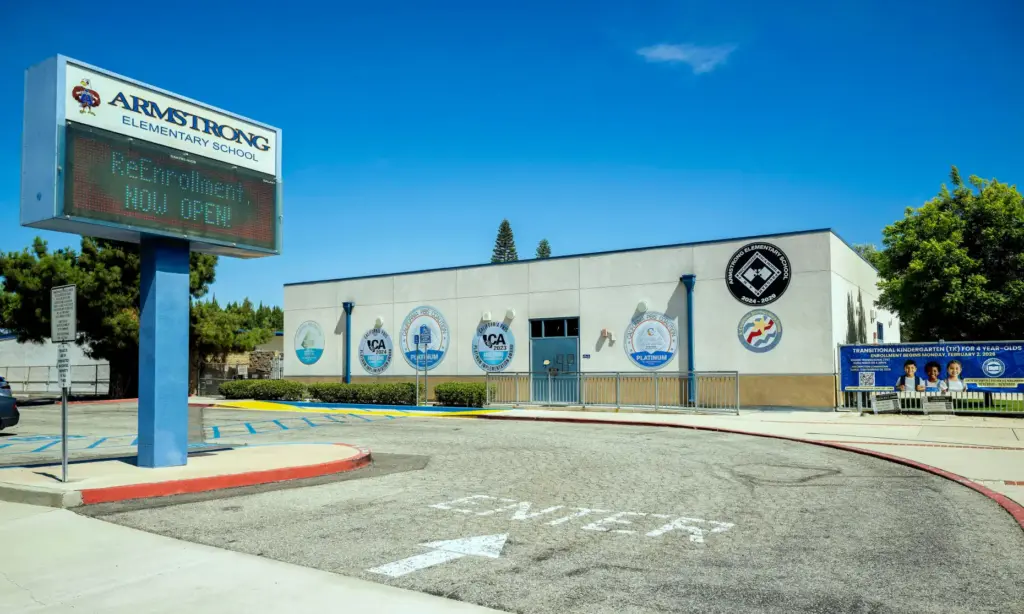 Armstrong Elementary School in Diamond Bar, which will merge with another campus next school year, is seen Monday, July 27, 2026. (Photo by Terry Pierson, The Press-Enterprise/SCNG)
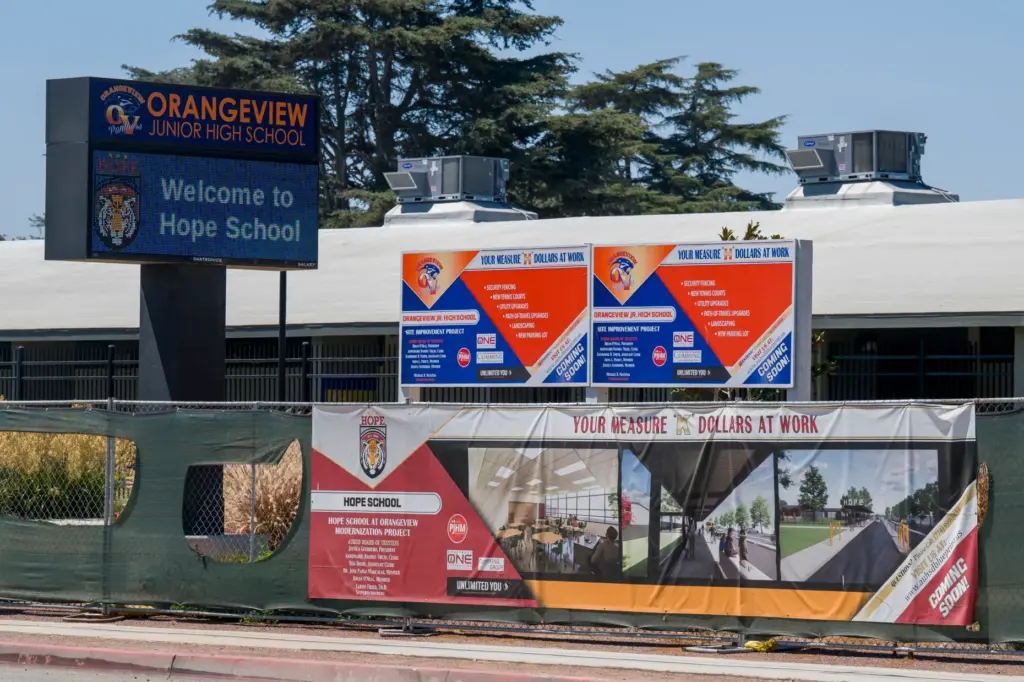 The former Orangeview Junior High School in Anaheim, on Thursday, July 30, 2026, is being renovated and will become Hope School, a special education school within AUHSD. (Photo by Leonard Ortiz, Orange County Register/SCNG)
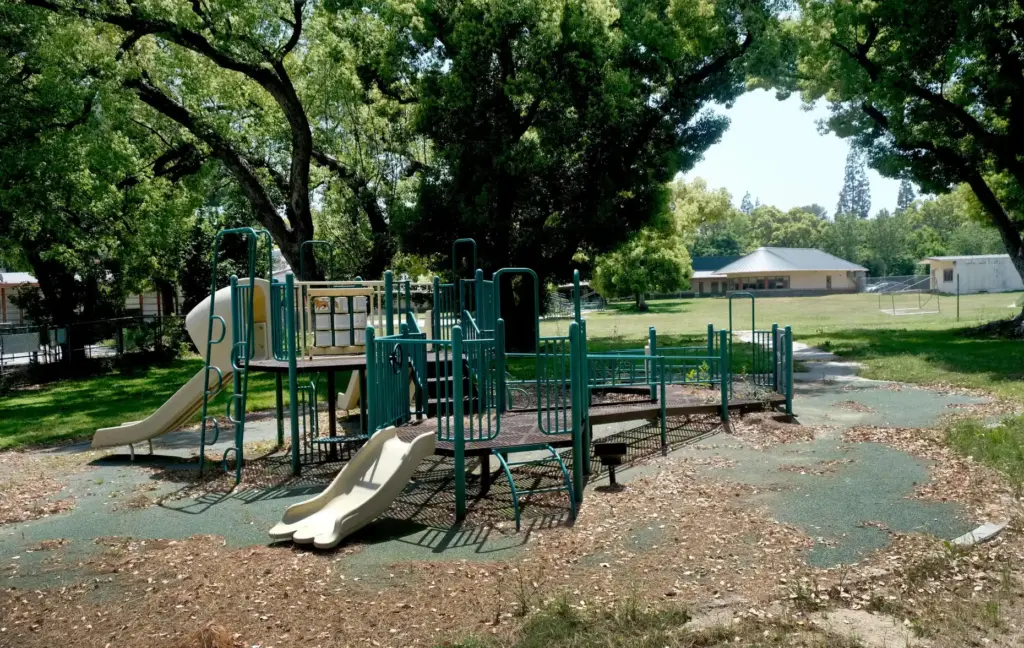 Site of the former Pasadena Unified School District’s, Roosevelt Elementary School, which closed in 2019. (Photo by Dean Musgrove, Los Angeles Daily News/SCNG)
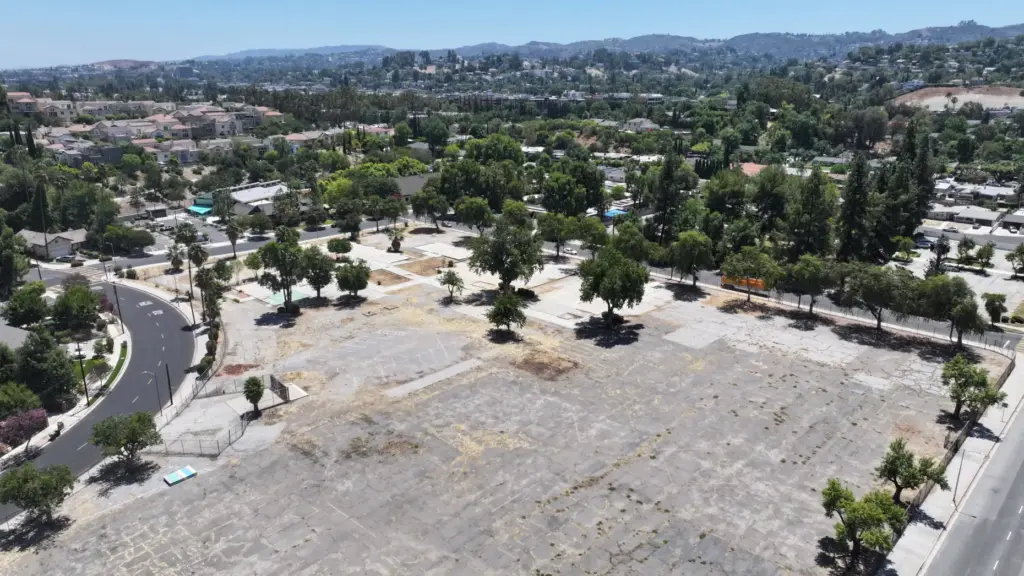 The site of the former LAUSD school, Collins Street Elementary, closed in June 2002 along Shoup Ave. in Woodland Hills. (The buildings were demolished in 2018. (Photo by Dean Musgrove, Los Angeles Daily News/SCNG)
Enrollment has a major impact on school funding
Districts and charter schools receive base grants based on the span of grades that the district or school serves, multiplied by the average daily attendance of its student body.
Since funding is based on attendance, lower enrollment means school districts receive less money from the state each year.
Hanigan, with the Orange County Department of Education, said this creates big challenges for schools since many of their operating costs — like maintaining campuses, transportation services and “core administrative functions” — don’t decline at the same pace enrollment does.
It leaves school districts with two options: reduce staffing levels or diminish their physical footprint, in terms of the number of schools they operate. Districts often try to choose the latter.
Since 2015, 630 public schools across the state have closed, according to a report called Getting Down to Facts, an independent review of the state’s PreK-12 system.
Ryan Burris, chief communications and public engagement officer for Capistrano Unified, said the district accounts for just three of those, one being Del Obispo Elementary, which closed at the end of this most recent school year and now houses an early childhood center. But he wouldn’t be surprised if Capistrano Unified closes another two or three schools in the next couple of years.
“Running small schools gets expensive, and when you’re funded the way we are … you’re basically just stretching dollars,” he said. “If we were funded at higher levels, that would be a lot less painful.”
Up north in the Anaheim Union High School District, the Orangeview Western School just finished its first year as a non-selective campus serving grades seven through 12. The new school model was created following the consolidation of Western High and Nearby Orangeview Junior High. The school board made the move in 2023, citing declining enrollment figures and financial challenges it had faced.
Orangeview Junior High’s now-vacated campus will soon house Hope School, the district’s only dedicated special needs school.
For Pasadena Unified, its decade of declining enrollment has been the driving force behind a $30 million structural deficit, which came to a head this past spring. For the 2015-16 school year, Pasadena Unified had 18,492 students enrolled. But 14,158 students were enrolled for the 2025-26 school year, according to California Department of Education data.
The district includes Altadena and Sierra Madre, communities still dealing with the catastrophic Eaton fire in January 2025. Five Pasadena Unified schools burned down in the disaster, with about 1,000 students and 120 employees losing their homes. But it’s the decade of declining enrollment that has led to financial troubles, district officials said.
Though the district’s Board of Education opted against moving forward with any closures or mergers, the $24.5 million in budget cuts it approved towards the end of last school year resulted in about 280 full-time positions being eliminated.
Pasadena Unified Board of Education Trustee Jennifer Hall Lee co-created an enrollment committee during her first term in office to look at the unique context of a district in “hyper competition” with private schools. She said programs like International Baccalaureate and dual language immersion are critical, so that the district offers “robust education for all parents” and can stand out in a crowded educational field.
And over in Long Beach Unified, school closures are also in the works. Hoover Middle School will be shuttered after this school year, its building to be repurposed to house a dual language immersion program for Keller and Stephens middle schools.
Pomona Unified, too, which has seen an 18% decline in enrollment over the past decade, is also turning to campus consolidation to create savings, said district spokesperson Ronald Lawrence. The school board voted earlier this year to consolidate Armstrong and Golden Springs elementary schools. Armstrong closed at the end of this most recent school year, and the shuttered campus was repurposed into an education center that now houses a districtwide learning enrichment program.
And Upland Unified, a K-12 district in San Bernardino County, approved moves to save the district $4 million in March by cutting spending in this upcoming school year, a decision made because of declining enrollment. The district looked at changes to staffing levels, as well as cuts to programs and administrative costs.
Over the past few years, Capistrano Unified has focused on closing small coastal schools, while building up new, larger ones more inland, said Burris. And while it’s a painful move for students, families and teachers, it’s a necessary measure, he said, as closing a school can net the district anywhere from $500,000 to $750,000 in savings.
“While it’s tough to close underenrolled schools and other things, it’s actually good in a lot of ways for students, in order to move them to programs that are more robust and comprehensive,” he said.
Read more Vancouver scores late goal to tie LAFC