
Going national
Here’s why August is a big month for our National Park Service in several ways.
Sunday, Aug. 9, 2026, Lassen Volcanic National Park will celebrate its 110-year anniversary.
Read more Man charged with arson in Spokane, Washington, told police he planned wildfire for weeks
Lassen Volcanic National Park was established in 1916, shortly after a series of highly publicized, dramatic volcanic eruptions of Lassen Peak in 1914 and 1915. Once established by Congress, Lassen is one of the oldest national parks in the United States.
The National Park Service is also celebrating 110 years this month. On August 25, 1916, President Woodrow Wilson signed the act creating the National Park Service, a new federal bureau in the Department of the Interior responsible for protecting the 35 national parks and monuments then managed by the department and those yet to be established. This “Organic Act” states that “the Service thus established shall promote and regulate the use of the Federal areas known as national parks, monuments and reservations. The National Park Service gradually built up capacity and expertise in park management and worked to promote the parks to the American public.
The first park
By the Act of March 1, 1872, Congress established Yellowstone National Park in the Territories of Montana and Wyoming “as a public park or pleasuring-ground for the benefit and enjoyment of the people” and placed it “under exclusive control of the Secretary of the Interior.”
Early protection
March 1, 1872 Yellowstone
March 3, 1875 Mackinac Island, Mich.
Sept. 25, 1890 Sequoia, Calif.
Oct. 25, 1890 Yosemite, Calif.
March 22, 1899 Mount Rainier, Wash.
May 22, 1902 Crater Lake, Oregon
Jan. 9, 1903 Wind Cave, S. Dakota
April 27, 1904 Sullys Hill, N. Dakota
June 29, 1906 Platt, Okla.
June 29, 1906 Mesa Verde, Colo.
May 11, 1910 Glacier, Montana
Jan. 26, 1915 Rocky Mountain, Colo.
Aug. 1, 1916 Hawaii
Aug. 9, 1916 Lassen Volcanic, Calif.
Lassen’s story
Lassen Volcanic National Park encompasses over 106,000 acres of diverse volcanic landscape. Located at the southern extent of the Cascade Range in Northern California, the park was established after a series of highly publicized, volcanic eruptions of Lassen Peak in 1914 and 1915. Prior to the park’s establishment, Cinder Cone National Monument and Lassen Peak National Monument were established in this area by proclamation of President Theodore Roosevelt in 1907 to be administered by the U.S. Forest Service. These two monuments and surrounding areas were combined into what later became Lassen Volcanic National Park.
More than 85% of park acreage is either designated or proposed wilderness lands. Nearly 79,000 acres of the park were designated as Lassen Volcanic Wilderness in 1972, and another 13,151 acres have since been proposed to Congress as additional wilderness.Lassen has a lot to see, such as sulfur vents, splattering mud pots and boiling springs. It has waterfalls and many lakes reflecting Mount Lassen’s 10,440-foot peak. There are meadows filled with wildflowers and even skiing in the winter.
There is a fee to enter the park (standard daily pass is $10). The park is east of Redding and in Shasta, Lassen, Plumas and Tehama counties.
You can learn a lot more about the park here.
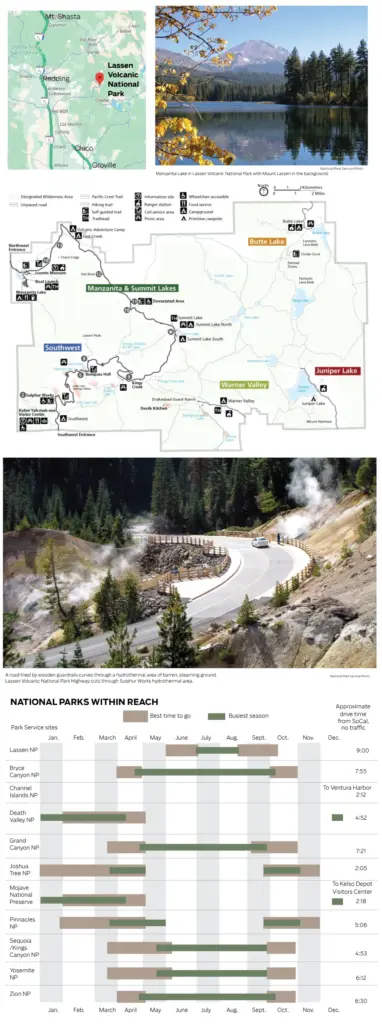
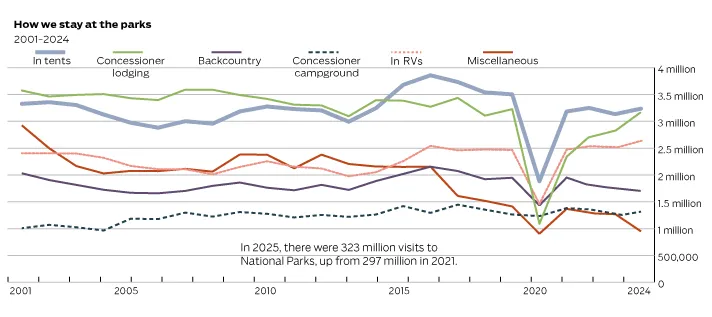
About 350,000 to 500,000 people have visited Lassen Volcanic National Park on average for the last few years, which is very uncrowded compared to other parks. Here are the most and least visited parks on average:
Read more Body found in California home burned by wildfire believed started by chain saw
The United States has 63 national parks
These were the 10 most visited in 2024:
Great Smoky Mountains National Park (12.2 million)
Zion National Park (4.9 million visits)
Grand Canyon National Park (4.9 million visits)
Yellowstone National Park (4.74 million visits)
Rocky Mountain National Park (4.15 million visits)
Yosemite National Park (4.12 million visits)
Acadia National Park (3.96 million visits)
Olympic National Park (3.71 million visits)
Grand Teton National Park (3.6 million visits)
Glacier National Park (3.2 million visits)
Least visited
Gates of the Arctic National Park and Preserve (11,907 visits)
North Cascades National Park (16,485 visits)
Kobuk Valley National Park (17,233 visits)
Lake Clark National Park and Preserve (18,505 visits)
National Park of American Samoa (22,567 visits)
Isle Royale National Park (28,806 visits)
Katmai National Park and Preserve (36,230 visits)
Wrangell-St. Elias National Park and Preserve (81,670 visits)
Dry Tortugas National Park (84,873 visits)
Great Basin National Park (152,068 visits)
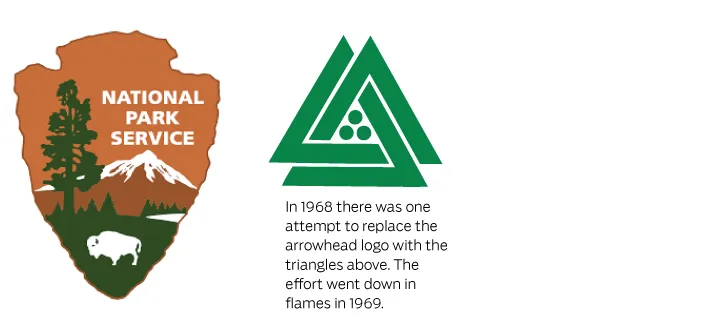
Park Service logo
The arrowhead was authorized as the official National Park Service emblem by the Secretary of the Interior on July 20, 1951. It is not officially documented but NPS site says:
The Arrowhead: The arrowhead shape represents historical and archaeological treasures.
The Tree and Grassland: The Sequoia tree and grassland represents all vegetation, which is continuously monitored and restored.
The Mountains: The mountains represent land formations, scenery, and recreational opportunities, such as hiking.
The Bison: The bison represents all wildlife.
The Lake: The lake represents water and recreational opportunities, such as kayaking and river walking.
Sources: National Park Service, U.S. Department of the Interior, VisitCallifornia.com, Smithsonian, Register research, Google Maps
Read more US sees a big jump in nausea cases among frequent marijuana users in the hospital