
Economic pundits – partisan or apolitical – don’t truly understand inflation.
Thankfully, the official inflation rate cooled a bit in July. It’s a welcome respite from a heated spring when the Iranian war spiked gasoline prices, among other things.
Read more Facing a statewide OB-GYN shortage, midwives become an ‘untapped resource’
But nobody should be cheering. Lower inflation is always better, but 2026’s version of “lower” isn’t enough to help many folks who are struggling to balance a household budget.
My trusty spreadsheet looked at Consumer Price Index reports for three Southern California metro areas – Los Angeles and Orange counties, the Inland Empire and San Diego County – and the national cost benchmark.
When you meld the three local indexes, you see that inflation in Southern California was running at an annual rate of 3.1% in July.
Yes, that’s down from the 3.5% pace of the previous three months.
Yes, that’s down from the 3.5% average annual rate in the first 18 months of Donald Trump’s second presidency.
And, yes, that’s down from the 4.9% average yearly increase seen during Joe Biden’s four years in the White House.
Mission accomplished? Hardly.
Reality check
Those who see economics through the lens of the family checkbook ponder inflation differently than those paid to follow economic gyrations.
The professionals oddly track inflation, minus what’s happening with food and energy costs. Or they spend time guessing the next short-term price fluctuations. Or they’ll muse about what Congress, the White House, or the Federal Reserve should do to cool price hikes.
The reality of these cost-of-living spikes for many households is far simpler than the wisdom of so-called experts. Average folks worry if their paychecks can outpace inflation.
Just think about what the CPI tells Southern Californians.
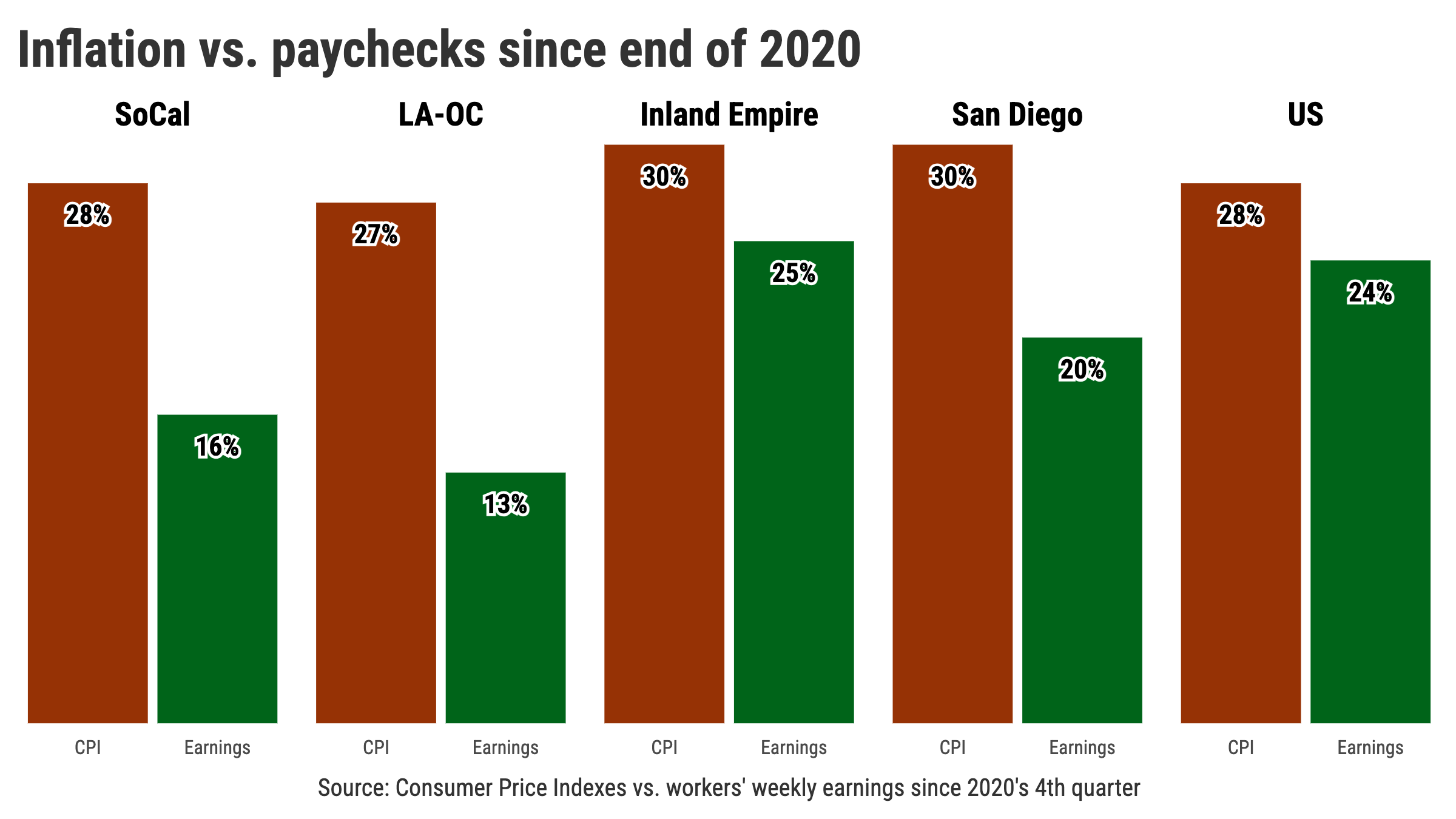
Goods and services across the five-county region cost 28% more over the past five and a half years.
Meanwhile, if you look at one measure of Southern California pay – the combined weekly earnings of private-sector workers – it’s up only 16% in the same period.
And that gap is not geographically universal. In L.A.-Orange County, prices are up 27% vs. 13% earnings gains. In the Inland Empire, 30% inflation outpaced 25% pay hikes. And in San Diego, costs rose 30% as wages grew 20%.
It adds up to just another major financial headache in a region with a punishing cost of living.ocregister.com
Figuring out how to pay the bills isn’t helped by professorial debate about how price indexes are built – or which cost measurement the economic gurus prefer to watch. The masses need solutions for everyday costs, yet few fixes are offered by pontificators or politicians.
Read more US markets strive for a positive week amid retail sales data and signs of cooling inflation
“Populist” talk of various forms of price controls – for rent or supermarkets, for example – is often derided by the punditry as “socialist” thinking. But the gurus don’t get it.
It’s the byproduct of growing frustrations that the ways the economy once worked no longer work for a significant slice of the population.
National pain
Look, Southern California, the best I can say is that others feel your pain, too. Ponder the typical American’s inflation picture.
The national inflation rate was 3.4% in July. That’s down from a 3.9% average for the previous three months, off from the 3.3% pace of Trump’s second term, and slower than Biden’s 4.9% annual pace.
But the national reality is that consumer prices are up 28% over the past five and a half years. And U.S. wages grew only 24% in that timeframe.
Big picture
The reality that paychecks are being eaten up by inflation is a curious pattern as a major election approaches.
Those folks lucky enough to beat the rough economic odds are likely happy with the status quo.
Yet those struggling with a paycheck’s shrinking buying power and a growing stack of unpaid bills probably want some serious change.
And what might a voter think is a fair inflation rate – other than anything below their latest pay raise?
Well, the Fed’s got a 2% target. You might choose pre-pandemic conditions of 2019, often seen as a symbol of the good ol’ days.
That year, prices in Southern California rose 2.7%. Nationally, inflation ran at 1.8%. Both rates are lower than in July 2026.
Jonathan Lansner is the business columnist for the Southern California News Group. He can be reached at [email protected]
Read more If your vehicle lacks insurance, the DMV will suspend the registration
- Try Jonathan Lansner’s Substack collection of economic trends. CLICK HERE!