
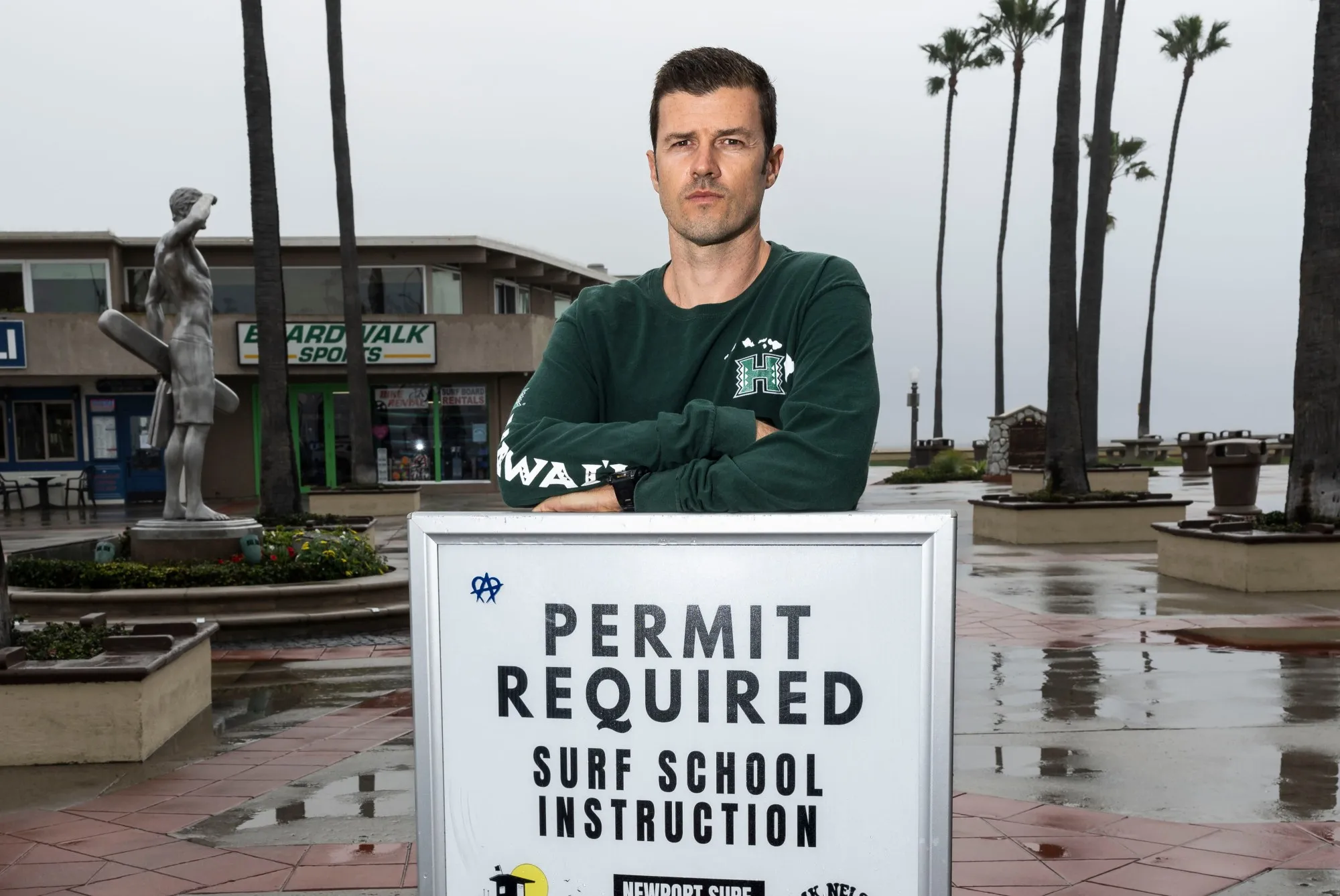
A Newport Beach surf instructor embroiled in a decade-long battle with the city will be able to teach people to ride waves after settling a lawsuit filed last year.
Read more Maryland tax court voids digital ad tax, orders refunds to Apple, Google and Peacock TV
Jason Murchison, owner of Learn to Surf, secured the right to teach paid surf lessons under a five-year agreement, similar to terms granted to the three other city-approved surf schools operating in Newport Beach.
Murchison, a veteran Navy diver, argued the town’s permitting system created a monopoly in the city and he had no fair chance to start a surf school. His lawyers argued it was his First Amendment right to teach people to surf.
The city, in turn, argued its process for selecting surf schools is similar to other recreational businesses that operate throughout the city, and a vetting process is needed to ensure that people pass background checks and other requirements before doing business in town.
The case raised questions about the regulation of areas considered public space, and who should have a say on what, and how many, businesses can operate on the beach and in the ocean.
Caleb Trotter, senior attorney for Pacific Legal Foundation representing Murchison, argued that it is unconstitutional and unlawful for the city to restrict Murchison from instructing others on how to surf and the city was favoring some beach activities over others. A person playing guitar for tips on the sand, for example, doesn’t have to adhere to the same rules, he said.
“This isn’t a crazy business hurting people, not taking up a bunch of land or resources. It’s doing what anybody could go out to the beach and do on their own with a small group of friends,” Trotter said. “He’s never looking to harm anyone, but support himself and his family and teach people who want to learn to do a beautiful thing. And so kudos to him for standing up for it … he’s just a shining example of why we need people willing to take the risk to stand up for themselves, because otherwise, change just might not happen.”
The city is pleased that the parties reached an amicable resolution without the expense and uncertainty of further litigation, said city spokesperson Georgia Rios.
Rios added that the court did not strike down the city’s surf-school regulations or determine that the city acted unlawfully or arbitrarily; rather, the parties voluntarily resolved the litigation through a negotiated settlement that includes a five-year operating agreement with Murchison.
“The settlement expressly does not constitute an admission of liability or wrongdoing by the city,” she said in an email. “The city remains committed to providing safe and equitable commercial access to its beaches while responsibly managing the use of these important public resources.”
Murchison, a Fullerton native, was putting himself through law school and needed a part-time gig to fund his education when he picked up a job giving surf lessons in Huntington State Beach. It wasn’t long before he started Learn to Surf, obtaining a business license and insurance, but when he tried to get permitting through State Parks, he never heard back.
Read more How 85°C Bakery Cafe is finding success in family neighborhoods
He went to Newport Beach and tried to get a permit there, but was denied several times, told the city already had enough surf schools along its 9-mile beach, he said in a previous interview.
He advertised his surf school near the Balboa Pier in 2016, and a week later got a ticket in the mail for conducting a surf lesson. Murchison was taken to court by the city in 2017 and the judge ordered the city and Murchison to come to an agreement outside of the court. Murchison agreed not to give lessons within the city boundaries or be subject to the city’s attorney fees.
He thought he found a loophole, he said previously, by giving lessons at the Santa Ana River, county-owned territory wedged between Newport Beach and Huntington Beach. But when one of his subcontractors drifted into Newport Beach’s waters, the city argued he violated their agreement. The attorney fees bill was $19,000, and another for $22,000 for legal fees to enforce the settlement.
Those fines were wiped out as part of the new settlement.
The city’s ordinance doesn’t spell out how to get an agreement or who can get one to teach, Trotter said, adding that recently a Ninth Circuit court struck down a San Diego restriction on teaching yoga on beachside bluffs; teaching and advising people is protected speech.
“There’s really very little difference between that from a legal standpoint and what surf instructors do,” he said. “So for the government to say, no, you can’t teach people how to do things, that’s just a straightforward restriction on speech that the 1st Amendment protects.”
All his client has ever wanted to do is be treated the same as the other schools and just be allowed to operate, Trotter said.
“From when I started this business in law school, everything I was doing was legal,” Murchison said. “I would not ever start some sort of illegal business.”
The settlement allows Murchison to move on and focus on growing his business, he said, with an East Coast operation recently launched.
“I’ve been doing this for 12 years now, and God willing I’ll do it for another 12 years and beyond,” he said. “When people come out from all over the world, all over the country, it’s great to be able to share this sport with them and do it in a safe manner where, but for our services, they probably would never be able to catch a wave on their own or do it safely.”
Read more Prosecutors revise Palisades fire defendant’s charges ahead of retrial