
Part 3 of a four-part series
That face; it’s a movie star’s face.
OK, it’s probably a character actor’s face, deeply carved with the agony and angst of a lifetime (or two or three).
Read more Barnes & Noble opens sprawling store at South Coast Plaza
Long before Danny Trejo became the “most killed actor in Hollywood” — playing roles like Machete and various versions of antihero/criminal/vigilante in “Desperado,” “Heat,” “From Dusk Till Dawn,” “Breaking Bad” and the rest — he was a heroin addict from an abusive home in Los Angeles.
“I remembered being a seven-year-old kid being choked by his dad,” Trejo wrote in his 2021 memoir. He was 12 when an uncle introduced him to smack, and 13 when he clocked his first overdose. Soon, there were robberies and drug arrests and prison sentences; San Quentin and Folsom and Soledad.
Behind bars, Trejo wrote, his heroin addiction only intensified.
When a massive riot erupted at Soledad on Cinco de Mayo in 1968, Trejo hurled a rock that smashed a prison guard in the head. Thrown into solitary, Trejo faced charges that he feared would carry the death penalty.
With nothing to lose, he began bargaining with God. Let me die with dignity. You don’t need to get me out of this, I know what I’ve done. Just let me die with dignity and I’ll say your name every day. I’ll do whatever I can for my fellow inmates.
“Inmates,” he said later, because he never expected to leave prison and mix again with non-incarcerated people.
Somehow, though, Trejo got a miracle. The rock-related charges were dropped, and he was paroled. He pulled his life together; embraced the 12 steps, got sober, helped others do the same. He’s been clean now for more than half a century, and he’s done it without the help of methadone, buprenorphine or any the drugs used to treat opioid addiction.
Which might make Trejo a somewhat unlikely spokesman for the virtues of America’s methadone clinic system.
‘Program, Not A Pill’
They denounced the overwhelmingly for-profit clinics as federally sanctioned monopolies, more interested in protecting profits than in helping patients. They were furious that no other legal path existed for accessing methadone – the most tried-and-true treatment for opioid dependence in America.
Many, in fact, demanded nothing less than destruction of a system that they said needlessly required in-person visits to clinics, where they often felt dehumanized and treated like criminals, even as they actively sought to kick their addictions and live sober lives.
And patients weren’t alone.
Addiction medicine doctors were outraged by the methadone system, too. How galling, they said, to be board-certified in the specialty but forbidden, by law, from prescribing a gold standard treatment outside a clinic setting.
Neighborhood pharmacies were none too pleased, either. They could fill methadone prescriptions for pain, but not methadone prescriptions issued to combat opioid dependence.
All of this matters to taxpayers. In 2023, the federal government spent $29 billion on opioid treatments, a figure that included some $5 billion through 2,100 methadone clinics, according to the Brookings Institution.
It was July 2024 — with bills pending in Congress to wrest methadone from the largely for-profit clinic system, and allow addiction doctors to prescribe it, and neighborhood pharmacies to fill it — that we met Trejo.
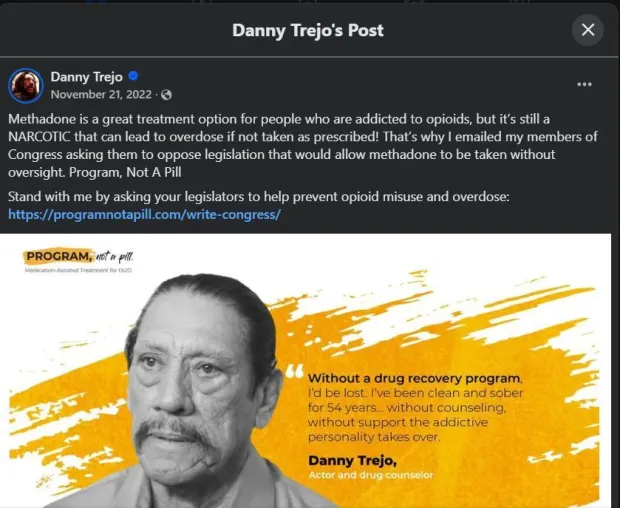
He settled his famously gregarious self into a cozy chair at the earthy offices of Western Pacific Medical Corp., a Glendale company that runs a dozen or so methadone clinics in Los Angeles and Orange counties. The company’s CEO, Mark Hickman, was there, as were several patients who credit the clinics — not just the medication, but all the counseling and other services that they get at the clinics — with saving their lives.
Trejo’s, however, was the famous face defending the methadone clinic system to the nation.
“There’s a big difference between being in a doctor’s office and getting a prescription, and coming to a place like this,” said Trejo, who spent years counseling his brethren in recovery.
“At a doctor’s office, there’s no one to discuss what’s going on with you. But at a place like this, in a program, you can go and sit and talk to a counselor who’s been where you are. You can say, ‘This is what I’m going through’ to someone who’s clean, who knows how it feels. …
“That support is one of the most important factors in getting clean and staying clean and trying to live a life,” he said.
“Without a drug recovery program, I’d be lost.”
The idea of letting recovering users bring methadone home to take, unsupervised, away from a clinic – as pending federal legislation would allow – was courting trouble, he said.
“You have to remember, for a drug addict, if one is good, two is better. And three! Oh my God! I know, for an absolute fact, that without counseling, without support, the addictive personality takes over.”
The risk of diversion, addiction, overdose and death are far too great to risk loosening access to methadone, Trejo argued. Lives were on the line.
‘Still a NARCOTIC’
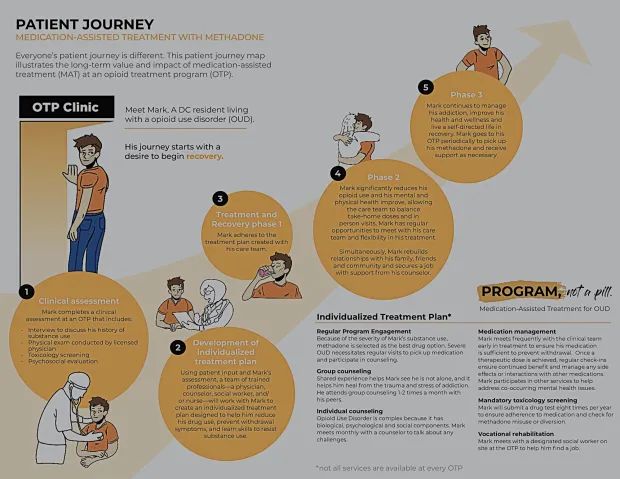
“Methadone is a great treatment option for people who are addicted to opioids, but it’s still a NARCOTIC that can lead to overdose if not taken as prescribed!” said a Trejo Facebook post from 2022.
“That’s why I emailed my members of Congress asking them to oppose legislation that would allow methadone to be taken without oversight. … Stand with me by asking your legislators to help prevent opioid misuse and overdose.”
In Trejo’s video testimonial, he drew parallels between doctors’ over-prescribing opioids for pain, and what doctors might do if they were allowed to prescribe methadone.
Prescribers, he argued, weren’t necessarily to be trusted.
“I’m not against doctors. But … if I go in for pain, or if I go in for medication, doctors are going to give me medication. And the biggest problem that I’ve seen in the past is that when Valium came out … doctors passed them out … so the streets were flooded with Valium. … Same thing happened with OxyContin.
“Right now, we have an opioid addiction problem. The streets are flooded. So now what’s going to happen when I walk into a clinic and say, ‘Doctor, I’m trying to kick drugs’? ‘Well, here’s six, seven doses of methadone. Take them as prescribed.’”
Read more Florida home of pair killed in Kenya helicopter crash is burglarized, cops say
To a drug addict, Trejo said, that means “take all of them.” And that’s why it was so vital to observe patients take their medication and have them return to the clinic – rules that infuriated many patients.
“I don’t know if doctors actually want their clinics flooded with people trying to get methadone,” Trejo added. “We, as a program, are ready for that. And we know how to handle that. And we know how to secure that methadone. And we know how to make sure they take it. So I honestly believe that methadone treatment programs are the best thing there is for opioid addiction.”
Hickman, chief executive of clinic operator Western Pacific Medical, issued a dire warning of his own.
“We feel that the bill, as proposed, allowing doctors to write prescriptions, is a recipe for disaster.
“We believe there’s going to be a huge increase in mortality and it’s going to chip away at the accomplishments that Opioid Treatment Programs have had over these years. We’re trying to convey that methadone is gold standard treatment, but it doesn’t work alone.”
For those who had more questions, ProgramNotAPill.com had answers.
“MYTH: The Modernizing Opioid Treatment Access Act (MOTAA) will expand access to methadone treatment by allowing addiction-certified office-based physicians to prescribe methadone for pick-up at pharmacies,” the trade group said of the bill then pending in Congress.
“FACT-CHECK: MOTAA will not increase access. The proposed legislation would allow methadone prescribing and dispensing at pharmacies, however the actual increase in access is dramatically overstated, given where addiction-certified physicians are located and the types of patients they accept.”
Why is methadone a Schedule II drug, alongside fentanyl, and how is it different from buprenorphine and naltrexone, two newer medications used to treat opioid addiction?
“While methadone is proven to help people get into and stay in recovery from an opioid addiction, methadone also has a high potential for misuse and can even lead to severe addiction,” the clinic owners’ group asserted.
“Methadone is different than buprenorphine and naltrexone because it is a synthetic opioid agonist, meaning it fully activates opioid receptors in the brain to produce pain-relieving effects. When prescribed and administered appropriately (under the supervision of a practitioner), methadone is a safe and effective treatment for opioid-use disorder that reduces opioid cravings and withdrawal and blocks the effects of opioids.”
Why are the current rules and regulations important?
“Methadone, buprenorphine and naltrexone are very different medications with different safety profiles. Naltrexone has no abuse or overdose potential. And while buprenorphine is an opioid, it has low abuse and overdose potential. … Conversely, methadone, a full opioid agonist, is proven to be highly effective when used in the confines of a comprehensive and highly regulated opioid treatment program. However, if methadone is not properly administered and regulated, we could experience even greater stigma against (medication-assisted treatment) if people die misusing methadone. Now is the time to uphold the standard of medication-assisted treatment and help bend the curve of the opioid crisis.”
Expanding access to methadone in “unregulated settings” — such as doctors’ offices — will not magically make opioid addiction disappear, it argued.
“Medication-assisted treatment is more than just medicine — it involves a comprehensive program of services curated by health care professionals, which includes counseling and behavioral therapies. Support Evidence-Based Recovery. Stand up for real evidence-based addiction treatment!”
‘Driven … by profits’
The message from methadone clinic owners enraged not only doctors, who bristled at the charge that they would provide inferior care, but also lawmakers who argued they were simply trying to modernize an antiquated system.
“(P)roposed federal legislation to make methadone more widely available has been subject to organized opposition by opioid treatment programs, including the recent ‘Program, not a pill campaign,’ advanced by your organization,” wrote Sens. Ed Markey, Mike Braun, Maggie Hassan and Elizabeth Warren, along with Reps. Donald Norcross and Don Bacon, to methadone clinic bigwigs.
“We write with concern that your organization’s opposition to expanding methadone treatment … is driven not by science, but by the profits that private-equity-backed (clinics) earn when patients are only allowed to access treatment through your programs.”
Flexible, pandemic-era rules allowed more patients to enter treatment and stay in recovery, they wrote. Studies found increased engagement with treatment, improved satisfaction and very few incidents of misuse or methadone theft. And the feared increase in methadone-involved overdoses? Data shows it never materialized.
In California, methadone-related deaths fell by nearly half between 2012, when tight rules were the norm, and 2024, when methadone take-homes had been expanded.
“As Nora Volkow, director of the National Institute of Drug Abuse, has stated, ‘(t)here’s absolutely no reason why physicians should not be allowed to prescribe methadone directly to patients,” the lawmakers wrote. The lawmakers also demanded financial details from the big methadone clinic chains.
The methadone clinics pushed back.
“(Y)our letter fails to acknowledge the historical success that (clinics) have had for individuals with opioid substance use disorder and their families,” said the response from Hickman, Western Pacific’s CEO.
Methadone clinics hold the highest success rate in all forms of addiction treatment, he argued, with comprehensive services that combine medication with counseling and behavioral therapies. Western Pacific’s program addresses all aspects of recovery, reducing drug use, improving social functioning and shrinking the risk of overdose and other negative health outcomes.
“(R)elieving withdrawal symptoms,” Hickman said, “is just the beginning.”
The Modernizing Opioid Treatment Access Act had 70 co-sponsors in the U.S. House of Representatives, and a dozen co-sponsors in the U.S. Senate. Yet it failed to advance.
The traditional clinic system, and its “Program, Not a Pill” campaign, won.
Some argued that patients lost. With the traditional clinic system in place, illicit drug dealers could still capitalize on knowing precisely where their target clientele — the vulnerable, the wavering — would gather. And dealers could make sure temptation was never far away.
Sherry Lynn James, a long-ago user who was living sober, accompanied her adult son to the methadone clinic in Costa Mesa on March 22, 2024. She waited in the car while he went inside for his observed daily dose. And, as she waited, she was approached by a dealer hawking his wares.
James had been more than two decades “clean,” but on that day she had a few drinks. She bought a dime bag.
She didn’t say a word about it when her son returned to the car and they headed to his home in Huntington Beach.
Next: Did methadone rules kill Sherry Lynn James? New ideas are back on the table, and legislators say they’re meeting the industry halfway.
Read more Here’s what Sean McVay wants from his Rams running backs