
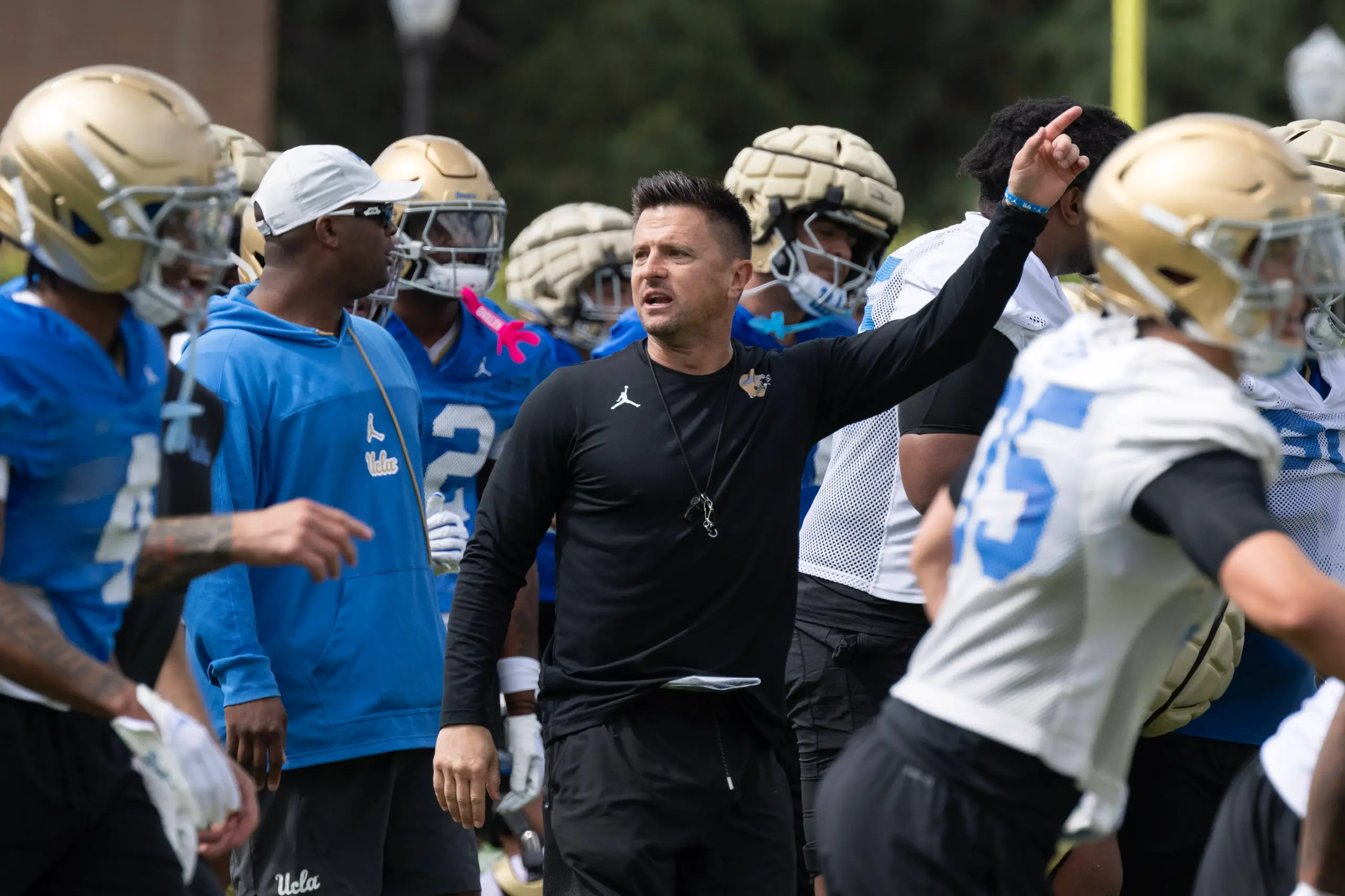
LOS ANGELES — UCLA football won the offseason.
Now the Bruins have to prove they can win a football game.
New head coach Bob Chesney arrived from James Madison University with a résumé decorated in wins. Quarterback Nico Iamaleava has grown into a leader of men. Four-time NFL Pro Bowler Derek Carr joined the staff to provide wisdom. UCLA welcomed back linebacker Trent Hendrick after spending time with NFL franchises.
Read more Why Mexican cartels are increasingly using car bombs and other explosives
Then, six days before UCLA’s season-opening game at Cal, chancellor Julio Frenk announced the dismissal of embattled athletics director Martin Jarmond, and the appointment of Tim Harris as interim CEO and AD – equipped to lead UCLA in this money-driven era of college sports.
While setting itself up to thrive in the 2026 college football season, UCLA has attracted the pressure and expectation to win in Chesney’s first season.
Throughout fall training camp, pictures are rosy, narratives utopic. Chesney said Monday that he doesn’t “really pay attention to that stuff,” but in Year 1 of a new regime with growth at quarterback, the infusion of NFL influences, and a new man atop the department, the Bruins have to validate the hype.
ALSO READ: UCLA football at Cal: Who has the edge in the season opener?
Their first chance comes against in their season opener at Cal at 7:30 p.m. Saturday.
Bring on the Chesney era
Chesney earned UCLA’s head coaching job after 15 years doing nothing but winning in Division II, FCS and at James Madison.
Throughout the offseason, he made himself available with local media and rebuilt alignment within the program. He opened practice doors to nearby high schools and quickly increased recruitment numbers.
With the gratitude of a true L.A. transplant, Chesney attracted 11 players from JMU’s College Football Playoff roster and convinced local kids considering a transfer to stay at UCLA.
Upon coming to Westwood, he met with Cole Martin, Rodrick Pleasant, Scooter Jackson and Iamaleava, four players from the greater L.A. area, and won them over with his energy. It’s a level no player initially believes a coach can carry consistently, but Chesney does.
“He’s the same man every day,” Iamaleava said. “Makes it easier for the whole team to want to go out there and play for him.”
“They’re the same people that I met from the first day I got here,” Pleasant said about meeting Chesney and his family. “They care about us. They care about the program. They care about you as a person. And they want to win.”
At the season’s doorstep, the nation’s vibe matches those four players’ first impressions – unsure if Chesney’s unbridled spirit will persist as he faces Big Ten opponents.
Since December, Chesney has always said the right thing. He’s created a sense of assurance that he’s the candidate for the job before winning a single game. His success has transcended levels before, but now he’ll have to demonstrate those trends will continue in the conference he referred to “as the best league in America.”
The evolution of Iamaleava
Iamaleava is entering his third season with a third head coach. A summer transfer from Tennessee last year offered him little time to acclimate. Now he’s had a spring and fall camp with UCLA’s mostly new coaching staff.
His character has received high regard and his teammates voted him captain without a campaign – a title he insists he didn’t earn solely “because I’m the quarterback.”
“I built a great relationship with all the guys,” Iamaleava said. “Letting them know that I’m a regular human being, just like them … We’ve been able to build a bond with each other.”
His teammates also have no doubt he can perform. Martin praised Iamaleava as “the best quarterback in the nation,” and tight end Josh Phifer believes “he can do everything.” That versatility as a thrower and scrambler could make him the perfect fit for offensive coordinator Dean Kennedy’s scheme, which marries the pass and run through optionality.
ALSO READ: UCLA football preview: Offense will lean on Nico Iamaleava and creativity
He’s also benefiting from Carr, the former Raiders and Saints quarterback whose perspective carries weight as he’s excelled at the level Iamaleava aspires to reach. Speaking on his podcast, “Home Grown with David & Derek Carr,” Carr described how Iamaleava texts him questions after practice.
“I’ve learned so much football from him,” Iamaleava said of Carr.
Iamaleava has contributed to a winning team before. In his second season at Tennessee, he helped the Volunteers reach the College Football Playoff, but struggled in a first-round loss to eventual champion Ohio State. Last season, he didn’t eclipse 2,000 passing yards and held a 13:7 touchdown-to-interception ratio.
With Kennedy’s offense, Carr’s presence and the surrounding belief in QB1, the stage is set for Iamaleava to be the reason UCLA’s a winning team.
Read more Ode to the remote control, that tiny box that lets you channel your desires without ever getting up
An experienced voice
After joining UCLA late into spring camp, Carr was named special adviser to the head coach in August. Rekindling with his old college friend from Fresno State, UCLA general manager Darrick Yray, Carr’s greatest contribution is sharing his NFL experience with the quarterbacks.
“He’s willing to give to the players, but he’s also willing to give to the staff,” Kennedy said. “Someone with that type of knowledge, you just want to be a sponge around that guy. He’s extremely modest in his approach. It’s been a joy to be around him.”
Carr spoke on his podcast about the balance of providing advice without stepping on toes. But his name, platform and NFL achievements demand attention and provide Iamaleava with an advantage few college quarterbacks have.
But another powerful voice in the room isn’t always a positive, especially when the coaching staff has such a history together, and the new guy is the GM’s buddy.
An experienced addition
Less than two weeks before Saturday’s season opener against Cal, UCLA brought Hendrick into the mix after he was granted a temporary restraining order resulting in a fifth year of eligibility.
Hendrick’s transition back to college should be seamless as he played his last two seasons with Chesney at JMU. The 6-foot, 230-pound reigning Sun Belt Conference Defensive Player of the Year finished with 106 tackles and three sacks and two forced fumbles last season.
He will be “ready to go” and is “going to play a role” Saturday, defensive coordinator Colin Hitschler said.
ALSO READ: UCLA football preview: Defense seeks controlled aggression
Hendrick’s situation is different from many other former professionals returning across college sports. He passes every Big Ten-instituted guideline restricting former NFL players from returning to college and is joining the coaching staff he was with, rather than choosing the highest bidder or best competitive situation.
“Obviously, we don’t want to add just anybody to our program,” Chesney said. “He knows the system. He can jump in there right away … He’s a nice addition of a kid that we trust and believe in as part of our family.”
Still, introducing any player so late into training camp could pose issues. Combine that with the stigma surrounding programs who add former professionals – a practice scrutinized by respected college coaches such as Oregon’s Dan Lanning and Georgia’s Kirby Smart – and it increases the spotlight on UCLA.
Change in leadership
Harris’ replacement of Jarmond atop the athletics department is meant to help UCLA become a leader in the business of college sports. His three-decade experience working for the Lakers is particularly relevant to the professionalization of the once amateur playing field.
ALSO READ: UCLA’s money woes and failure to adapt cost Martin Jarmond his job
Along with understanding sponsorships, partnerships and maximizing revenue, college athletics directors are required to deal with agents, general managers and players signing NIL deals similar to contracts. Harris managed all of that as president of business operations with the Lakers.
“He’s dealing with contracts, with players’ egos; he’s dealing with marketing and doing partnerships and activating sponsorships. He’s done all that stuff with the Lakers,” Tibor Pelle, who was Harris’ UCLA soccer teammate in the early 1980s and is now an agent for youth soccer players, told the Southern California News Group. “So I’ll tell you, I think we’re really lucky to get him at UCLA.”
Harris played goalkeeper for the men’s soccer team from 1979-83, so he brings the unmatchable trait of being a UCLA alum to the CEO and AD positions. While his business acumen and passion for the school don’t directly impact the results of football games, he’s expected to exceed where Jarmond fell short.
Determining success
With each notable acquisition, UCLA loses possible excuses to blame for underachieving in Chesney’s first season. Expecting a complete turnaround from going 3-9 in 2025 is an unrealistic standard set by Chesney’s JMU predecessor. Curt Cignetti, in his second season at Indiana, won an undefeated national championship.
But 12 years removed from UCLA’s last 10-win season with coach Jim Mora and quarterback Brett Hundley, and still experiencing scars from Chip Kelly’s departure and DeShaun Foster’s brief tenure, the Bruins’ fans are starved for victories. Chesney is expected to deliver immediately.
Chesney and his staff, though, don’t measure success by the win column, and will attempt to prevent expectations from impacting how they judge the outcome of Year 1.
“It’s never about wins and losses,” Hitschler said. “It’s about the process. And the process leads to wins and losses. I think that mentality, that brand, that we’re talking about, that fight for every inch. As long as you’re doing that, if the scoreboard comes up with a loss, it doesn’t mean that you didn’t win the game from how you prepared and how you played. Doesn’t mean we didn’t fight like hell and come out on top at the end of the season.”
That might be the case in most settings. But a feel-good season, with gradual improvement rooted in process and preparation leading to mediocre results, won’t cut it for a program desperate for tangible success and the pieces in place to achieve it.
Read more The Lucas Museum of Narrative Art has adventure around every curve