
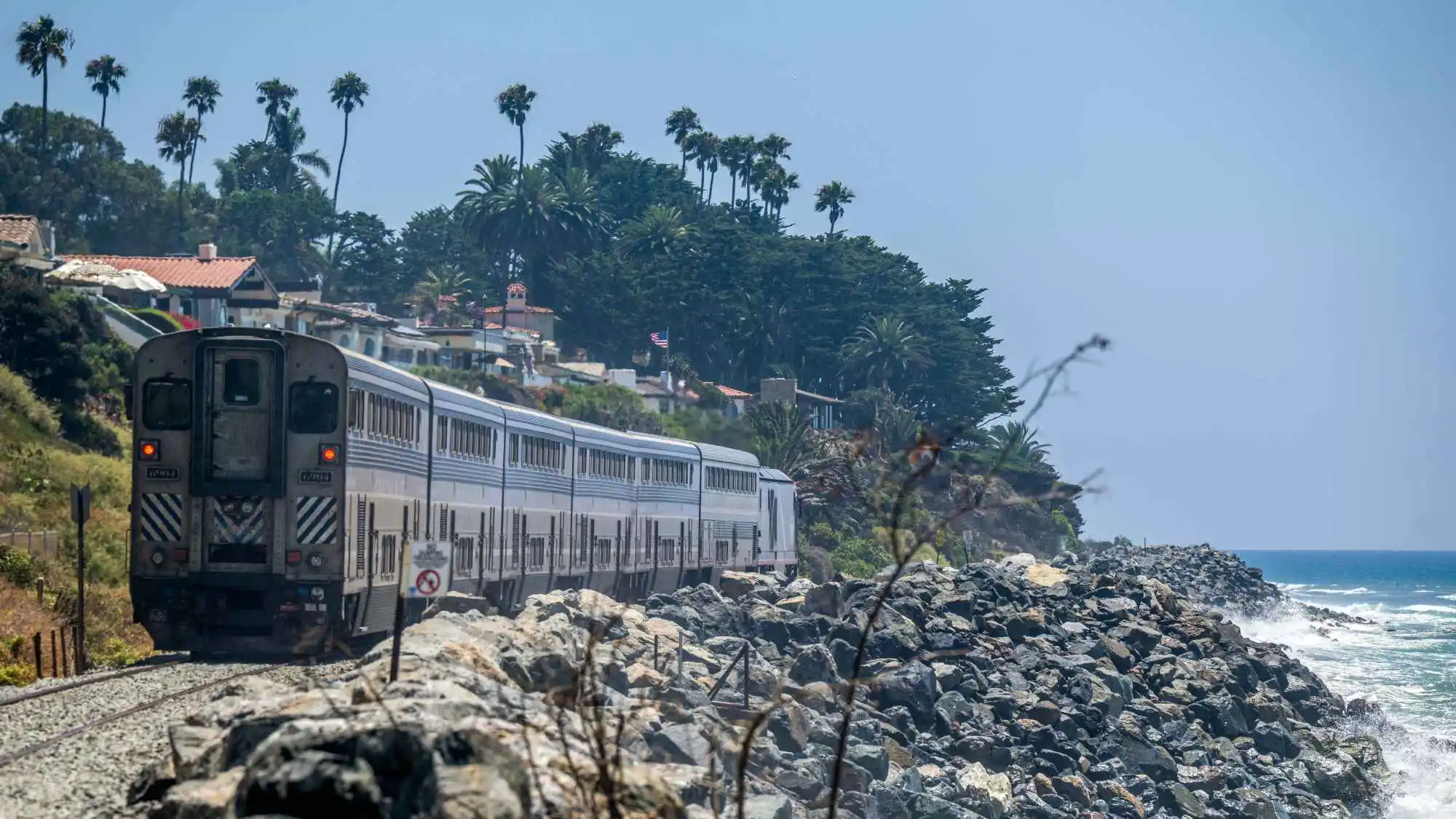
The Orange County Transportation Authority board declared an emergency along the coastal rail line in San Clemente this week, authorizing its CEO to expedite efforts to protect the train tracks from ongoing erosion ahead of the El Niño season.
Read more Protesters walk 96 miles – from desert to L.A. – to denounce ICE
The move allows CEO Darrell Johnson to advance shoreline protection with about 690,000 cubic yards of sand in areas of San Clemente where the rail line has been damaged in recent years or is vulnerable to future threats. It also attempts to move forward an “engineered shoreline protection structure” and repair existing riprap along about three-quarters of a mile south of San Clemente State Beach.
The declaration should help Johnson “move quickly to secure specialized contractors, materials, marine dredging equipment and sand sources as they become available, attempting to avoid delays that could leave the railroad vulnerable to additional storms and high-wave events,” OCTA officials said in an announcement.
The coastal railroad through San Clemente is part of the 351-mile Los Angeles-San Diego-San Luis Obispo, or LOSSAN, Rail Corridor and carries Metrolink and Amtrak Pacific Surfliner passenger trains, as well as freight and military transportation.
The tracks, where they run beachfront in south San Clemente, in front of the Cypress Shores community, have been damaged several times since 2021 by overtopping waves and high tides. The ocean is reaching the rail line because of continued erosion in the area that has eliminated a beach buffer.
There are also threats from the inland side of the tracks, with landslides happening in several areas along the rail line that have also required extensive repairs. A160-foot-long catchment wall and beach trail repairs are wrapping up at Mariposa Point since a slope failure earlier this year.
Rail operations through San Clemente have been interrupted multiple times because of coastal bluff failures, beach loss, erosion of the railroad embankment and deterioration of shoreline protection.
Damage occurred again in recent weeks, causing the rail line to temporarily close again to passenger service while crews performed emergency stabilization work.
The area would receive about 450,000 cubic yards of sand, the remaining 240,000 cubic yards planned between North Beach and Mariposa Point. A final design is still in the works for an engineered shoreline protection structure, OCTA officials said.
The OCTA’s board action follows Gov. Gavin Newsom’s Sept. 21 state of emergency proclamation in preparation for the developing 2026-27 El Niño conditions, as well as the county’s and several coastal cities’ similar declarations.
“For the past five years, OCTA has taken all possible steps to speed up work to protect this critical link in Southern California’s transportation system and it’s important to acknowledge our board’s leadership in this effort,” Johnson said in a release, thanking Newsom and state partners for recognizing the “emergency that requires strong partnerships and expedited action.
Read more 2.5-acre Yucca Valley compound with pool, sport court seeks $3M
“We look forward to continuing that collaboration and working with our federal partners on an expedited schedule so we can get the necessary permits to put these protections in place as quickly as possible.”
The declaration does not eliminate environmental review or permitting requirements from agencies.
OCTA will continue working with the California Coastal Commission, U.S. Army Corps of Engineers and other regulatory agencies to secure necessary approvals, officials said.
The OCTA is looking offshore of Surfside-Sunset near Huntington Beach as a viable source of beach-compatible sand, the same material used in a large federally led program that added about 200,000 cubic yards of sand on the north and south sides of the San Clemente Pier.
The source has been approved by the Southern California Dredged Material Management Team, which includes representatives from federal and state regulatory agencies.
Delivering hundreds of thousands of cubic yards of sand to vulnerable areas near Cyprus Shore and San Clemente State Beach presents another challenge: With the railroad squeezed between the bluff and ocean and limited access from land, large-scale sand placement will require specialized marine dredging equipment capable of pumping it ashore.
“The number of large, U.S.-qualified hopper dredges capable of such work are limited, and many are committed to major projects around the country months in advance,” OCTA officials said. “That limited availability is one reason OCTA is moving now to advance design, permitting and contracting simultaneously, providing greater flexibility to secure appropriate equipment and move forward when a work window becomes available.”
OCTA has secured more than $300 million in state and federal funding for its coastal rail stabilization projects.
The transportation authority has had the funding sitting in a bank account for the last few years waiting to be deployed, but “needless bureaucracy and red tape at the state and federal level delayed our ability to proactively protect our beaches,” OCTA Vice Chair and Fifth District OC Supervisor Katrina Foley said.
The latest declaration, she said, provides “flexibility and the ability for quick action to save our beaches and critical coastal rail infrastructure in anticipation of a heavy El Niño winter storm season.”
Read more FTC settles with Southern Glazer’s over claim it discriminated against smaller alcohol sellers