
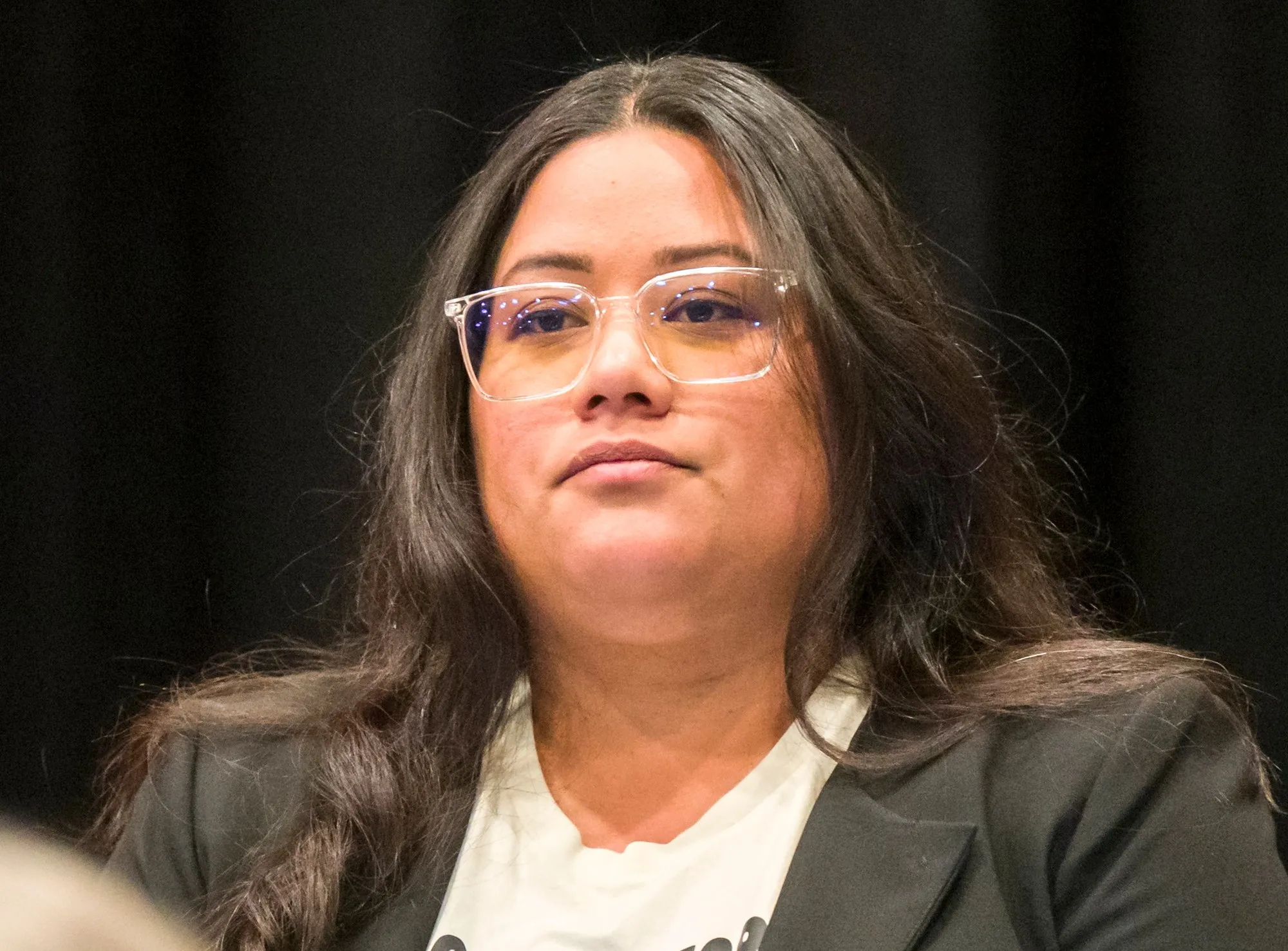
Ahead of the November general election, the Southern California News Group compiled a list of questions to pose to the candidates who wish to represent you. You can find the full questionnaire below.
Read more Mother and son from Bermuda named as passengers on missing medical flight from Bermuda to Boston
Name: Jessie Lopez
Age: 37
Current job title: Santa Ana City Councilwoman, Ward 3 / District Representative, Office of Supervisor Vicente Sarmiento
Political party affiliation: Democratic
Incumbent: No
Other political positions held: Santa Ana City Councilwoman, Ward 3 Democratic Party Central Committee, AD 68, 2020 – Present
City where you reside: Santa Ana
Campaign website or social media: VoteJessieLopez.com
Fuel costs for Californians are higher than anywhere else in the country. What specific policy would you support to ease the burden drivers feel at the pump? And how would you measure whether that policy was actually successful? (Please answer in 200 words or less.)
Working families are paying more at the pump while oil corporations keep reporting record profits. Trump’s misguided war is driving up these costs, too. I want to see California’s price-gouging penalty on oil refiners actually enforced. We need a watchdog, like the state’s Division of Petroleum Market Oversight, to investigate unexplained price hikes and refinery slowdowns and hold bad actors accountable. We need more transparency, so the public can see refinery maintenance schedules and pricing data, instead of just taking the companies’ word for it.
We also need to make clean energy vehicles more affordable to obtain for more families. That means making EVs and charging infrastructure genuinely affordable and accessible, especially for renters and working people who can’t just install a charger in their garage.
As more of our transportation system becomes electrified, the state’s major challenge will be to maintain refining capacity while declining demand discourages private investment in long-term maintenance of these legacy facilities.
How can state lawmakers ease barriers for those wishing to become homeowners and unburden renters with high rental costs, or is this an issue beyond the scope of Sacramento? (Please answer in 200 words or less.)
This is very much a Sacramento issue, and it comes down to building enough for-sale housing to meet demand while putting protections in place for existing renters.
I’ve done this work locally. In Santa Ana, I helped pass Orange County’s strongest rent stabilization and just-cause eviction ordinances, capping increases at 3%. Voters locked those protections into our city charter in 2024. I backed our inclusionary housing ordinance to help build affordable homes, and I helped fund our city’s first-time homebuyer program. I’ve also watched my own colleagues block a fully affordable homeownership project, proving that local control too often becomes a veto.
In Sacramento, I’d enforce the housing element law with real consequences, tying state infrastructure funding to compliance and giving the state clear authority to step in when cities plan on paper but never approve. For renters, I’d close the “renovation eviction” loophole and fund right-to-counsel programs so residents facing unlawful evictions have representation in the room.
For first-time buyers, I’d invest in community land trusts and nonprofit developers. I’d also limit how much single-family housing large corporate landlords can buy up in one area because AD 68 families will never be able to outbid a corporation.
Elected officials often talk about the need to prevent people from losing their homes in the first place as part of combating homelessness, but California has more people living on the street than any other state. How would you work with colleagues in Sacramento to get people off the streets and into stable housing situations? (Please answer in 200 words or less.)
There are two main issues here.
First, there are working people who genuinely cannot afford the cost of living in California, even though they are employed, some of them working two jobs just to get by. Even retired homeowners in my district are struggling. This requires continued support to build enough housing to make rent affordable for all working Californians.
Second, there are chronically homeless people who need intensive services and support. The state pays billions of dollars each year to programs that have very little oversight and accountability. As the recent scandal in Los Angeles County has shown us, we need stronger accountability mechanisms to ensure that taxpayer dollars are used effectively.
As a community health care worker, I met families crowded into single units because rent left them with no other option, often just one step away from the street. On the City Council, I helped pass rent stabilization protections to keep seniors housed. I also backed CARE Court and Proposition 1 to bring mental health funding to a county that has never had enough beds and still does not. I would ensure my district is not an afterthought when funding is allocated.
California has the highest grocery prices of any mainland state in the U.S. What’s one specific policy Sacramento could support to bring down food prices for individuals and families struggling to make ends meet? (Please answer in 200 words or less.)
When I was a little girl, my mom shopped with a calculator in her head. She knew what everything cost, which aisles to skip, and what she could afford to put back. I hear that same calculation from residents in my district today. They are working more, working longer, and still finding it harder to afford the basics.
Sacramento should expand CalFresh outreach and eligibility so working families and seniors who qualify can actually access the help available to them. That is immediate relief, and it puts food on the table faster.
But we also have to address why groceries cost so much in the first place. That means strengthening antitrust enforcement against grocery consolidation. When a handful of companies control a region’s market, families have fewer choices and less leverage. We saw that with the proposed Kroger-Albertsons merger, which would have further concentrated California’s grocery market. I would give the attorney general’s office the resources to scrutinize these deals and challenge consolidation that reduces competition and drives up costs.
My mom shouldn’t have had to be an expert in grocery prices just to feed our family. Neither should anyone else.
California’s budget approved by officials this summer included $300 million to offset healthcare costs expected with the expiration of federal subsidies. Do you support this effort by state lawmakers? Also, what would you do to protect Californians’ access to healthcare in light of federal changes that have restricted benefits to various groups? (Please answer in 200 words or less.)
During the pandemic, I went door to door as a community health worker. I sat with people who had not seen a doctor in years because they were uninsured or undocumented and had learned not to ask. Some were essential workers who kept our communities running. That experience is why I fight for healthcare access and less bureaucracy.
Yes, I support the state’s $300 million investment. As federal ACA subsidies expire, families in Santa Ana, Anaheim, and Orange could see their premiums rise, and California is right to step in. But this is a stopgap, not a long-term solution to what families are facing.
California needs a stronger defense against federal rollbacks. That means strengthening state subsidies through Covered California so coverage does not rise and fall with Congress, protecting Medi-Cal eligibility and funding here at home, and making sure the Office of Health Care Affordability holds providers accountable for unsustainable cost growth.
Healthcare should not depend on who is in the White House. And no Californian should feel they have to choose between paying their bills and seeing a doctor. I want a California where people know they can ask for care and get it.
California’s high-speed rail project has been beset by delays, ballooning costs and federal funding cuts. Should the state continue with this project? Why or why not? If you support moving forward with the project, how do you propose the state pay for it? (Please answer in 200 words or less.)
As a legislator, I would demand a transparent project timeline, independent cost and schedule reviews, and measurable benchmarks for construction, ridership, and spending. There should be a focus on funding and supporting existing regional rail systems like Metrolink and the Orange County-San Diego rail line that is being impacted by coastal erosion.
I will not support continuing to spend money on high-speed rail without stronger oversight, clear benchmarks, and consequences when the project misses them. At the same time, walking away now would mean writing off billions already invested and abandoning a project that will provide a cleaner alternative to driving and short-haul flights.
Californians should not have to choose between abandoning an important infrastructure investment and writing blank checks. We can finish what we started while insisting on accountability, transparency, and fiscal discipline.
Increasingly, we’re seeing communities push back on data centers opening in or near their neighborhoods. Environmentalists complain about the amount of water and energy that data centers need to operate. Residents complain about relentless noise pollution. And others worry about losing agricultural land to these centers. On the other hand, the tech industry emphasizes the role of data centers in supporting cloud computing and artificial intelligence. As a policymaker, how would you balance the concerns of critics with desires to ensure that California remains a leader in innovation? (Please answer in 200 words or less.)
Read more David Penaloza, Assembly District 68 candidate, 2026 election questionnaire
We’re one of the most environmentally burdened cities in Orange County, with some of the worst air quality in the region and unresolved lead contamination in our soil. We are not the place for a facility that draws that much power and water, and I’m not waiting for the state to tell us that.
That’s the point I’d bring to Sacramento. Cities need clear authority to say no, and communities already carrying a pollution burden shouldn’t be the default landing spot for this development. Neither should agricultural land or water-stressed regions.
Where these facilities do get built, they should meet strict conditions: 100% clean power sourcing, minimal water use, enforceable community benefits like local hiring, and full responsibility for the grid upgrades they require, rather than spreading that cost across everyone’s utility bill.
California can lead on AI and cloud computing without letting the industry pick the communities least able to push back. Innovation isn’t a permission slip. If the industry wants to grow here, it can grow somewhere that isn’t already paying the price.
Do you support Proposition 40, the proposed billionaire’s tax that would impose a one-time, 5% tax on individuals and trusts with a net worth of more than $1 billion? Revenues from the tax would primarily go to fund healthcare-related programs, including Medi-Cal, though a small portion would also be used to fund food assistance and education-related programs. Explain why you do or do not support this measure. If you don’t, what alternative solution do you propose so that the state has money to pay for the types of services this tax is intended to fund? (Please answer in 200 words or less.)
Yes. California’s wealthiest residents, those with more than $1 billion in net worth, can afford to contribute toward healthcare and other essential services that millions of Californians rely on.
In my community, Medi-Cal is not an abstract program. It is how seniors, children, working families, and people between jobs get access to a doctor. With federal cuts threatening coverage, Sacramento needs a reliable way to protect these services without asking working people to pay more.
A one-time tax on billionaires is a reasonable way to raise that revenue. It does not increase taxes on a family earning $50,000, $100,000, or even $500,000 a year. It asks those with extraordinary wealth to make a one-time contribution to the state that helped make their success possible.
Even NVIDIA CEO Jensen Huang, whose fortune would make him one of the people most affected, was asked about the tax and responded, “I have not even thought about it once.” He went on to say he was “perfectly fine with it.”
To me, that is what fairness looks like: protecting access to healthcare without putting another burden on working Californians.
The state has ambitious goals to transition away from heavy reliance on fossil fuel. Meanwhile, oil refineries in California that shut down in the past year said they did so in part because of the state’s costly regulatory requirements and decreasing consumer demand for traditional gasoline. But the closure of these refineries have drivers concerned about the price of gas going up – especially at a time when affordability remains the No. 1 concern for many Californians. How would you balance the state’s clean energy goals with desires to prevent Californians from further pain at the pump? (Please answer in 200 words or less.)
The transition away from fossil fuels should mean lower costs for families, not higher ones. That’s an outcome the state can actually engineer. Refineries are closing because the market is shifting. What the state controls is whether that shift arrives as a bill for drivers or as a real set of alternatives.
I’d move faster on the alternatives and help make EVs and charging genuinely affordable for working families and support investing in transit routes in neighborhoods like ours.
I’d enforce the price-gouging penalty on refiners so the remaining companies can’t treat tighter supply as an opening to pad profits. And I’d require advance notice and transition planning before a refinery closes, so supply stays steady and refinery workers move into clean energy jobs with union wages, not off a cliff.
California can lead this transition and come out with cheaper transportation and better, good-paying jobs on the other side.
Similarly, the Trump administration is aggressively pushing to expand offshore oil drilling and production in California. Explain why you do or do not support this move. If not, do you believe California state leaders have the legal authority to stop or restrict it? (Please answer in 200 words or less.)
I don’t support this. Expanding offshore drilling off California’s coast puts our marine ecosystems, coastal economy, and public health at risk, all to prop up an industry the state is trying to move away from. We’ve seen what oil spills do to our coastline, and it’s not worth the risk for a short-term supply that doesn’t even address the affordability problems driving this push in the first place.
California has real tools here, even in the face of federal pressure. The state controls its own coastal waters out to three miles and can use its coastal permitting and environmental review authority to block new onshore infrastructure, like pipelines and processing facilities, that any offshore expansion would depend on. State leaders should also be prepared to pursue legal action, as California has done successfully before, to challenge federal overreach into state waters and coastal protections.
Protecting our coast isn’t just an environmental issue; it’s about protecting the tourism, fishing, and property values that our coastal economy depends on.
A law signed in 2024 establishes statewide standards for new, large warehouses in California, including distance buffers separating warehouses from schools, homes and other so-called “sensitive receptors.” Do you support Sacramento having a role in local land-use decisions when it comes to logistics? Why or why not? Is there anything else state government should do when it comes to regulating warehouses? (Please answer in 200 words or less.)
Yes. This isn’t just a local zoning question; it’s a public health issue. I’ve seen firsthand how communities near ports, rail yards, and industrial corridors bear the brunt of diesel pollution while decisions about where to put these facilities get made without consistent health protections. A statewide standard, like distance buffers around schools and homes, ensures that every community receives the same baseline protection regardless of how much political power they have at the local level.
I’d also want the state to require zero-emission equipment standards for new warehouses, stronger air monitoring near existing facilities, and real enforcement funding so these standards don’t just exist on paper. I support requiring community benefit agreements, like local hiring and infrastructure investment, for large warehouse developments in impacted neighborhoods, so the communities living with these facilities actually see benefits.
Tell us about a time you’ve changed your mind on a political position. What was it, and what changed your mind? (Please answer in 200 words or less.)
When I was first elected to City Council, I believed that solving homelessness was primarily a matter of providing enough funding for programs. Over the past six years, I have changed my mind. I’ve seen that funding alone does not create lasting results when programs lack accountability, measurable outcomes, and effective implementation.
That experience changed how I think about policy more broadly. Whether addressing homelessness or pursuing Vision Zero, passing a resolution or funding a program is only the beginning. We continue to see pedestrian deaths when Vision Zero strategies are not implemented fully and intentionally. Real change requires understanding the ultimate goal, designing systems around that goal, tracking results, and being willing to change course when something is not working.
I now believe government must invest not only in programs, but in the capacity to research, measure, implement, and improve them. That means building the right teams, working with outside experts and auditors when necessary, partnering across agencies, and confronting bureaucracy when it stands in the way of results.
Changing my mind taught me that effective government is not about checking a box — it is about being accountable for whether the policy actually works.
Bonus question: What is the best book you’ve read this year? Explain why you found it compelling.
“Solito” is the best book I’ve read this year because I experienced it as the daughter of immigrants living through a moment when the fears my parents have carried for years feel painfully close.
Javier Zamora’s story of traveling alone to the United States as a 9-year-old and being separated from his parents stayed with me because it made immigration deeply human. Behind every statistic or political debate is a child, a parent, and a family living with uncertainty and fear. I see that fear in my own parents. My mom won’t leave her house without her passport. My dad stopped going to the swap meet. When my family gathers, they tell me, “Things have NEVER been like this here.” What has been difficult is watching my parents witness fellow immigrants being brutally beaten and separated from their families. It has reminded them that the safety and stability they worked so hard to build can be taken away at any moment. “Solito” made me think about my parents’ sacrifices differently. It reminded me that immigration is not an abstract issue. It is about families, love, fear, resilience, and the hope of making it home.
Read more Paula Swift, Assembly District 70 candidate, 2026 election questionnaire