
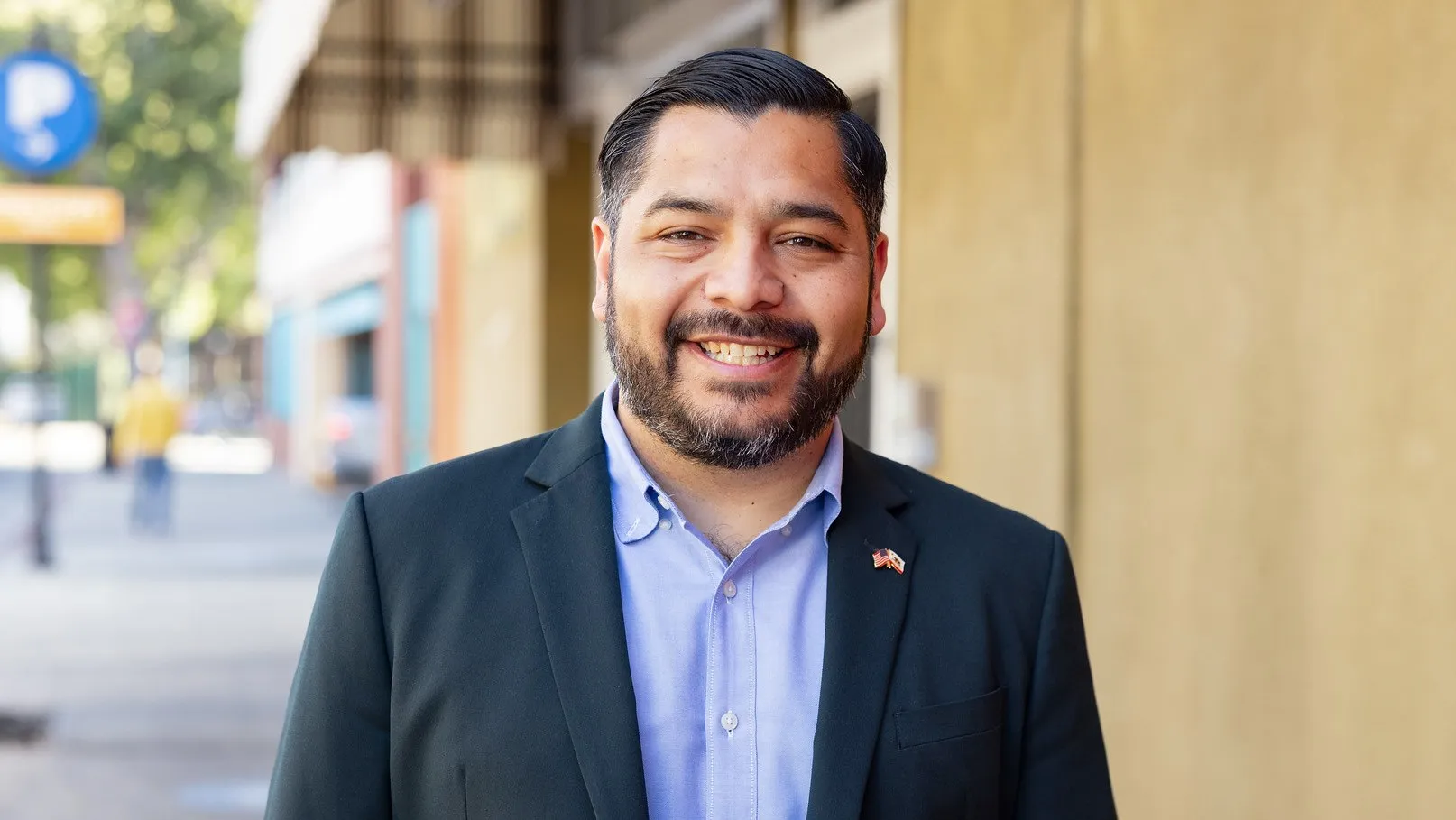
Ahead of the November general election, the Southern California News Group compiled a list of questions to pose to the candidates who wish to represent you. You can find the full questionnaire below.
Read more Paula Swift, Assembly District 70 candidate, 2026 election questionnaire
Name: David Penaloza
Age: 38
Current job title: Councilmember/Director of Regulatory Affairs
Political party affiliation: Democrat
Incumbent: No
Other political positions held: Santa Ana City Councilmember (2018- present)
City where you reside: Santa Ana
Campaign website or social media: DavidPenaloza.com
Fuel costs for Californians are higher than anywhere else in the country. What specific policy would you support to ease the burden drivers feel at the pump? And how would you measure whether that policy was actually successful? (Please answer in 200 words or less.)
Gas prices are continuing to increase and fluctuate, which has been driven largely by the Trump administration’s failures and foreign policy conflicts.
However, there are ways to give Californians significant and immediate relief at the pump. I would support re-evaluating or suspending policies like the gas tax that are placing an additional financial burden on working families. Additionally, we need to look at the overall cost of vehicle ownership as a way of mitigating the effects fuel prices have on Californians. Vehicle registration and car maintenance are all within the wheelhouse of policies that the legislature can review that increase costs for residents.
How can state lawmakers ease barriers for those wishing to become homeowners and unburden renters with high rental costs, or is this an issue beyond the scope of Sacramento? (Please answer in 200 words or less.)
Far too many young Californians can’t afford to buy a home where they grew up, and too many older Californians are being priced out of homes they’ve lived in for decades. We need to be making it easier and less expensive to build more housing at every level of affordability. That means more single-family homes, more condominiums, more townhomes, and more apartments. Increasing supply will drive down the high cost of rent and give families more attainable options.
However, most people do not want to rent forever. They want the opportunity to have their own home. That’s why we need to expand first-time homebuyer programs, including down payment assistance plans, and increase pathways for young families to buy a home.
At the same time, young families are being outbid by large corporate investors who are willing to pay sometimes double, even triple, what the average Californian can afford. We should hold these companies accountable, increase transparency, and investigate reasonable limitations on the number of homes they can purchase.
Elected officials often talk about the need to prevent people from losing their homes in the first place as part of combating homelessness, but California has more people living on the street than any other state. How would you work with colleagues in Sacramento to get people off the streets and into stable housing situations? (Please answer in 200 words or less.)
I believe that approaching homelessness as simply an issue of housing scarcity ignores other underlying factors that are contributing to our statewide homelessness crisis. People experiencing homelessness all have different paths and stories, but most unhoused people have not only been priced out of their homes, but they are also struggling with drug addiction and mental health issues.
Addressing homelessness needs to be done with a multi-pronged approach that includes increasing access to wraparound services, including mental health support and drug rehabilitation programs. I believe the state needs to put money into enforcing Prop. 36, which our state, county, and district voted in support of. Here in Santa Ana, we’ve found success by enforcing our street outreach program to clean up our streets, by prioritizing getting people into safe and stable housing, and by working to get them the help they need to stay off the streets.
California has the highest grocery prices of any mainland state in the U.S. What’s one specific policy Sacramento could support to bring down food prices for individuals and families struggling to make ends meet? (Please answer in 200 words or less.)
To put it plainly, the price of everything has increased dramatically, and Orange County families are feeling the impact every time they go to the grocery store. It’s important that we are looking at ways to reduce overhead costs on what it takes to get these products to the grocery store. Costly regulations and unfunded mandates placed on our farmers and the rising costs of transportation are all driving up costs, and families are paying the price.
California’s budget approved by officials this summer included $300 million to offset healthcare costs expected with the expiration of federal subsidies. Do you support this effort by state lawmakers? Also, what would you do to protect Californians’ access to healthcare in light of federal changes that have restricted benefits to various groups? (Please answer in 200 words or less.)
Yes, I strongly support this action taken by the state legislature to offset healthcare costs and ensure that Californians, regardless of immigration status, ZIP code, or identity, have access to the quality, affordable health care that they deserve. I also believe it’s important to remember that California is a donor state. The money that the federal government cut from us is the same money that we put in. It’s time to start being creative and standing up to the federal government in the face of political attacks that are hurting our most vulnerable communities. We need to make sure that we are spending money on things that matter and ensure we are spending tax dollars effectively and efficiently to make sure Californians are taken care of.
California’s high-speed rail project has been beset by delays, ballooning costs and federal funding cuts. Should the state continue with this project? Why or why not? If you support moving forward with the project, how do you propose the state pay for it? (Please answer in 200 words or less.)
Read more Tri Ta, Assembly District 70 candidate, 2026 election questionnaire
The cost overruns, waste, and inefficiency in the high-speed rail project have been inexcusable. I believe investing in public transportation is important for growing our communities and local economies, which is part of why these failures are so frustrating. California voters agreed to move forward with a job-creating project to develop high-speed rail, all with a promise of federal support. While I hope that the financial obstacles we’re facing, which stem, in part, from political attacks from the Trump administration, are temporary, we must be able to deliver for our residents in a fiscally responsible timeline.
Increasingly, we’re seeing communities push back on data centers opening in or near their neighborhoods. Environmentalists complain about the amount of water and energy that data centers need to operate. Residents complain about relentless noise pollution. And others worry about losing agricultural land to these centers. On the other hand, the tech industry emphasizes the role of data centers in supporting cloud computing and artificial intelligence. As a policymaker, how would you balance the concerns of critics with desires to ensure that California remains a leader in innovation? (Please answer in 200 words or less.)
While I am open to new possibilities and growing our communities, I believe data centers need to be held responsible for how they build and how they are operating. There needs to be oversight, accountability, and a clear definition of data centers to ensure that we can create strong protections for residents. In no way should residents be subsidizing the costs of utilities that these data centers are using.
Do you support Proposition 40, the proposed billionaire’s tax that would impose a one-time, 5% tax on individuals and trusts with a net worth of more than $1 billion? Revenues from the tax would primarily go to fund healthcare-related programs, including Medi-Cal, though a small portion would also be used to fund food assistance and education-related programs. Explain why you do or do not support this measure. If you don’t, what alternative solution do you propose so that the state has money to pay for the types of services this tax is intended to fund? (Please answer in 200 words or less.)
While I recognize that the intended effect of Prop. 40 would be to address the growing wealth gap, I do not support Prop. 40, and I am generally not supportive of any new tax increase. I believe there is a lot that we can do currently to ensure our tax dollars are being spent effectively and efficiently, and that does not involve any significant unintended consequences for our state’s revenue.
The state has ambitious goals to transition away from heavy reliance on fossil fuel. Meanwhile, oil refineries in California that shut down in the past year said they did so in part because of the state’s costly regulatory requirements and decreasing consumer demand for traditional gasoline. But the closure of these refineries have drivers concerned about the price of gas going up – especially at a time when affordability remains the No. 1 concern for many Californians. How would you balance the state’s clean energy goals with desires to prevent Californians from further pain at the pump? (Please answer in 200 words or less.)
As our state continues to transition to a cleaner economy and reduce our reliance on fossil fuels, we need to ensure that working families can financially transition alongside us. And until there is the necessary infrastructure, we need to make sure that we are supporting both industries during this transition to ensure that Californians aren’t paying the price.
Similarly, the Trump administration is aggressively pushing to expand offshore oil drilling and production in California. Explain why you do or do not support this move. If not, do you believe California state leaders have the legal authority to stop or restrict it? (Please answer in 200 words or less.)
I do not support the Trump administration’s aggressive move to expand offshore drilling in California. Our state should absolutely have the right to stop the federal government from these actions when our communities are at risk. It’s critical that we protect our coastlines, wildlife, and the health and safety of residents from potential oil spills.
A law signed in 2024 establishes statewide standards for new, large warehouses in California, including distance buffers separating warehouses from schools, homes and other so-called “sensitive receptors.” Do you support Sacramento having a role in local land-use decisions when it comes to logistics? Why or why not? Is there anything else state government should do when it comes to regulating warehouses? (Please answer in 200 words or less.)
Absolutely, I believe our elected state representatives should have a role in these decisions. We have a responsibility to protect communities, and we should be able to regulate warehouses to protect schools and homes.
Tell us about a time you’ve changed your mind on a political position. What was it, and what changed your mind? (Please answer in 200 words or less.)
Until I became a parent with two children, I didn’t appreciate how challenging, expensive, and essential high-quality childcare is. I always thought that on two incomes, my wife and I wouldn’t have a problem affording childcare. But we’ve struggled to keep up with bills while also paying for reliable, quality childcare. It’s an issue I’m going to focus on in the legislature, because I believe many working families are struggling with the same challenge.
Bonus question: What is the best book you’ve read this year? Explain why you found it compelling.
“The Ins-N-Outs of In-N-Out Burger” by Lynsi Snyder! I thought this was an incredibly interesting and compelling book detailing the story of how a working-class family was able to build a fast food empire without losing sight of the quality of their products and treating their workers and employees well. The founder talked about what it means to build up and give back to a community while working to achieve your version of the American (or should I say Californian) Dream, and I believe a lot of those same ideals can be translated to elected office.
Read more JJ Galvez, Assembly District 71 candidate, 2026 election questionnaire