
Aside from standing in for the governor when that person is out of state and being next in line to become California’s chief executive should that office become vacant, most voters have only a vague idea of what the lieutenant governor does on a day-to-day basis.
Read more Time for term limits? Dems in majority could have familiar faces in key roles
And yet, as the second-in-command in California, the lieutenant governor serves on boards and commissions dealing with higher education, public land use, coastal issues and economic development.
In practical terms, the person elected to this office can help shape California’s higher education and housing landscapes, its economy and climate goals.
And as president of the state Senate, the lieutenant governor gets to cast the tie-breaking vote in that chamber on the rare occasion that the need arises. (That hasn’t happened since 1996, according to California State Library communications manager Alex Vassar, when then-Lt. Gov. Gray Davis was summoned to vote on a controversial bill concerning same-sex marriage.)
All this to say that while most voters may not be all that familiar with the role of the lieutenant governor, the position can significantly impact Californians.
And both candidates running for this position believe they would be the one to make the most meaningful impact if elected.
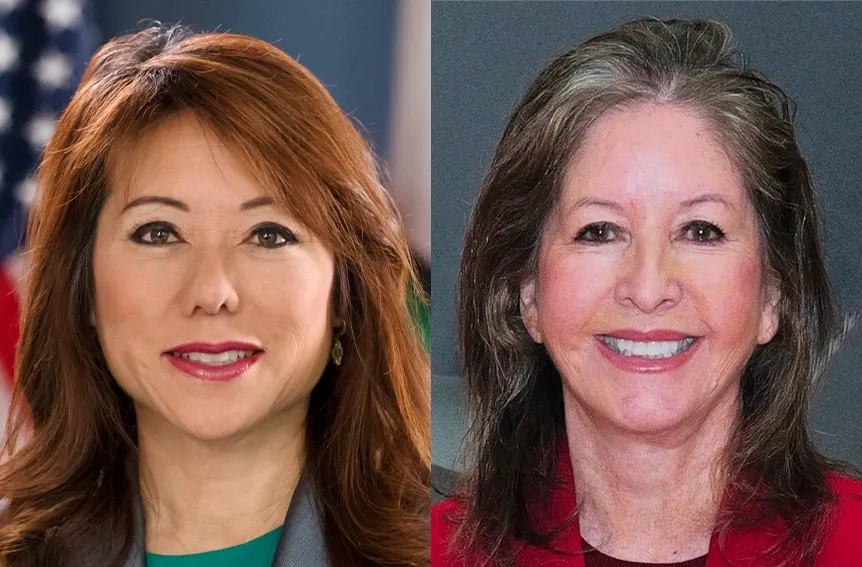
California Treasurer Fiona Ma, a Democrat, and former state Sen. Gloria Romero, who left the Democratic Party and registered as a Republican in 2024, are vying to succeed termed-out Lt. Gov. Eleni Kounalakis. (Kounalakis, a Democrat, is running for state treasurer against Republican Jennifer Hawks, a retired businesswoman, this year.)
We asked Ma and Romero to answer a set of questions about their plans to keep higher education affordable and bolster California’s workforce. Here’s what they had to say, based on their written responses and follow-ups with their campaigns.
College affordability
The lieutenant governor sits on the governing boards for the University of California, California State University and California Community Colleges systems.
To provide financial relief for students and families, Ma said she’d advocate for UC and CSU tuition freezes, more affordable student housing and an expansion of paid internships.
And she wants to explore potential partnerships with financial institutions or other private-sector organizations to increase grant funding to cover gaps between what students receive in financial aid and what they need to pay for living expenses.
“California should expand Cal Grants to cover the full cost of attendance — not only tuition, but also housing, food, books, transportation and childcare. These expenses often force students to work excessive hours, incur debt or leave school before earning a degree,” Ma said.
She said she would advocate for a “total cost of attendance” grant supplement for low- and middle-income students, prioritizing first-generation students, students who are parents and those experiencing housing or food insecurity.
“As state treasurer, I have helped finance student housing and supported programs that help families save for college,” Ma said. “I understand that affordability involves more than tuition. Students should not have to sleep in their cars, work multiple jobs or travel long distances simply to earn a degree.”
Meanwhile, Romero said that before asking UC families to pay more, she would push “to cut administrative bloat, scrutinize excessive executive compensation, protect classroom instruction, expand affordable student housing, accelerate graduation, and confront academic under-preparation that can increase the time and cost of earning a degree.”
Read more The midterms stakes are high for these 2028 presidential prospects
The former Los Angeles Community College District trustee and former state Senate Education Committee chair, who has also taught college-level courses, said she would encourage the use of remote, online, artificial intelligence and round-the-clock course offerings so students have more chances to enroll in classes they need to graduate. Right now, students sometimes get shut out of courses they need because the classes are already fully enrolled. That forces them to wait at least until the following term to enroll, potentially delaying graduation.
Romero also proposed a degree guarantee concept where colleges and universities would be required to offer courses a student needs to complete their degree program within the traditional timeframe or offer an alternative solution, such as allowing them to take the course at another campus, substitute an alternative course or waive the course requirement if academically appropriate.
If a student who otherwise is making satisfactory academic progress is forced to delay graduation and enroll in another term because the course they needed wasn’t available, the college or university would cover the tuition and mandatory fees for that course.
Like Ma, Romero acknowledged that aside from tuition, issues like housing, food and transportation can be factors in whether a student graduates.
“I would prioritize existing financial aid dollars toward students with the greatest demonstrated need and demand greater transparency and accountability for how colleges control the cost of attendance,” Romero said.
Workforce development and the economy
Another key area the lieutenant governor focuses on is economic development.
Romero said she’d bring together housing developers and advocates, small business owners, employers, workers, educators and regional leaders “to identify the regulations, costs and workforce shortages that are holding back hiring — and push the governor and legislature for solutions.”
She also said she would promote trade, port modernization, infrastructure investment and “responsible development” that results in good-paying jobs through her roles on the California State Lands Commission and California Commission for Economic Development.
“As lieutenant governor, I will use the office as a statewide advocate for job creation, economic opportunity and slashing housing regulations, which is key to making California affordable again,” Romero said.
Both Romero and Ma spoke of strengthening partnerships between employers and colleges and universities, including apprenticeship programs, to develop future workforces.
Ma, a certified public accountant, noted her past work helping women- and minority-owned small businesses compete for contracts and said she’d continue advocating for more access to capital, streamlined permitting and fewer barriers for businesses as lieutenant governor.
“I will use my financial expertise to continue to expand affordable housing and homeownership, improve access to capital for small, women- and minority-owned businesses, and connect workforce training with good-paying jobs in healthcare, agriculture, technology, advanced manufacturing, clean energy and the creative economy,” Ma said.
Ma and Romero were the No. 1 and 2 vote-getters, respectively, in the June primary election, out of a field of six leading candidates.
To read more about the candidates’ positions on these and other issues, check out their full responses to our questionnaire in our online voter guide.
Read more First suicide memorial by a US archdiocese signals a compassionate shift by the Catholic Church
Voters have through Nov. 3 to cast their ballot for the general election.