
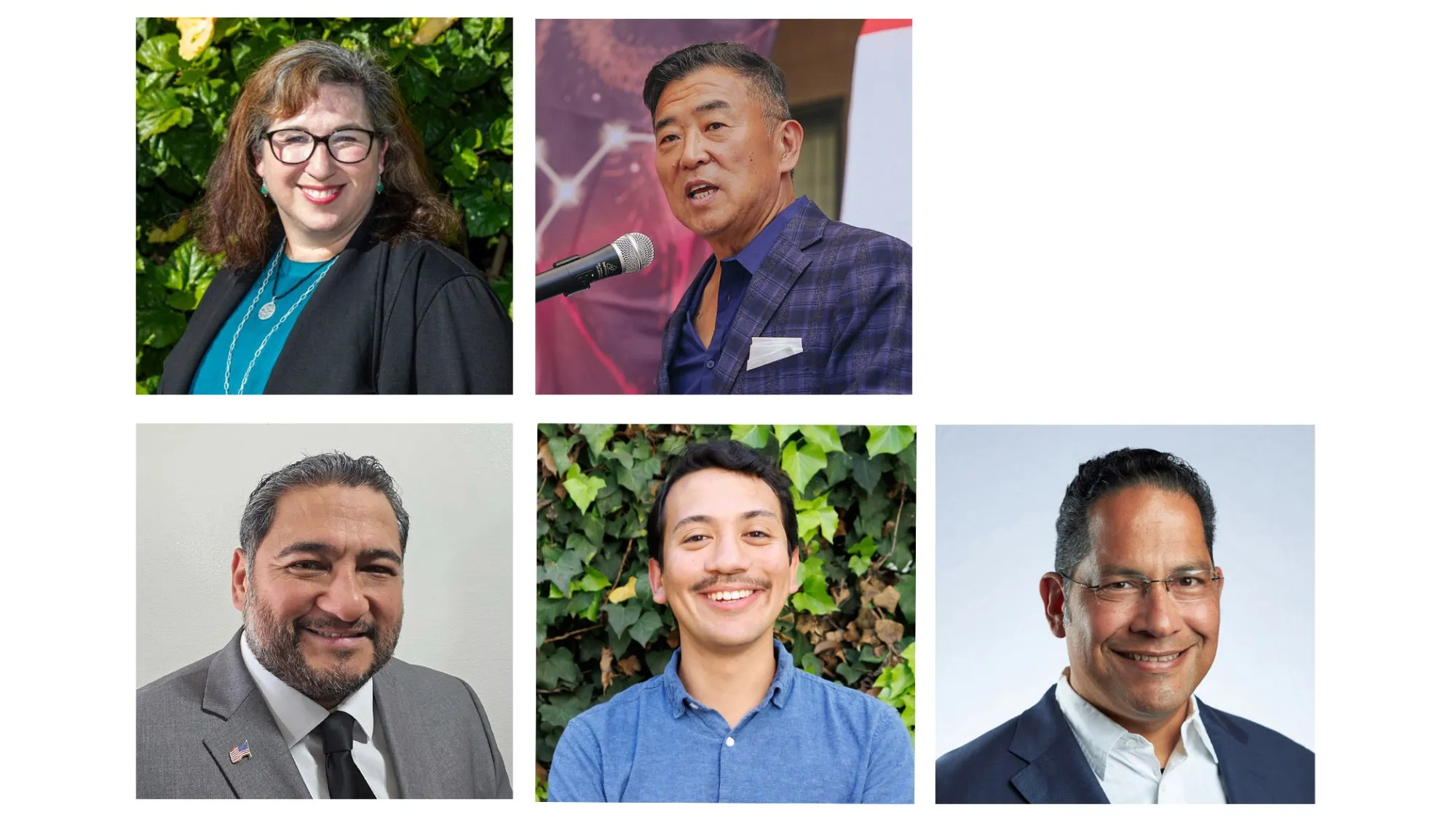
Fullerton voters will be deciding two City Council races this November, with at least one new face destined for the dais.
Read more Katie Zacharia, Trump’s new White House press secretary, makes a brief appearance before reporters
On the ballot for District 3, voters will see two candidates: incumbent Shana Charles and Daniel Kim, a businessman.
Vying for the District 5 seat — Councilmember Ahmad Zahra did not seek reelection — are David Fischbein, a quality assurance specialist, Jozef Maldonado, a production chemist, and Oscar Valadez, a construction contractor.
We asked the candidates questions about housing, city finances, transparency, and more, which you can read in our voter guide.
Here are their answers to a couple of questions:
How can the city best meet the demand and mandates for more housing, including at lower price points, while also preserving local control and the quality of life for existing neighborhoods and residents?
District 3
Charles: I’ve been encouraging housing growth in all areas, supporting all building projects that have come before council. I also have supported building new affordable housing in our city and at Cal State Fullerton (which is in my district), and have linked renters to resources to improve their current housing situations, whether financial or code enforcement.
We have an obligation to fulfill our housing goals, and I believe we need a balance of apartment rentals, affordable multi-family residences, and single-family homes to have a vibrant and thriving city.
Kim: As executive director of an affordable housing nonprofit that has developed communities across California and Arizona, I understand this issue from the implementation side, not just from a government dais. Meeting our housing mandates doesn’t mean settling for one-size-fits-all, cookie-cutter apartment blocks. It means building the right mix of housing types — rental, workforce, senior, and ownership — matched to what different neighborhoods actually need, using tools like transit-adjacent infill, adaptive reuse, and accessory dwelling units.
Homeownership matters. Wherever possible, our housing strategy should include a genuine path to ownership, not just more rental units. That’s the American Dream, and it builds the kind of long-term investment in a community that renting alone doesn’t.
Local control still matters too: Where state mandates outpace real infrastructure capacity — traffic, parking, water, schools — Fullerton should use every bit of discretion state law allows and protect the character of our existing neighborhoods.
I’m fiscally responsible in how we spend, and I believe in building housing the right way: diverse in form, reflecting the surrounding community, designed for long-term quality of life and community vibrancy, not a short-term, one-size-fits-all fix.
District 5
Fischbein: Fullerton needs a balanced approach to housing that creates more opportunities while protecting the quality of life of our established neighborhoods. I support responsible housing development in appropriate locations, including underused properties and commercial corridors, while opposing one-size-fits-all development that creates excessive density, parking problems, or additional strain on city services.
As Fullerton grows, housing must be planned alongside the infrastructure and services needed to support it. I will encourage stronger partnerships with Cal State Fullerton and Fullerton College to address student housing pressures and support housing options for working families, young adults, seniors, veterans, and longtime residents. My goal is responsible growth that expands housing opportunities without sacrificing the neighborhoods that make Fullerton a great place to live.
Maldonado: Fullerton needs more housing, but we need to be thoughtful about where and how we build it. I support adding housing along major corridors and in underused commercial areas where development makes sense, while protecting established neighborhoods from poorly planned projects.
We also need housing at different price points. That means making it easier to build starter homes, apartments and affordable housing while cutting unnecessary delays and costs in the permitting process. At the same time, new development needs to account for infrastructure, traffic, parking, parks and other services.
The answer cannot simply be saying yes to every project or saying no to everything. We need a housing strategy that meets our obligations, increases supply and gives working families a realistic chance to afford living in Fullerton.
Valadez: Fullerton needs more housing that working families, seniors, and young people can actually afford — and we need to grow responsibly. As a planning commissioner, I believe we can meet our housing obligations while protecting the quality of life that makes our neighborhoods special.
New housing should be focused in appropriate areas, particularly near transit, jobs, commercial corridors, and other locations where additional density makes sense. Fullerton should offer a range of options — starter homes, townhomes, apartments, ADUs, and senior housing — so residents at different stages of life have real choices. At the same time, Sacramento should not dictate every land‑use decision through a one‑size‑fits‑all approach. Cities need flexibility to determine where and how housing fits their communities.
Housing also cannot be planned in isolation. New development must be paired with adequate streets, water and sewer infrastructure, parks, public safety, parking, and other essential services. My approach is responsible growth: meet our housing needs, preserve established neighborhoods, involve residents in the planning process, and ensure development strengthens Fullerton for future generations.
In your opinion, what is the biggest need your city faces, and how would you address it?
Read more Kroger to lay off 3,000 corporate employees over 3 years as it leans into artificial intelligence
District 3
Charles: Roads and infrastructure repair and safety, increasing green space and sustainable active transportation, homelessness and affordable housing, and community cohesion, including supporting our neighbors being targeted by ICE, all of these are critical issues facing Fullerton right now.
But with the worst roads in the county for decades now, it’s past time to get serious about how we are going to tackle the over $200 million of backlogged road repairs that are needed to bring us up to par. Since the mid-1990s, we have tried again and again to cut services, to reallocate funds, to bring in grants, to identify other funding sources to fix our roads. And other cities have passed a small sales tax and fixed their roads. It’s time for Fullerton to get serious about fixing our roads with a dedicated half-cent sales tax, with 100% going to roads.
I will pursue that along with increasing county funding so that by the end of my second term, Fullertonians will see real, visible, tangible progress.
Kim: Fullerton’s biggest need is public safety staffing, and alongside that, trust. FPD is currently understaffed by roughly 20% relative to authorized positions, which limits proactive policing and strains response times outside downtown. Closing that gap also requires rebuilding trust: trust that resources will be used well, and trust that commitments made to officers and residents alike will be honored.
I’d address it primarily by growing the city’s revenue base: promoting Fullerton and attracting sustainable economic development, supporting rational, deliberate growth rather than reaching for tax increases as a first resort, and rationalizing the city budget so spending reflects real priorities, with public safety as the largest priority in that budget.
If additional revenue is still needed, I’d support a limited, sunset-term general sales tax measure, requiring approval by a majority of Fullerton voters, paired with a public commitment that funds go toward the purpose promised. No deal — whether in a boardroom or at the ballot box — gets done without that kind of trust, and Fullerton has to earn it back.
District 5
Fischbein: Infrastructure. Fullerton’s road problem is not a mystery: decades of deferred maintenance have left nearly half our neighborhood streets needing major repair. I will fight for a transparent street-repair plan, independent audits of paving contracts, stronger quality controls, and fair investment. Residents deserve to know where the money goes, which roads get repaired, and why.
Fullerton is a college town and Cal State Fullerton and Fullerton College are important parts of our community, but partnership must work both ways. I will press both institutions to pursue transparent, long-term agreements modeled on the Berkeley approach — helping Fullerton recover documented fire and emergency-service costs and investing in streets, sidewalks, lighting, traffic improvements, and other infrastructure affected by campus activity.
Other Orange County cities are improving neighborhood roads through preventive maintenance, dedicated funding, transparent project schedules, and competitive contracting. Fullerton should apply those same practices for safer streets, repaired sidewalks, and accountability for every infrastructure dollar. As we pursue responsible economic revitalization, including new businesses, productive reuse of vacant properties, and expanded visitor activity, we should work to direct a responsible share of new, ongoing city revenue toward neighborhood infrastructure without raising taxes or promising money before it materializes.
Maldonado: Fullerton’s biggest need is getting its financial house in order so we can reliably provide the basic services residents expect.
Our budget problems show up everywhere: deteriorating roads, reduced library services, aging infrastructure and difficulty making the long-term investments our neighborhoods need. We cannot solve each of those problems separately without addressing the underlying financial situation.
I would focus on growing our local economy, supporting small businesses, attracting new investment and making Fullerton easier to do business in. At the same time, we need to prioritize core services and infrastructure and make sure taxpayers are getting value for what we spend.
My goal is not simply to balance one year’s budget. It is to put Fullerton on a sustainable path where we can maintain our roads, parks, libraries and public safety while planning for the future instead of constantly reacting to the next fiscal crisis.
Valadez: Fullerton’s biggest need is rebuilding trust in City Hall and restoring our ability to work together to solve problems. We face real challenges — aging streets and infrastructure, financial pressures, public safety concerns, homelessness, housing affordability, and maintaining our parks and neighborhoods. We will not solve them if City Hall is divided and residents have lost confidence in their government.
As a councilmember, I would focus on what matters: setting clear priorities, making responsible financial decisions, investing in essential services and infrastructure, and measuring whether we are actually delivering results.
Just as importantly, the City Council must work as a team. We will not always agree, but councilmembers should operate in good faith, listen to residents and one another, and look for common ground rather than allowing personal or political differences to prevent progress.
My approach to public service is simple: service above self. Put the community first, rebuild trust through transparency and results, and bring people together to make Fullerton stronger for the next generation.
Read more of the voter guide, including what the candidates said would make them good leaders and how they would represent the city’s diverse community at ocregister.com/voter-guide.
Ballots may be returned by mail (must be postmarked by Nov. 3 and received within a week of Election Day) or to the OC Registrar of Voters’ drop boxes around town now, and the first vote centers will open for casting ballots in person on Oct. 24.
Read more UCLA forward Timea Gardiner hoping for injury-free 2026-27