
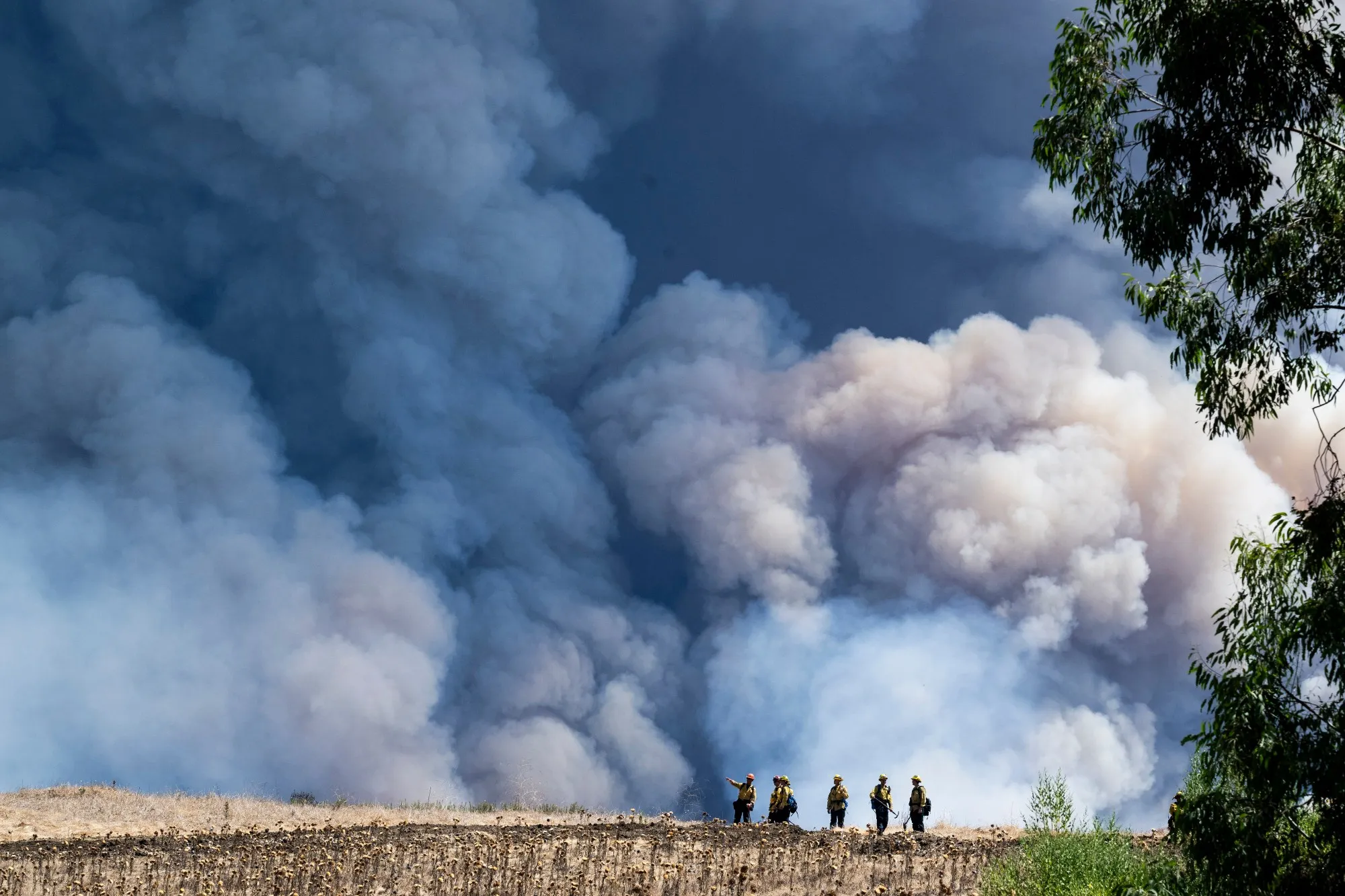
The Orange County Fire Authority is preparing to test software that allows firefighters to simulate how their actions could change the course of a wildfire, part of a broader effort to use emerging technology to improve wildfire response.
Read more Watchdog group seeks to block Jared Kushner from serving in his volunteer envoy role
The agency recently reached an agreement with Paladin Industries, a San Francisco Bay Area company developing technology that allows firefighters to model a wildfire’s spread and test how different responses, such as establishing containment lines or dropping fire retardant, might affect its path.
OCFA is also working with FireWERX, a nonprofit that connects fire agencies with technology developers and researchers, on a separate competition offering up to $300,000 in funding to develop technology to track firefighters working in remote areas where communications are unreliable.
Both initiatives were discussed Tuesday, Oct. 13, during a wildfire technology roundtable hosted by Rep. Young Kim that brought together fire officials, researchers and technology developers.
Testing wildfire strategies
“We’ve had predictive modeling available for a long time,” OCFA Division Chief Mike Sheehan said. “It’ll provide us, based on fuels, weather, topography and conditions, where we can expect the fire to be in an hour, three hours, 10 hours — but it’s based on if we do nothing. Well, we’re not doing nothing, right?”
Paladin’s technology aims to address that limitation by incorporating firefighters’ proposed actions into computer simulations, allowing commanders to compare how different strategies might change a fire’s predicted spread, company founder Jackson Yip explained.
Paladin’s software does not use artificial intelligence, a deliberate choice by the company.
“We don’t use AI,” Yip said. “We’re intentionally not using AI because then we can dig into the reasons why decisions were made, the reasons why the fire spread the way it did.”
Sheehan said the software could help OCFA prepare its incident commanders by allowing them to revisit historical wildfires, test different responses and see how those actions might have affected a fire’s development.
The simulations could be particularly useful in areas with a history of wildfires, he said, including along Laguna Canyon Road.
“Certainly the actions that we take, some are going to be more effective than others,” Sheehan said. “So, to be able to test that in a safe environment … is going to help build our fire plans, our pre-planning out, to where we can better respond to these incidents and protect homes better.”
Read more Southern California woman sought for bank fraud added to FBI’s ‘Most Wanted Fraudsters’ list
Sheehan also described a potential use for community wildfire education, including showing homeowners associations and fire safety councils how fire-resistant vegetation could affect a wildfire’s behavior.
Yip said the company finalized its agreement with OCFA the previous week, becoming its first fire agency partner in Southern California.
He said he expects OCFA’s work with the technology to begin this winter.
FireWERX is also working with Paladin on a subgrant on behalf of OCFA to support the technology’s development and expansion, Jackie Williams, FireWERX’s director of State and Local Partnerships and Special Projects, said.
The amount of the proposed subgrant and the cost, if any, to OCFA were not immediately clear.
Tracking firefighters in remote areas
Fire departments can track the locations of their engines and other vehicles, but keeping track of individual firefighters once they leave those vehicles remains a challenge, particularly in remote areas, fire officials said during the roundtable discussion.
“We don’t know where people are, which is extremely concerning from a safety standpoint, but also an efficiency standpoint,” Matt Ahearn, a federal wildfire official, said during the roundtable. “Where do you put that asset at the right time for the right purpose?”
Williams said FireWERX is collaborating with OCFA on a competition to develop technology capable of tracking firefighters on foot in areas with limited or unreliable communications.
The competition, which opened Sept. 30, offers up to $300,000 in funding to help the winning team or teams further develop their technology. Williams said OCFA, the U.S. Forest Service and Cal Fire were among the agencies that helped shape the challenge, with the goal of developing technology that could eventually be used by fire departments across the country.
Applications are being accepted through Oct. 18, with the winning team or teams expected to be announced in December.
“We’re not going to be complacent in this area,” Sheehan said. “We haven’t been for years, so we intend to continue to grow this and be prepared.”
Read more Gavin Newsom, Arnold Schwarzenegger tout California’s role as a climate leader