
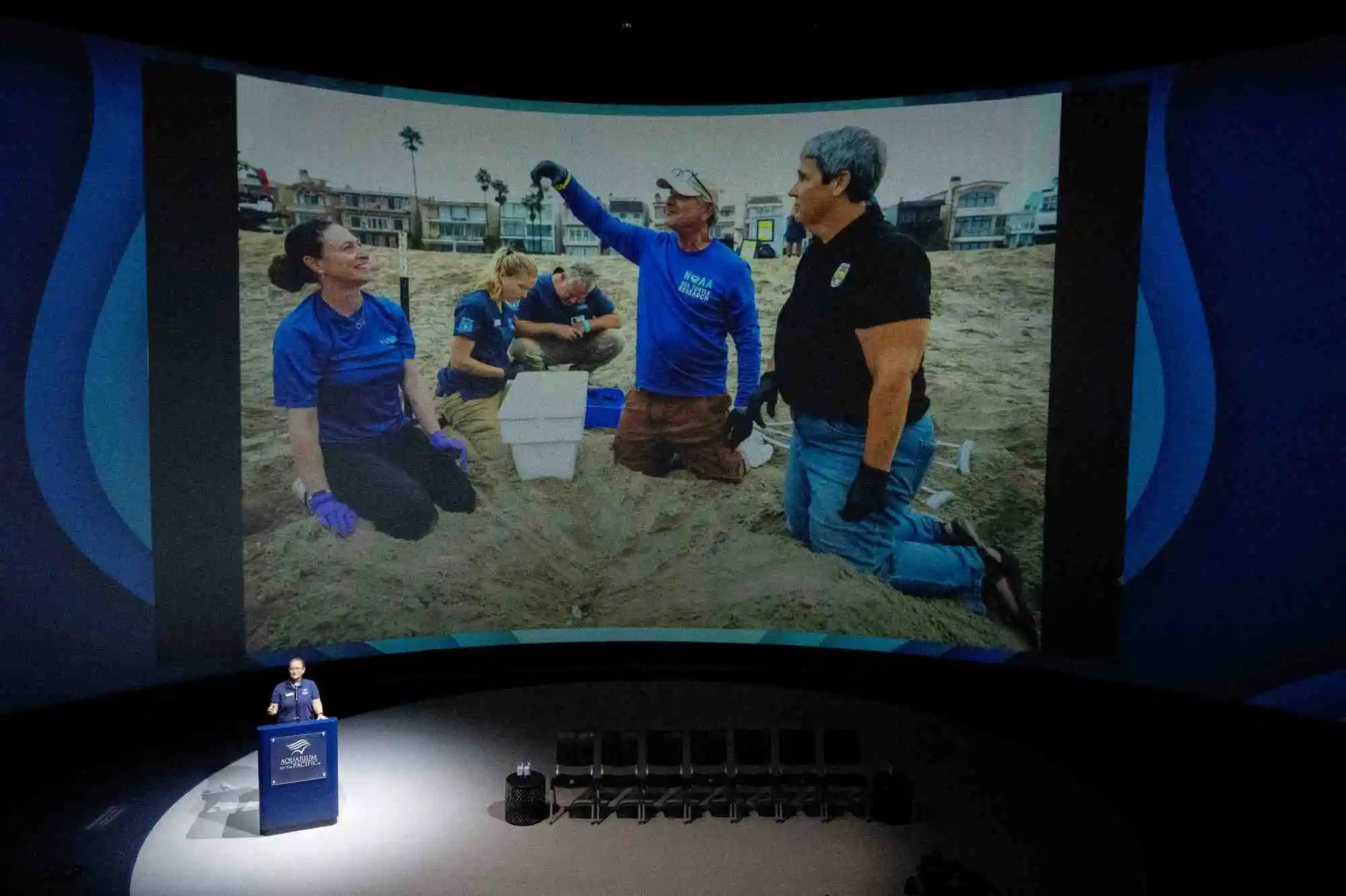
Given the damage inflicted on Southern California shores by recent storms and pounding surf, last month’s decision to move sea turtle eggs laid at two local beaches — rarely seen in Los Angeles and Orange counties — to the Aquarium of the Pacific was hailed as a life-saving move on Friday, Oct. 23.
Read more Sheriff Chad Bianco wants Riverside County to pay legal costs for ballot seizure
“It is likely the nests could have been inundated with water and destroyed from the high surf and waves associated with tropical storm Rachel,” a U.S. Fish and Wildlife Service representative said on Friday. “Both Seal Beach and Huntington Beach documented high surf and standing water in the vicinity of the nests after the storm.”
More than 200 endangered olive ridley sea turtle eggs are being monitored at the Long Beach aquarium after they were removed from two Orange County beaches threatened by high surf and tides. The eggs are expected to hatch in early November, officials said.
Two teams set out around dawn on Sept. 25 to excavate the nests near the Seal Beach National Wildlife Refuge and in Huntington Beach, removing 104 eggs and 100, respectively, said Aquarium of the Pacific President and CEO Jeffrey Flocken.
The eggs were transported to the aquarium, where they will be incubated in hopes that they will be viable and hatch, Flocken said.
“This is an unprecedented situation, and we’re proud to provide a temporary home for these eggs as they incubate,” Dr. Lance Adams, veterinarian at the Aquarium of the Pacific, said at the time. “We’re hopeful that this will lead to a successful hatching in the near future and a successful release back to the wild.”
Officials had been monitoring Hurricane Polo and the potential for large swells at the time. The storm, later followed by tropical storm Rachel, contributed to powerful swells that pounded Southern California shores with damaging surf, overwhelming multiple beaches and doing severe damage to homes on the Long Beach Peninsula.
The decision to move the eggs prior to the storms was made by federal and state wildlife officials, Flocken said, explaining that the National Oceanic and Atmospheric Administration, California Fish and Wildlife, and the U.S. Fish and Wildlife Service got together and determined that the best chances of survival “would be to excavate those eggs before these swells happened, and potentially flooded (the area), and which would have killed the eggs in these different nests, rendering them not viable to be hatched.”
The two nests, discovered Sept. 16 and Sept. 19, were the first confirmed natural sea turtle nests on the U.S. West Coast, according to the interagency team overseeing the nests. The first nesting spot was found near the Seal Beach National Wildlife Refuge. Three days later, an olive ridley turtle laid eggs near the Huntington Beach Pier. Officials later determined the eggs had been laid by two different turtles.
Olive ridley turtles are the smallest sea turtles, with adults weighing up to 100 pounds and growing between 2 and 3 feet in length, according to the NOAA.
Nesting turtles typically lay multiple nests over the nesting seasons to increase chances that some will hatch successfully if others are lost, the U.S. Fish and Wildlife Service said.
Read more What’s going on with Dan Sullivan and Dan Sullivan? The Alaska Senate litigation, explained
“If the eggs hatch, the current estimate is that they will … (emerge) sometime the first two weeks in November,” an agency representative told CNS on Friday, adding that moving sea turtle eggs to an incubator setting does not necessarily improve their chances of hatching.
“Handling can affect hatching success; changes in temperature, moisture and oxygen can also affect hatching success, hatchling health and the natural balance of males and females,” the wildlife service said. “For these reasons, nest relocation is used only as a last resort. Instead, our conservation efforts focus on reducing disturbance at the nest site itself such as shielding artificial lights so that eggs can remain in place to incubate and hatch naturally.
“Any hatchlings that do emerge will be released as soon as possible that night to preserve their limited energy reserves for the journey offshore,” the agency added, and the “emerged hatchlings will not be handled or disturbed until they are ready for release, as activity increases their expenditure of limited energy stores.”
Officials will also look at water temperatures and other factors when releasing the hatchlings, the wildlife service said.
“Depending on water temperatures and beach conditions,” the agency said, “hatchlings will be placed just landward of the surf zone and allowed to crawl the short distance to the water on their own. Artificial lights will not be used during hatchling releases, as they can disorient the hatchlings.”
A The best estimate is that about 1 in 1,000 sea turtle hatchlings typically survive to adulthood, according to NOAA Fisheries’ Southwest Fisheries Science Center, although the actual rate depends on factors like ocean conditions, predation, fishing bycatch and other variables.
Ocean temperatures off Southern California are beginning to decline, as is typical each fall, according to the science center, but they are still expected to remain above normal.
“However, even with this seasonal change, NOAA Fisheries estimates that ocean temperatures off Southern California will remain around 3-4 degrees C above normal into early next year,” according to a statement from the center.
Anyone who finds a stranded turtle can call the NOAA Fisheries West Coast Stranding Hotline at 562-506-4315. Sightings of sea turtles can be reported using the NOAA Fisheries West Coast Facebook account at facebook.com/NOAAFisheriesWestCoast.
Read more Alan Wapner took 72 trips in 5 years, charging airport agency $184,997