
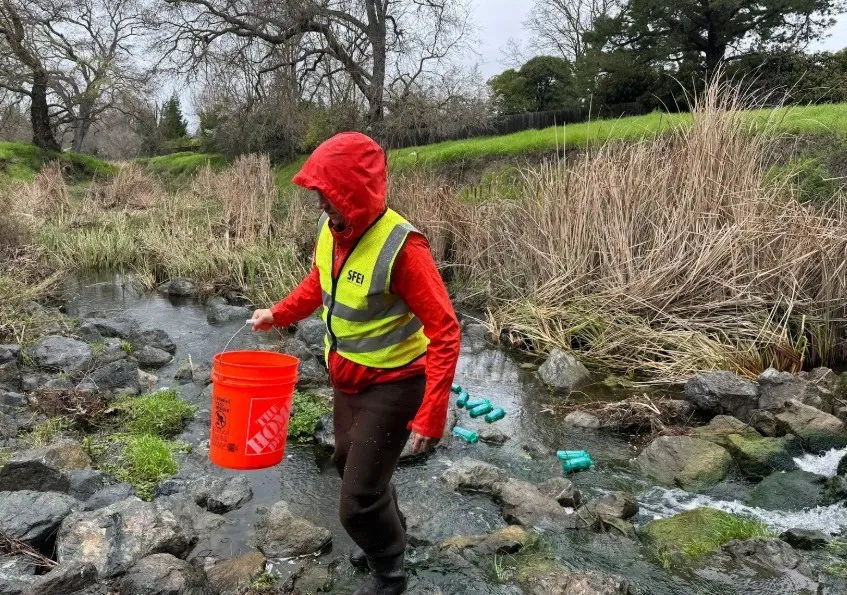
Call it a message in a bottle, 21st-century style. In service of the environment.
Read more As dining costs climb, restaurants rethink what makes a meal worth the price
Scientists working to learn more about ocean pollution placed GPS tags in hundreds of plastic bottles, dropped them into creeks and rivers around the United States and made a surprising discovery: An estimated 50% of plastic bottles entering the ocean or the Great Lakes in North America every year originate from at least 10 miles inland and travel through waterways from as far away as 120 miles from the coast.
The study, published Friday in American Chemical Society Environmental Science & Technology Water, a scientific journal, sheds new light on how litter, even when discarded long distances from the beach, can end up in the ocean weeks or months later.
“Keeping trash out of creeks, even very far inland, is important,” said Alicia Gilbreath, a senior scientist with the San Francisco Estuary Institute, a non-profit research group based in Richmond that contributed to the study. “Everything upstream eventually flows to the bay.”
Gilbreath placed 57 bottles in five creeks in Contra Costa County and found they moved up to 5 miles over a 3-month period.
Each year, roughly 10 million metric tons of plastic enter the ocean from across the world. Much of it flows down rivers to the sea. The long-lasting litter can entangle and choke sea turtles, whales, sea lions, manatees, dolphins, fish and sea birds and other marine animals. Over time, sunlight, heat and waves break up plastic trash into tiny pieces called microplastics, which humans can ingest when they eat fish.
Microplastics can also enter people’s bodies through eating meat or produce, drinking unfiltered water, preparing food on plastic cutting boards or breathing in tiny plastic fibers from carpets, dust, synthetic clothing and other sources.
As part of a broad research project, scientists from the University of Southern California, Florida International University, Loyola, the University of New Hampshire, the San Francisco Estuary Institute and other organizations put GPS tags in 390 bottles. They deposited them in creeks and rivers at seven locations: Walnut Creek in the Bay Area, the Los Angeles Basin, Boston, Miami, Chicago, Washington, D.C. and Toronto.
From 2022 to 2024, they tracked where the bottles went using satellite tags, measured the speed and distance they moved and retrieved them before they reached the ocean or open bodies of water like San Francisco Bay.
The researchers found that plastic bottles can move up to 5 miles a day through watersheds during heavy rainstorms. They move farther in urban areas where concrete channels flow through cities to provide flood protection, and slower in creeks and rivers in forested areas where logs and roots can slow or stall the debris’ downstream trip.
“We have long known that rivers transport plastics to the ocean,” said Britta Baechler, a biologist and director of ocean plastics science at the Ocean Conservancy, a non-profit group based in Washington, D.C., that helped coordinate the study. “We wanted to begin understanding how long it takes and how far it goes.”
The bottles were placed in creeks and rivers of various sizes, different distances from the coast and left out an average of 86 days each.
Even though they were marked as part of a scientific experiment, some ended up in landfills when people apparently found them and threw them away. Others turned up with bite marks from animals and a few were tracked to people’s homes. Most were retrieved by researchers in kayaks or wading in the waterways.
One bottle in the Ipswich River in Boston only traveled about 80 yards. The farthest, in the Los Angeles River, floated 33 miles. Scientists were limited to leaving them out for about 3 months, Baechler said, because of the lifespan of the GPS batteries. If left out longer, they would have traveled farther.
Read more Democrats flipped 9 US Senate seats — the most in almost 70 years
After tracking how far the 8-inch-long, hard plastic bottles traveled and their rate of speed, the scientists built a mathematical model to estimate how far millions of bottles travel across North America under various river and creek conditions, using the rates they found in the study.
They estimated that 50% of bottles that reach the Pacific Ocean, Atlantic Ocean or the Great Lakes in any given year originated from more than 10 miles inland and some can come from as far away as 120 miles inland.
One conclusion, Baechler said, is that even in inland communities, tools such as volunteer litter cleanups, laws to reduce litter like requiring trucks taking trash to landfills to cover their loads with tarps, enclosed garbage cans in parks, street sweeping programs, and installing trash-capture devices in underground storm drains can make a big difference.
“I live in Portland,” she said. “Portland is 70 miles from the ocean. But if there’s a bottle dropped on the sidewalk in my neighborhood, it could end up on the beach.”
Americans use roughly 50 billion single-use plastic water bottles every year, Baechler said. That’s about 145 per person per year on average. Researchers estimate that about 3%, or 1.5 billion plastic water bottles, end up as litter in the environment, on roadsides, creeks, lakes, rivers, bays and beaches each year.
Only 10 states, including California, have “bottle bills” where a 5- or 10-cent deposit is placed on bottles when they are sold and the money is returned to people who turn them into collection centers. Those states tend to have higher rates of recycling, she added.
Experts, who were not part of the study, said the research provides useful information.
“This study pretty much proves what we have been saying for many years now,” said Eben Schwartz, marine debris program manager at the California Coastal Commission. “We are really all connected to the coast no matter where we live.”
Every year in September, tens of thousands of people pick up trash along beaches, creeks and rivers as part of the annual California Coastal Cleanup. This year, people in all 58 counties participated.
Since the event began 40 years ago, plastic items — from utensils to lids to bags — have made up 7 of the 10 most commonly found types of trash during the cleanup. From 1988 to 2025, California volunteers picked up 679,902 plastic bottles, making up about 3% of all the pieces of trash recovered.
“The key is creating less waste in the first place,” Schwartz said.
In the Bay Area, scientists with the San Francisco Estuary Institute put 57 of the GPS-laden plastic bottles in five locations around Contra Costa County — Grass Valley Creek in Danville, Galindo Creek in Concord, Tice Creek in Walnut Creek, and two stretches of Walnut Creek in the city of Walnut Creek and in Concord.
The researchers picked up three times as much plastic trash as the number of bottles in the experiment, Gilbreath said, so even though a few were lost, there was still a net reduction in litter. They recovered the bottles when satellite tags said they were getting close to San Francisco Bay.
“Trash can travel a long distance,” she said. “Aesthetically, it’s not pleasing. Plastic breaks down into small particles that can be ingested by fish and animals. There are harmful chemicals that come with trash. And when trash gets into San Francisco Bay, it devalues the bay that we all love.”
Read more US futures point higher, led by rebound for Nvidia