
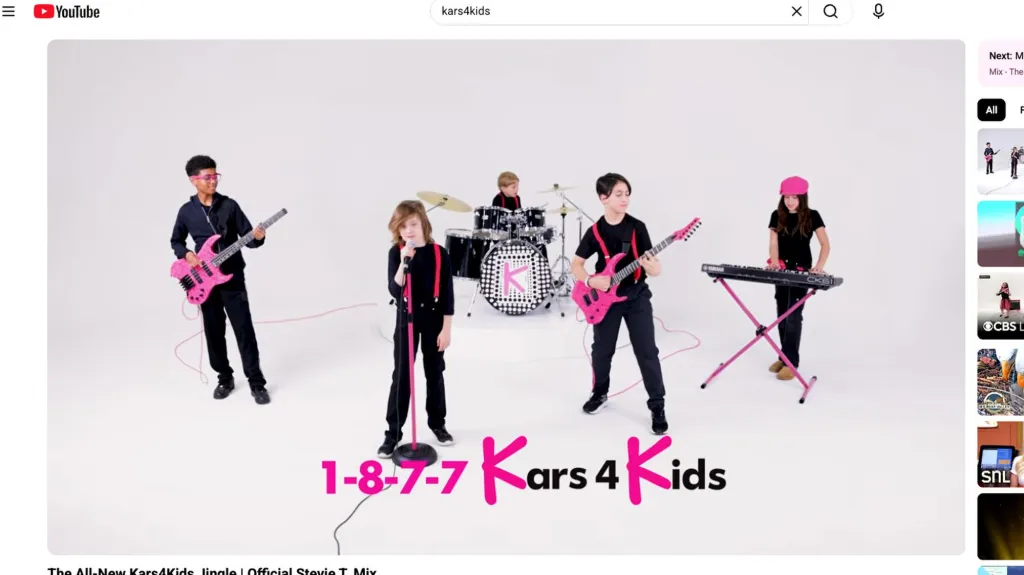
The earworm “Kars4Kids” jingle has been banned from California’s airwaves by an Orange County judge who ruled it could mislead listeners into believing donations were going to underprivileged children in the state.
Read more Scientists find climate change is reducing oxygen in rivers worldwide
Superior Court Judge Gassia Apkarian found the donations actually fuel an organization in New Jersey that spent the money on matchmaking services for young Jews and trips to Israel for 17- and 18-year-olds.
Apkarian ruled the radio and TV commercials violate California’s False Advertising law, and gave the company 30 days to take the joke-inspiring ditty off the air.
“The “Kars4Kids” name, when coupled with an advertisement that ‘does not mention anything’ about its specific mission … is likely to deceive the public,” Apkarian said in her May 8 ruling. She said the ad improperly made it appear that kids were the beneficiaries in order to elicit emotional responses and make it financially successful.
The television commercial depicts young children pretending to play Pepto-Bismol-colored instruments and singing the catchy jingle: “1-877-Kars4Kids, K-A-R-S Kars for Kids, 1-877-Kars4Kids, donate your car today.”
Said the judge: “The name ‘Kars4Kids,’ the 8-10-year-old actors in the advertisement, and the repetitive jingle all serve to reinforce the belief that donations are used exclusively for the benefit of children.”
Apkarian noted the people helped by the donations are actually young adults.
The 30-second ditty, though memorable, has elicited Saturday Night Live skits as well as the ire of listeners who find it irritating, to the point of commenting on social media that the song should be played on repeat to torture terrorist prisoners. Another commenter cleverly wrote: “I’d rather drive my kar off a kliff.”
X commenters on Friday were celebrating the end of the widely annoying jiggle in California.
“I’ve prayed to Jesus for 20 years that I wouldn’t have to hear that jingle again. Now that I’m on the verge of enlightenment it should only take 20 more years of drinking to get it out of my head,” J Glanton wrote.
HikingKat wrote: “We endured this extremely annoying ad for years and they are not even providing benefits to needy kids! You criminals!”
Another X user, CeeCee, wrote: “The nightmare is finally over. … No more bleeding ears.”
Apkarian’s ruling ended a lawsuit by Bruce Puterbaugh, who donated a nonoperational 2001 Volvo XC valued at $250. Puterbaugh had heard the Kars4Kids jingle repeatedly over the radio and believed his donation would help underprivileged children in California.
Read more Santa Clarita man who hacked Disney employee’s computer is going to federal prison
The radio and television commercials do not mention how the money is spent.
Puterbaugh testified that he felt “taken advantage of” after making the donation and discovering that the proceeds did not stay in California, but supported a religious mission on the East Coast.
“That’s not what I wanted. … I feel taken advantage of by the ad and information that was not there,” he testified. He said he never visited the company’s website — which disclosed more information on how the donations are distributed — because he is not a “computer person.”
During the trial, Kars4Kids Chief Operating Officer Esti Landau acknowledged that the two-decade-old jingle “does not say anything” about the charity’s specific nature. Kars4Kids is a Jewish organization, yet the word “Jewish” is absent from the ad; and the primary function of Kars4Kids is to fund Oorah, an organization dedicated to Orthodox Jewish heritage and summer camps in New York and New Jersey.
Landau also acknowledged that while 25% of the revenue comes from California, Kars4Kids has no programs in that state beyond handing out 1,000 backpacks, mostly for branding purposes.
She said Kars4Kids is the primary funding vehicle for Oorah. Approximately $45 million is sent annually to the sister charity, representing more than 60% of Kars4Kids’ total funds. Another 30% is spent on in-house advertising and 6% for administrative costs. Of the 120,000 vehicles donated nationwide, approximately 30,000 (25%) come from California.
Landau added that donors wanting any substantive information regarding the charity’s mission must click on the website.
The judge said reasonable consumers should not have to go to a website, especially if the ad directs them to a phone number — found in the jingle itself.
Apkarian further ruled that using funds for “gap year” trips to Israel for 17-and 18-year-olds or a $16.5 million real estate acquisition contradicts the “needy child” persona cultivated by the jingle.
“The Court finds that the failure to disclose that funds benefit adults and families — and that this support is contingent upon a specific religious affiliation — is a material omission,” she wrote. “The Court finds that the Defendant’s stated intent to make the advertisement ‘memorable’ through extreme repetition, while simultaneously stripping it of all substantive facts, constitutes an actionable strategy of deception.”
The judge ordered Kars4Kids to pay Puterbaugh $250 in damages.
Attorneys for Kars4Kids did not return a voicemail seeking comment.
A separate federal class action lawsuit by against Kars4Kids for false advertising by another plaintiff is pending.
Similar complaints of deceptive advertising were brought against the charity in 2009 in Pennsylvania and Oregon. Settlements were reached there.
Read more Here’s how much drug overdose deaths have declined in recent years
Audience engagement producer Teagan Davidge contributed to this article.