
The “California Dream” continues to be plagued by a persistent affordability crisis.
Read more In Iran’s capital, weapons demonstrations send a signal at home and abroad as threat of war remains
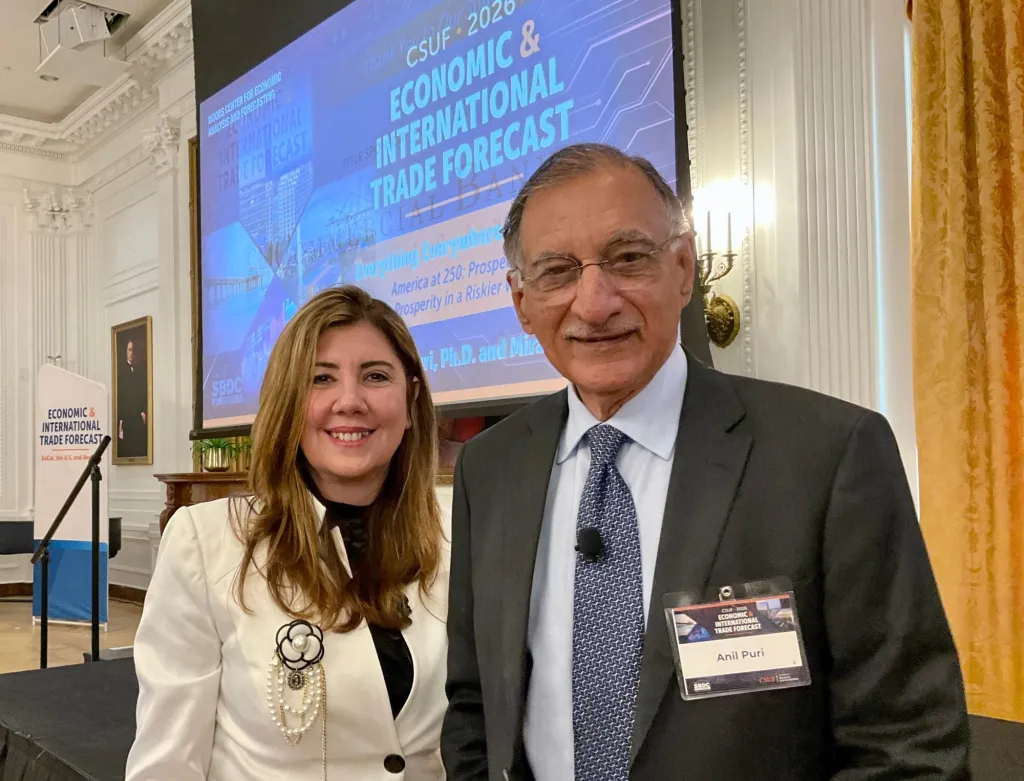
That single sentence captures the litany of data points outlined by economist Anil Puri during Cal State Fullerton’s 2026 Spring Economic Forecast conference, titled “Everything, Everywhere All at Once.”
Puri, director of the university’s Woods Center for Economic Analysis and Forecasting, and economist Mira Farka, the center’s co-director, presented their forecast for the global, U.S., California and Orange County economies on April 29 at the Richard Nixon Presidential Library and Museum in Yorba Linda.
The conference is an annual collaboration between Cal State Fullerton and the Orange County Business Council.
“It comes from a movie, but it’s so appropriate for what’s happening today,” Puri said of the forecast’s title.
In California, the theme is familiar, he said.
Stalled job growth, uneven job creation, outmigration, weaker immigration and rising housing and insurance costs all point to continued population decline.
The affordability squeeze is colliding with that decline and with weaker job creation, Puri said.
“We lost a million people from California,” Puri said. “Domestic outmigration has been negative for many years now. We are sending more people out than are coming in.”
Housing costs remain a major driver. The average price of a home in California is about $827,000 — and $1.9 million in Orange County — compared with roughly $431,000 in Nevada, Arizona or Idaho.
Insurance premiums have risen at double-digit rates over the past decade, with another 10% increase expected this year, Puri said.
“So people are moving out of California to get more homes,” he said. “It has been that way for many years now.”
Even with health care fields adding about 11,500 jobs in 2025, Orange County was still down about 600 jobs overall, Puri said.
Tariffs did less harm than feared
While tariffs have created uncertainty, Puri and Farka said the economic effect has mostly been less severe than feared because the rates announced on paper do not always match the rates actually imposed.
“We reached volume highs in terms of global trade … $26 trillion in global trade just last year,” Farka said. “At the end of the day, tariffs proved to be far less damaging.”
Read more Officers who defended Capitol from rioters sue to block payouts from $1.8B ‘anti-weaponization’ fund
They believe the current escalation will likely soften through negotiations and exemptions.
“Our baseline scenario … assumes that we’re going to have a couple of months of negotiations going on,” Farka said.
Uneven enforcement could also limit economic damage, even where tariffs remain in place, she said.
Still, Farka outlined areas where tariff risk could persist:
Section 301 tariffs, or “country-specific” tariffs, create higher uncertainty for companies tied to those sourcing relationships.
Section 232 tariffs, which are “sector-specific” tariffs, can spread across an entire industry regardless of country, making it difficult for firms to avoid higher costs.
The administration is also considering possible new tariffs affecting pharmaceuticals and semiconductors, according to the economic report.
National economy can adapt, recover
The national outlook is generally upbeat, according to the report, stemming from the U.S. economy’s capacity to adapt, shift and reinvent itself more rapidly than any other major economy.
“Our view is that the U.S. economy will weather the current global supply shock stemming from the Iran conflict with fewer bruises than most,” the report said.
Sports events give California a boost
A series of high-profile events is expected to provide a significant, though temporary, boost to Southern California and the state as a whole.
Super Bowl LX at Levi’s Stadium in Santa Clara generated an estimated $500 million in economic activity.
Looking ahead, California will host 14 matches during the 2026 FIFA World Cup, with total economic impact estimated to exceed $1.1 billion.
Los Angeles will host Super Bowl LXI in 2027, and the city will take center stage in 2028 as host of the Olympic and Paralympic Games, events economists project will draw 15 million spectators and a global audience of roughly 5 billion.
The economists predict the enduring value of these events will come from the infrastructure improvements and international recognition they bring to the state.
Read more The GOP’s YOLO caucus is small but growing. That may spell trouble for Trump’s congressional agenda