
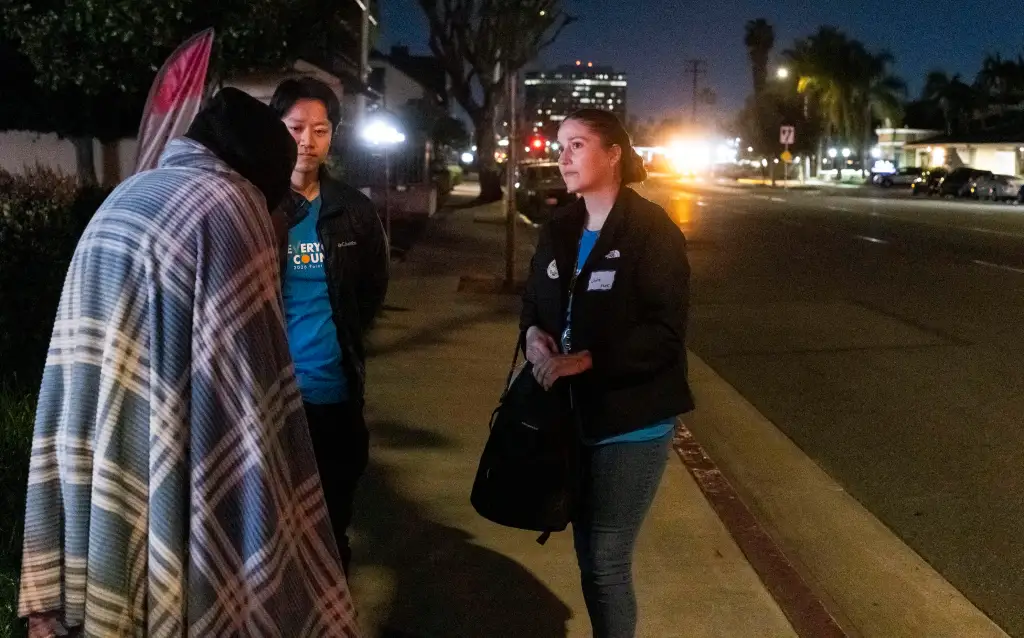
Newly released data from Orange County’s Point in Time Count early this year recorded a 14% drop in the unhoused population over the past two years, a sign of hope for many advocates and county officials.
Read more Meta settles social media addiction case brought by rural Kentucky school district
But more than 6,300 people still live on the streets or in emergency shelters, and officials acknowledge a bottleneck in getting people out of shelters into permanent homes.
Next month, voters will be marking ballots in three races for the Orange County Board of Supervisors, with at least one seat guaranteed to have a new face come November now that District 4 Supervisor Doug Chaffee is termed out.
The Orange County Register asked candidates their thoughts on everything from government spending to public safety for its voter guide, including about homelessness and how it is addressed in the county (before the release of the Point in Time County results). Here is what the candidates had to say:
District 2 candidates
Kimberly Davis: The system is still too reactive. We’re spending heavily on temporary solutions without enough focus on long-term stability; especially mental health care, substance abuse treatment, and transitional support that actually keeps people housed. I would shift priorities toward accountability and outcomes. That means tracking which programs are truly moving people into permanent housing and which ones are not. Funding should follow results, not just good intentions.
We also need stronger coordination between the county, cities, and service providers. Right now, services can be fragmented, making it harder for individuals to navigate the system and easier for resources to be duplicated or wasted. Most importantly, we have to address root causes. Housing alone is not enough if someone is struggling with untreated mental health issues or addiction.
My approach is simple: invest in what works, fix what doesn’t, and ensure every dollar is tied to measurable outcomes that actually reduce homelessness and not just manage it.
Nelida Mendoza: To alleviate and eventually eliminate the unhoused resident issue, I plan to expand affordable housing supply and partner with cities and developers to build low-income and supportive housing; find state and federal funding to convert unused county/city buildings or motels to affordable housing; increase budget for unhoused resident programs to get people into housing promptly. In addition, such funds must be consistent. I’ll work to improve program coordination between mental health care, addiction treatment, job training, and housing programs. The bottom line is to ensure regional collaboration with all Orange County cities rather than trying to work alone in District 2. I intend to build a program that maximizes coordination of where low-income housing and shelters are built to ensure equal distribution within the county of Orange.
Vicente Sarmiento: The county is effectively spending resources on mental health care and medical care for the unhoused. One program that we brought to my district that is incredibly successful is the “Street Medicine” program. This program brings medical services directly to the population who needs it, and meets them where they are.
More funding must be invested in prevention. Studies demonstrate that it is far more cost effective to prevent someone from becoming unhoused, rather than housing someone on the street with consequent mental health and substance use problems. That is why our office introduced the Homeless Prevention and Stabilization Pilot Program for families facing eviction. The program provides funds to cure rental, utility and medical arrears, coupled with on-going stabilization dollars and wrap-around services to ensure success.
James Wallace: In my opinion, we already spend plenty of money on the issue of homelessness. I think the real issue is looking at what exactly that money is getting us. Not every person who is homeless has mental health issues. But the ones who do, perhaps we can allocate some of that homelessness spending on more services that provide counseling and help motivate them to get back on their feet and be a productive member of society.
District 4 candidates
Rose Espinoza: In my opinion, District 4 has done better than the rest of Orange County in meeting the needs of the unhoused. I recall attending a mandated meeting with Federal Judge David O. Carter in his chambers, along with all the mayors of North Orange County, as he put federal pressure on cities and required them to do more. Through oversight of litigation against OC cities, Judge Carter made it clear that there needed to be regional cooperation, emphasizing that cities share responsibility for the local homeless issue.
The North Orange County Service Planning Area, North SPA (Service Planning Area), was approved in 2018, with proposed locations in Buena Park and Placentia. I have been a member of the county’s Bridges of Kramer advisory board for a number of years and continue as an alternate, where I have seen progress, but certainly more can be done.
I would recommend that we follow the OC Grand Jury’s recommendation and shift more funding toward prevention, including emergency rental assistance, eviction diversion, and housing retention programs for seniors and fixed-income residents. These programs cost a fraction of the cost of emergency shelter and crisis services.
Fred Jung: For too long, funds across California were being shoveled to nonprofit groups claiming to be addressing the problem. Untold billions of dollars later, not much progress. There is a housing element to the homelessness problem, of course. But the far bigger culprit has been a combination of drugs, alcohol, mental health, and a legal system ill-equipped to address the situation. The county has done a great job at cleaning up encampments and ensuring those who are living on the streets are doing so within the boundaries of the law.
Tim Shaw: I have advocated for homeownership professionally for the last 10 years. North Orange County cities have led the way in the county in addressing homelessness. While I was on the La Habra City Council, we partnered with neighboring cities to bring hundreds of shelter beds to our region. The navigation centers we built in Buena Park and Placentia are solving the immediate needs homeless people have by giving them somewhere to sleep and eat, while also helping them meet their long-term goals by getting them medical services, counseling, and job training. We should support programs like these that move people toward permanent housing. We should not simply throw money at problems but demand clear performance metrics so we know what is working. Funding should support partnerships with cities and local nonprofits that are closest to the issue on the ground. Every dollar should be tied to outcomes like reduced encampments, increased housing placements, and improved long-term stability.
Read more Fryer: Rosary, Servite track teams ready to soar at Masters Meet
Connor Traut: Orange County has made great strides on street outreach, healthcare services, and building navigation centers. Those dollars matter, and keeping that momentum going makes sense.
The gap is accountability and results. Too many times, we approve funding and then don’t consistently measure whether it’s actually getting people off the streets and into stable housing. That has to shift.
As our next supervisor, I’ll advocate for clearer performance standards, tighter coordination with our cities, and more attention on mental health and substance use treatment, since those issues sit at the center of a lot of homelessness. Further, we should back the programs that reliably end in permanent housing, including more supportive units, not wasteful programs that cycle people through short stays in shelters and motels. We must never allow OC to turn into LA.
Enforcement, while a last resort, must be part of the mix. Families deserve parks, sidewalks, and other public spaces to stay safe and workable for everyone. We can address homelessness in a system that is both compassionate and effective, helping people get off the streets permanently while restoring quality of life in our neighborhoods.
District 5 candidates
Diane Dixon: Orange County has made real investments in homeless outreach and emergency shelter, and those front-line workers deserve credit for difficult work done under difficult circumstances. Encampment enforcement has improved because leaving people on the streets without services is not compassion; it is neglect.
But the numbers tell a hard truth. Orange County’s unsheltered population grew 37% between 2022 and 2024. Meanwhile, Sacramento has spent $24 billion on homelessness statewide since 2019, and I have proposed a state audit to find where the money went and how many homeless individuals were served. No one knows the outcomes at the state level. The homeless programs do not track outcomes, so it is impossible to know if they accomplished anything. Gov. Newsom even vetoed bipartisan legislation that would have required annual evaluations of how that money was spent.
Orange County cannot afford to repeat Sacramento’s mistakes. I will push for a full audit of county homelessness spending and program efficiency and work with my colleagues to shift resources toward mental health treatment and substance abuse recovery rather than simply subsidizing housing with no accountability attached, and require every service provider to demonstrate measurable results. Writing checks without requiring results is not a homelessness policy. It is a blank check with no end in sight.
Residents deserve transparency and honesty. As your supervisor, I will deliver that.
Katrina Foley: One of the simplest ways we expanded affordable housing was an administrative change my office initiated and the county implemented in 2024. That change increased the county’s use of Project Based Vouchers to 20% of Housing Choice Voucher allocations, the maximum HUD allows. Instead of using additional county general fund dollars, we use HUD-funded vouchers to help developers cover housing costs.
Project Based Vouchers also keep each unit affordable for the full affordability covenant, rather than following an individual tenant as tenant-based vouchers do. Every $1 invested by the County of Orange Housing Authority, even through vouchers, leverages $5 in outside financing. Local investment also makes projects more competitive for state funding and helps developers build faster.
We also need to change how case managers and social workers are assigned. Today, they are assigned by Service Planning Area and centralized out of the city of Orange. That creates long travel times and delays. One day, my staff waited 90 minutes for outreach workers to arrive and help someone. We should assign staff based on geographic hot spots, partner with cities and other county facilities, and use mobile vehicles to place social workers closer to the people who need them.
Lucy Vellema: District 5 is currently allocating funds to address homelessness by converting motels into permanent housing. They’re also clearing encampments of homeless individuals living on our streets through Project Homekey. The $3.6 million from the State of California was issued to extinguish the encampments at Talbert Park in Costa Mesa, which are being addressed by partnering with the OC Health Care Agency. The $30 million allocated for Supportive Housing & Services funding focuses on seniors, veterans, and individuals with serious behavioral health conditions in our communities. Also, housing vouchers and HUD housing are provided to low-income families and the homeless.
Through these programs, many are benefiting from stable housing rather than the alternative of living on the streets or in their cars. However, more housing expansion and accountability needs to be implemented to ensure that funding is appropriately being funneled towards these projects. Now more than ever, we need accountability with public funding and to expand housing for the homeless and low-income families.
Voting in the June 2 primary is underway, with ballots mailed out to all registered voters. Unless one candidate garners more than 50% of votes in the primary to outright win the seat, the top two vote-getters will move on to the November general election ballot.
Read more 2-time NASCAR champion Kyle Busch has died at 41, NASCAR says
Find the Register’s voter guide at ocregister.com/voter-guide.