
Ryanne Mena reported this story as a USC Annenberg Center for Health Journalism 2026 California Health Equity Fellow and Engagement Grantee.
Read more Trump’s plan for a fence at Lafayette Park near White House gets review by federal panel
The Parias family was devastated. Their father, Richard Parias, had just been shot by federal immigration agents and was accused of attacking the agents with his car. After that, he was detained and faced the possibility of deportation. The family scrambled to find him legal representation.
But first they had to run.
Immigration agents returned twice within days after the shooting. The family feared Gabriella, Richard’s wife, could be targeted next.
“We had to move, basically, as far away as possible,” she said in Spanish during an interview.
Gabriella didn’t sleep for four or five days after the shooting. She lived off of coffee and Red Bull while continually talking to lawyers, gathering documents, filling out paperwork, and worrying about her injured husband.
“Believe me, sleep was the last thing on my mind,” she said.
Toll on families, communities
The Trump administration’s aggressive immigration crackdown has led to the detention of over 610,000 people, according to the Deportation Data Project.
More than 145,000 children across the nation have been separated from at least one of their parents since the beginning of President Trump’s second term, a Brookings Institution study from May found. Across California, nearly 50,000 people have been detained by federal immigration agents within that same time period, according to the San Francisco Chronicle.
The impacts extend past the individual detained, cascading into families and communities, according to Usha Tummala-Narra, a clinical psychologist and professor at Boston College. She has been studying the psychology of immigration and trauma for over 25 years.
“Decades of attachment research (show) that separations like this that are traumatic separations have deep impacts on children and parents,” she said.
A decline in one’s physical well-being, stress, panic, and chronic anxiety are some of the effects.
“These detentions have created a culture of fear,” Tummala-Narra said. “And situations like this are compounded by the fact that communities also feel helpless to a certain degree of not knowing how to help people in those circumstances.”
In Southern California, dozens of people shared how their detention, or that of their loved one, took a toll on their lives through surveys, interviews and at an event facilitated by this publication.
One formerly detained 48-year-old woman from Thailand described turning to drugs and alcohol to numb the emotional pain left by her detention. Another woman said she developed high blood pressure, anxiety, and depression after her husband was detained during a routine ICE check-in appointment. Several respondents reported a feeling of guilt for enjoying quality food and finding joy in life while their loved ones were locked away.
Most reported a lasting sense of trauma, fear, anger, stress, and economic hardships after they or their loved ones were released.
After Addy Cedillo’s husband was detained by federal agents at a routine ICE check-in appointment last September, she developed depression, anxiety and high blood pressure. She lost her job as an account manager for a telecommunications company after going on a leave of absence, she said, and still owes thousands of dollars in immigration lawyer fees. Her children had to begin going to therapy to cope with the family separation.
In the 10 months after her father was detained, 25-year-old Lesly would spend every night lying in bed, restless and worried, “not knowing if (my dad) ate, if he’s okay, how he is sleeping,” she said. Lesly’s last name is being withheld for fear of retaliation in her father’s ongoing immigration case.
“I couldn’t help to feel the guilt of being able to enjoy something as simple as a sunrise knowing that he didn’t see that,” she said.
The journey to Adelanto
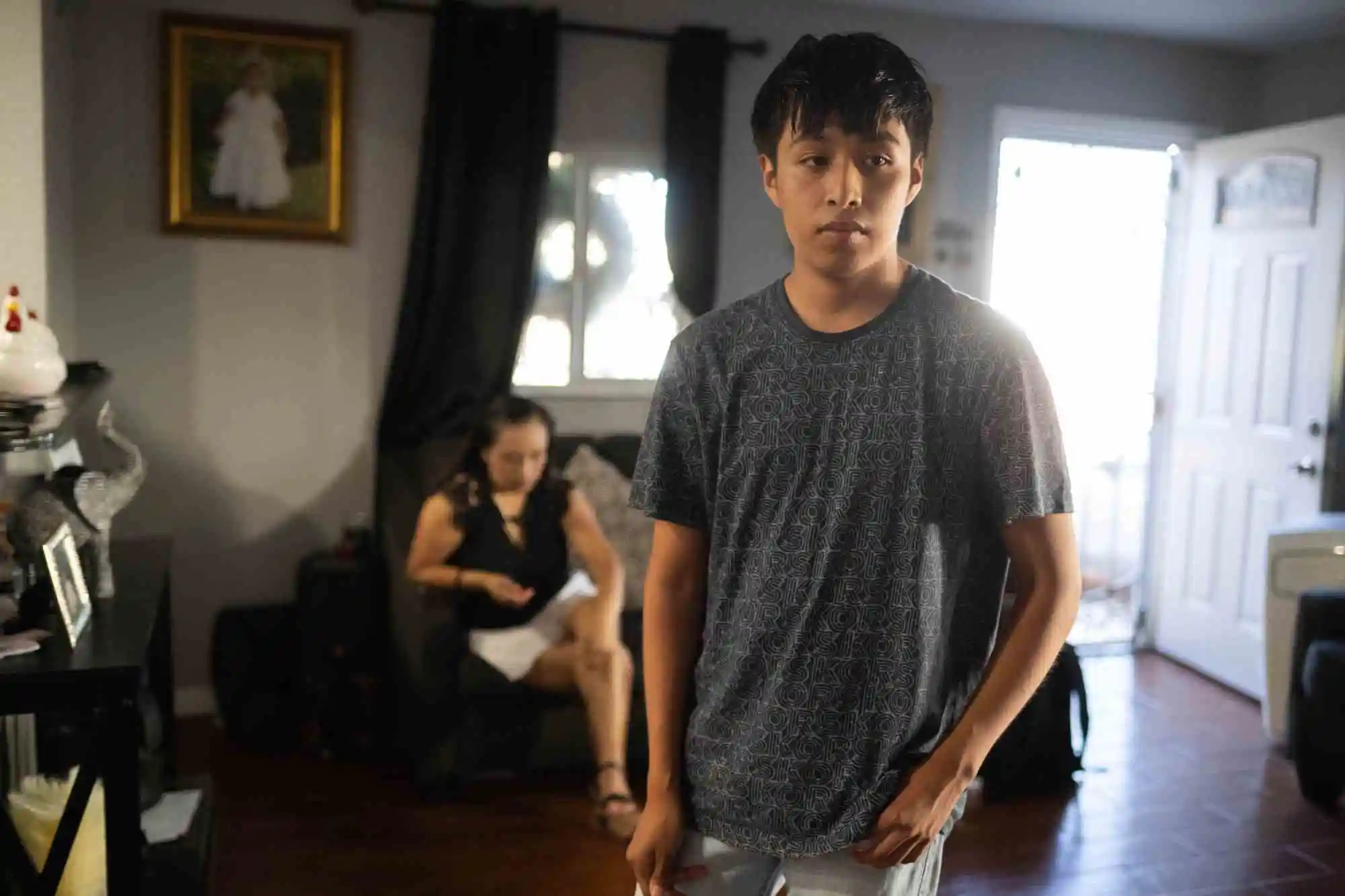
Just as the sun begins peaking over the horizon, 20-year-old Ulises Parias is already alert and ready with a cup of coffee in hand. By 6 a.m. most Saturday mornings, he’s begun the 85-mile journey to visit his injured father detained inside the Adelanto ICE Processing Center.
On a recent Saturday morning, Ulises wore gray jeans and his green Mexico national soccer team jersey to visit his dad. This year’s World Cup was the first without his father. “It didn’t feel the same without him,” he said.
Ulises put on a playlist of Spanish songs he created specially for this almost weekly journey to the High Desert. The song Mi Último Deseo, Spanish for ‘My last wish’, by Banda Los Recoditos came on. “This is one of my dad’s favorites,” he said.
The music serves as a particular type of distraction.
“I don’t want to think about where I’m going, not until I’m there. … If I did, I’d turn back because I don’t want to think of my dad in a place like that,” Ulises said.
After arriving and checking in at the front desk, Ulises clipped on a white GEO Group visitors badge and anxiously waited in the visitors lobby. For the next 30 minutes, his left leg shook as he sat hunched forward in a blue plastic seat waiting to be temporarily reunited with his father.
To get to the visitation room, Ulises must pass through a metal detector before walking down a cold hallway. At two heavy gray metal doors, guards escorted visitors into the room and pointed them to their visiting area: a set of three blue seats across from a white chair with a short white table in the middle. In the background, Spongebob and sports played on TVs mounted to a white wall.
One by one, detained men in orange and red jumpsuits came out from another room.
Richard Parias, Ulises’ father, appeared, standing in an orange jumpsuit. A navy blue and white sling held his left arm. His black hair was messy, and his eyes were red, gazing over bags.
Ulises nestled his head atop his father’s right shoulder in a brief embrace. Richard hugged his son with his right arm, bringing his son’s head to meet his own.
The father and son talked about their family and conditions inside the detention center, including alleged water contamination issues. Once, Richard said, the drinking water looked, “como tamarindo,” – like brown water.
The hour was fleeting.
“It’s hard leaving him there, cause I know how much he’s suffering,” Ulises said after the visit. “I just want to take him home with me. But I know I can’t.”
A violent detainment
On the morning of October 21, 2025, 44-year-old Richard Parias was on his way to document a car crash when he was boxed in by at least three seemingly unmarked vehicles, body camera footage obtained by the LA Times shows.
The video shows a federal immigration agent holding a gun pointed toward Richard in one hand while breaking his passenger-side window open with the other. While Richard’s car appears to not be moving, the agent shoots Richard in the left arm.
After recovering in the hospital, Richard was taken to the Metropolitan Detention Center in downtown LA. Several weeks later in November, he was released from federal criminal custody on bond and transferred over to ICE custody, and taken to the Adelanto ICE Processing Center.
Read more Hikers describe intense rain and wind before floodwaters ravage Grand Canyon
In December, a judge dismissed the charges against Richard, including assault on a federal officer, citing the government’s failure to provide pre-trial discovery material, like body-worn camera footage, to the defense in an appropriate time.
The Department of Homeland Security maintained in a statement that Richard weaponized his car and rammed it into law enforcement vehicles in an attempt to escape when he was shot.
Richard entered the U.S. from Mexico without authorization in 2002 and spent over 20 years working and raising a family with his wife in Los Angeles. He had no criminal record or final order of removal when federal immigration agents shot and detained him, according to immigration attorney Margaret Hellerstein.
Questions about medical care
Since being detained, Richard Parias has consistently reported being in pain and routinely asked for medical care for his injured left arm, according to medical records from November through May obtained and reviewed by this publication. The documents consist of medical request forms filled out by Richard, visitation notes written by facility medical personnel, and reports generated by outside medical services.
He has been prescribed a variety of medications including Motrin, nerve pain and seizure medicine Gabapentin, and Bengay muscle rub cream.
In March, Richard was seen by an on-site nurse for complaints of increased pain, who noted decreased mobility in his left shoulder and left hand, with swelling and tenderness in the area, according to DHS. That led to the nurse submitting an orthopedic referral and ordering additional medications.
Medical reports from April include details of Richard experiencing radiating pain from his neck to his left hand and decreased mobility to his left shoulder, arm, elbow, and hand.
“While palpating his left forearm … patient presents tears in his eyes due to pain,” a report states.
Richard saw an orthopedic surgeon in April, medical records indicate, who recommended he get an MRI for his left elbow and forearm, testing for nerve and muscle damage, and to see a physical therapist. As of early September, Richard says he still hasn’t received physical therapy.
His left arm was in too much pain to show a reporter during visits inside Adelanto in June and July. At the time he also said he couldn’t move his left hand, which hung limply from his sling.
GEO Group, the private-prison company that owns and operates the Adelanto ICE facilities, referred all questions about Richard’s medical care to ICE.
“It is a longstanding practice to provide comprehensive medical care from the moment an alien enters ICE custody. This includes medical, dental, and mental health services as available, and access to medical appointments and 24-hour emergency care,” an unnamed ICE spokesperson said.
Richard’s alleged lack of medical care was the inspiration behind the Stop ICE’s Medical Neglect Act of 2026, a bill recently introduced by U.S. Rep. Sydney Kamlager-Dove (D-Los Angeles).
After Kamlager-Dove went to visit Richard, one of her constituents, inside Adelanto, she was “scared he was going to die in there,” she said.
“His arm had atrophied, it had turned purple. … He was not given proper physical therapy. And what I saw looked like an arm that was on the verge of being amputated,” Kamlager-Dove said in an interview.
The Adelanto ICE Processing Center has faced widespread scrutiny in the last year for alleged inhumane conditions, including spoiled food, contaminated water, and inadequate medical care.
In August, a federal judge ordered a list of improvements to be immediately implemented, including 24-hour access to clean drinking water, unspoiled food, and daily facility cleanings.
The court order stems from a January lawsuit filed by a coalition of civil and immigrant rights groups against federal agencies and authorities alleging inhumane conditions inside the Adelanto ICE Processing Center.
Grasping at hope
Richard Parias was his family’s primary breadwinner. After he was shot and taken away, 20-year-old Ulises Parias had to find a job to help pay for rent, food, gas, bills, and other expenses, like the weekly $150 his family sends to his father for communications and commissary. So, he picked up a job at a pizza shop.
Ulises worked about four days a week during summer break. But now that the fall semester has begun, he cut down to working three days a week, on top of dropping his sister off at school and taking 17 units in school. He’s an engineering major with the goal of becoming an electrical engineer one day.
“If I didn’t stay in school, my dad would kick my ass,” Ulises said.
But school was a struggle for him and his sister after their father was shot and taken away.
Ulises missed half a school semester. “I just didn’t have it in me,” he said. His teachers allowed him to make up missed work and he finished the semester with B’s and C’s.
His 16-year-old sister started ignoring everything and spent all her time on her phone. Her grades in school dropped and she started going to therapy, her parents said.
“It’s pretty hard knowing I can’t reach out and hug him or feel his hands,” she said. “And I remember when he used to be here, I would just randomly touch his sleeve or his hand or something. And knowing I can’t even do that, it’s like I’m forgetting the way he feels, you know?”
It is unknown when or how Richard will be reunited with his son, daughter and wife. He remains injured inside Adelanto as his immigration lawyers fight for his release.
“I just don’t have hope,” his 16-year-old daughter said. “I’m just waiting for it to happen, (for someone to say) you’re not going to see your dad in the place that you were raised again, but I guess maybe I’m trying to just prepare myself for it.”
Despite setbacks with his father’s immigration case, Ulises remains hopeful that one day his father will be released and not deported.
“Cause at the end of the day, that’s the thing I need to keep going forward,” he said.
Read more Fed’s Waller says central bank’s next rate move depends on upcoming inflation report