
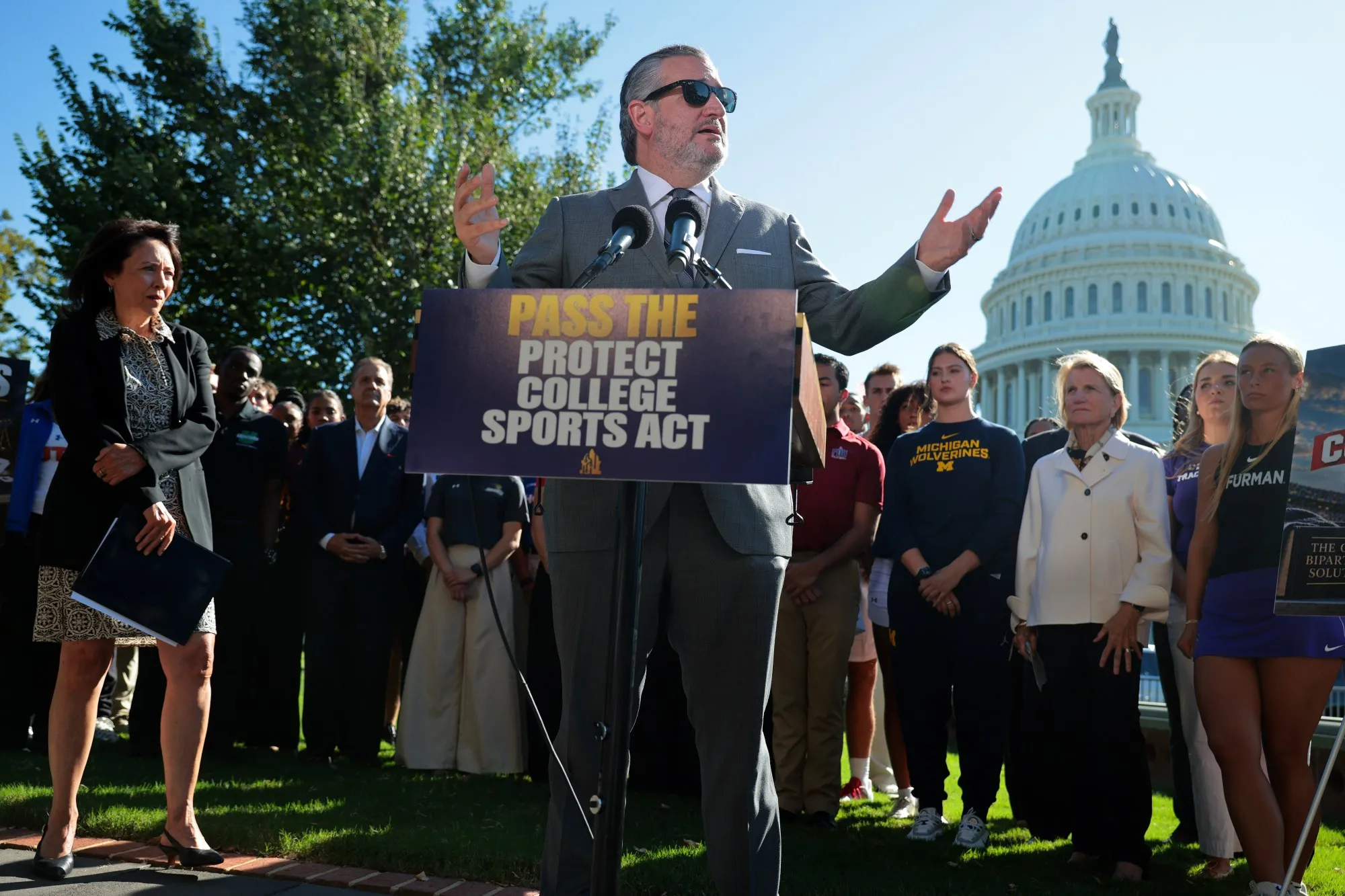
If you watch ESPN’s “College Game Day” – and if you do, you’re way more tolerant of self-serving idiocy than I am – you were subjected to an extended political ad during this past week’s show, located on campus in Austin, Texas.
Read more Annie Dillard, Pulitzer-winning author of ‘Pilgrim at Tinker Creek,’ dies at 81
The subject was the looming vote in Congress on the “Protect College Sports Act,” federal legislation that mainly is designed to give college sports an antitrust exemption. Sen. Ted Cruz (R-Texas) was given a platform on the program to campaign for the bill he has co-sponsored with Sen. Maria Cantwell (D-Washington), with Pat McAfee and Nick Saban looking on approvingly.
Would that bill, by the Knight Commission on Intercollegiate Athletics, really quell the chaos that the NIL era has wrought? And if so, at what cost?
Here are a couple more questions: What parts of college sports need “protecting” or “saving,” anyway? And how much of the content of this bill actually has college sports fans in mind?
Senators voted 74-24 on Tuesday afternoon to advance the legislation for a full vote, which will probably take place Thursday, and if it passes that chamber it will then go to the House. It is not a gimme since there is significant pushback, particularly from labor and civil rights groups who cast a wary eye toward what they see as provisions that would limit athletes’ rights – particularly but not exclusively the right to collective bargaining.
And, in fact, after Cruz’s pro-legislation appearance on College Game Day drew objections from those opposed to the bill, NAACP CEO Derrick Johnson appeared on ESPN’s SportsCenter on Tuesday afternoon for a rebuttal. Among other things, he noted that the athletes’ “voice in the process” was among those things missing from this bill, as were “so many things that should be in there to protect the players.”
The proposed legislation does require “at least one-third of athletic association governingboards or other committees with rulemaking authority to consist of current or recent formerstudent athletes.” It doesn’t guarantee that the other two-thirds will listen.
The Knight Commission summary of this bill notes that it is “neutral on, and does nothing to alter, employee or non-employee status for student-athletes.” Given that the NCAA and college administrators seem fairly strident in their view that players are not considered employees – even though they are paid to play, essentially – I can understand the pushback by player advocates.
(A further thought: If athletes’ compensation had been limited to Name/Image/Likeness payments from outside benefactors – as I suggested years ago with the “Sam Gilbert Rule” to make such payments legal – that wouldn’t be an issue. Now that they’re getting paid directly by the schools, as the courts have mandated, they are employees and should have just as much right to form a union as other university employees, period.)
And keep in mind: There are provisions within this legislation for limiting athletes’ pay. There remain no provisions for capping coaches’ pay, save for a provision that anything above $500,000 “can only be paid from college sports revenues or donations to the athletic department.” In other words, your tax dollars can’t be put to work to buy out an underperforming coach’s contract.
There is, however, a provision that prevents “FBS football coaches from leaving mid-season.” Maybe that should be rephrased, “any time before the national championship game,” just in case Lane Kiffin is tempted to again stretch the definition of mid-season.
Really, though, the ads and testimonials don’t really say much about what this will do for the fan, which figures. The paying customer/booster/athletic department contributor is normally taken for granted anyway – just try sitting through a few of those three-minute commercial breaks while you’re inside the stadium and you’ll see what I mean – so why should this be any different?
But consider the atmosphere in Berkeley a couple of weeks ago when UCLA and Cal – sibling institutions, historic rivals, but now marooned in different conferences in the seismic shakeup of college sports – met in the teams’ football season opener.
Read more Fed rate hike will likely push borrowing costs on credit cards, mortgages — but benefit savers
The message I drew from that crowd and its enthusiasm: Regional rivalries, and conferences with schools that have something in common, still matter a lot.
Yet the chase for TV money, predominantly fueled by football, destroyed one conference – the legacy Pac-12, as opposed to the group now playing under that name as a Group of Six league – and has turned the others into bloated versions of themselves: The Big Ten with 18 teams, the Atlantic Coast with 17 and the Southeastern Conference and Big XII with 16 apiece. At least three of those conferences are geographically incomprehensible.
And don’t get me started on those Olympic sports athletes who have to squeeze into a middle seat on a flight to a game halfway (or more) across the country.
My view? The solution to protecting, and indeed enhancing, college sports might be as simple as returning it to its regional roots. I suspect those who follow a school’s teams are less bothered about multiple transfers and large athlete paychecks than they are by schedules full of teams with little or no shared history.
The PCSA legislation as written would prevent formation of a “super league,” but to truly regionalize it may be necessary to separate football from everything else and put it in, yes, its own super league, such as the promotion/relegation model we’ve advocated before. It would have 10-team tiers, based on teams’ records over the last three or four seasons. The top teams in each tier go to the 16-team playoff, the bottom teams are relegated, and the more you win the more you improve your station in life.
(No, I’m not providing a sample list this time. I got in trouble with that last year.)
But Bay Area News Group colleague Jon Wilner made this prediction last week: “When football breaks off, the college sports industry will reform along regional lines.”
Let’s hope so.
The beauty of this system? Picture USC, UCLA, Cal, Stanford, Arizona, ASU, Oregon and Washington back together in every other sport. I suspect Oregon State and Washington State, burned once, would say no, thanks.
But neighborhood and regional rivalries bring out the best in everyone. We didn’t realize how good we had it, how much more interesting and fun it was, watching these schools play for supremacy in the West as well as a shot at the big tournament.
I’m guessing it’s not possible to reclaim the Pac-12 label. One possibility for naming a new alignment would be the Pacific Coast Conference, a tribute to the league that formed in 1915 and housed many of these schools. But that conference collapsed in 1959 amid scandal. So maybe not.
But if you’ve got an idea for a conference name under which these legacy schools could come back together, by all means send it in. Maybe someone with influence will be paying attention.
Read more 2 dead, 6 hospitalized after SUV crashes into Metro bus in Chatsworth; driver arrested