
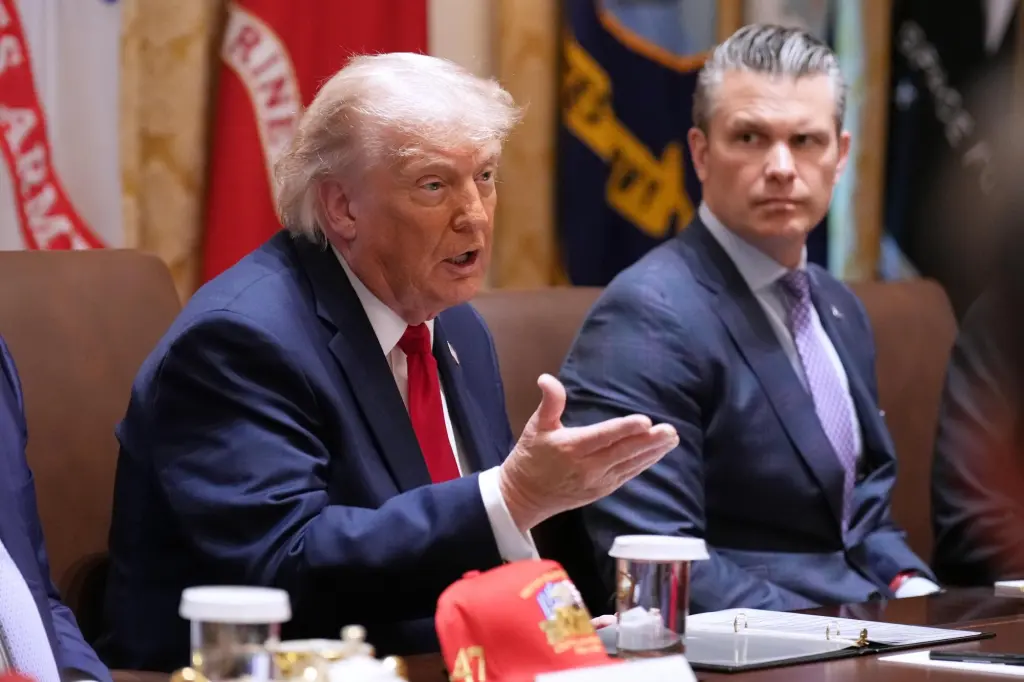
The United States is at war again in the Middle East. Clashes with Iran are likely to persist for some time, as America cannot win and President Trump cannot accept defeat.
Read more Attempt to save a struggling swimmer leaves 5 dead in an Ohio river
Ambiguities and dissatisfaction with the memorandum of understanding led to violations of the ceasefire. It is difficult to see how the Trump administration can wrest a winning deal from an Iranian regime that is clearly more committed to the fight and which has ‘discovered’ the world’s dependence on oil (if that was ever in any real doubt). Trump’s rhetorical tricks do not seem to be working on the battered regime in Tehran any more than they did on the algae in the reflecting pool. This moment perhaps calls for a bit of national soul-searching—how did we get here, yet again?
Trump promised during his third presidential campaign that he would not pick unnecessary fights far from America’s shores: “we will have no more wars … peace for all.” But on his return to office, he seemed to revel in violating his own dictum about foreign affairs. Venezuela was invaded. Canada, Greenland and Cuba were among those threatened. Iran was attacked. Shock was achieved, at least initially, but there was a notable deficiency of awe.
This war with Iran was unpopular with Americans from the start. A rationale for what amounted to a surprise attack arrived late, was garbled in transmission and remained vague and multi-faceted. With the exception of drawing down Iran’s military capabilities (missiles, aircraft, combat vessels) and killing off swaths of the leadership, other objectives (regime change, eliminating Iran’s missiles and nuclear weapons program) appeared largely beyond pragmatic reach.
Iran, for its part, possessed an important bargaining chip, one that did not go without notice in Congress, though its significance was ignored by the White House. Iran blocked the transit of shipping in the Strait of Hormuz. In practical terms, the US lost the war as soon as Iranian officials recognized that they were better off playing chicken with the world’s oil supply than going toe-to-toe with the US military. Since then, Trump has been left looking for an exit that threads the needle between making concessions to Tehran and publicly embarrassing himself on the world scene.
The US failure cannot be blamed on a lack of American military skill. Secretary of War Pete Hegseth—who changed the title of the department just prior to demonstrating that the US still cannot win a war—is not mistaken when he ticks off an impressive list of Iranian targets that US forces have destroyed. But Hegseth, and by extension others inside and outside of the administration, are profoundly wrong in claiming that breaking things amounts to victory.
Wars end at the loser’s discretion, not the winner. The victor only sets the conditions that make defeat unavoidable. America has failed at this. Not because of Iranian drones or a few very regrettable US casualties. Not because American airpower has failed to “take out” enough targets. But because war is about prevailing in the minds of an adversary, not on its hardware, infrastructure, or even its population.
Our military is fine. It did, and is doing, its job. It is not how they fight that is the issue. It is what we—or by extension our leaders—ask them to achieve that is at the core of our persistent series of military fiascos in distant places.
Similar fallacies are present in just about all of our previous Middle East misadventures. Recall President George W. Bush’s “mission accomplished” faux pas during a staged aircraft carrier landing in May 2003. The “mission” had not been accomplished. America was still mired in Iraq two decades later, with little of substance to show for the effort.
Read more Trial begins for Massachusetts mom who says postpartum issues led her to kill 3 children
No military, however capable, can overcome bad grand strategy. War is hard. Winning is difficult, especially when we don’t know what we wish to achieve as a nation. Officials in Washington persist in conceiving of war in largely military terms. We have better weapons. So victory is inevitable, no? But war, as Prussian General Carl von Clausewitz explained, is “the continuation of politics by other means.”
If victory is genuinely inevitable for one side or the other, then the eventual loser usually cuts a deal. Indeed, when a win is obvious enough, war never even happens. This is the way that most wars end—before they begin—with a bargain in some diplomatic back room. The fact that a war happens is evidence that the two sides do not agree.
War then is a process of discovery, of unearthing the political winner, not just the military one. And it occurs through an evolution of beliefs, not just by breaking stuff. Damage is a catalyst, not the remedy, or (usually) even the end.
Take a look again at this current, recurring fight with Iran. By any reasonable military standard, the U.S. has “won” on the battlefield. Iranian forces are decimated. They are reluctant to show themselves, for fear of rapid destruction. If this conflict had been restricted largely to military goals—such as reducing Iran’s nuclear capabilities (probably a recurring task) or limiting Iran’s power projection capabilities (again, we will have to “mow the lawn”)—then America’s military might have succeeded, achieving what it needed and then coming home.
But this war was about more than just who has more martial toys. When one adds political goals (such as ‘regime change’) one is traipsing into the world of resolve, rather than capabilities. It matters much more who is willing to take the hits, in the end, than who can deal them out.
America can beat just about any nation on the battlefield. Because of this, we swagger and occasionally lose our balance, imagining easy victories. When our opponents agree, there is no fight, only a concession (often tacit). But when we do fight, it is with an opponent who is much more resolved than we are. They are willing to take the blows that we dish out. It is their staying power that matters in the end, not our knack for “shock” without “awe.”
Erik Gartzke is a professor of political science and director of the Center for Peace and Security Studies at the University of California at San Diego. The views expressed in this essay are entirely those of the author. They do not reflect the opinions of any institution, public or private.
Read more Lakers agree to deal with free agent forward Matisse Thybulle