
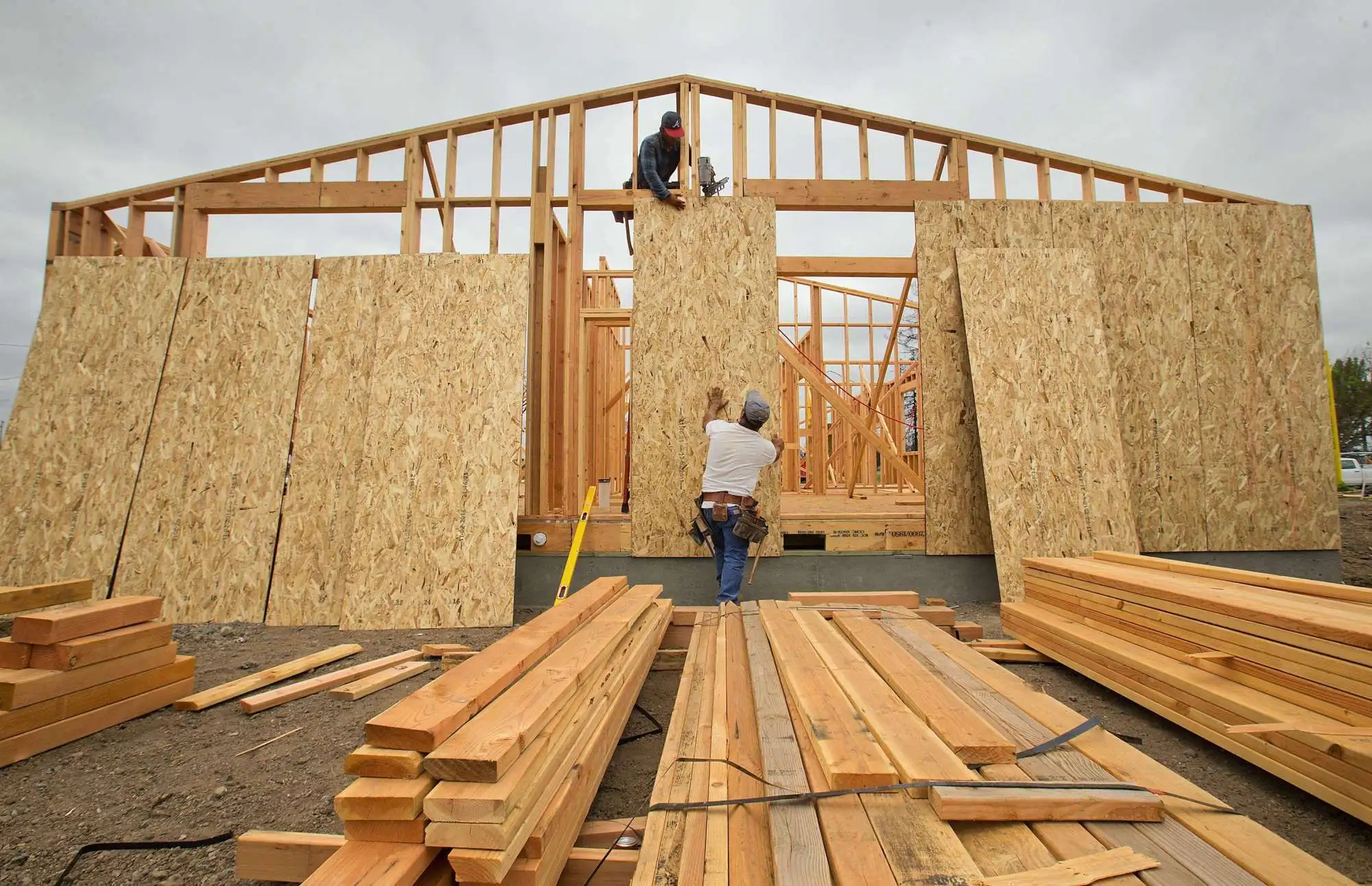
California voters have greenlighted up to $25 billion in bonds to fund second mortgages that are intended to help more renters become homeowners and spur new home construction.
Read more Board of Peace delivers bleak report on Gaza, warning of ceasefire collapse without immediate action
Now supporters’ claims that the new state-backed loan program could support more than 900,000 home purchases and spur the construction of 190,000 new homes and condominiums will be put to the test.
In many California communities, the question of how much help the program will actually provide is likely to hinge on the supply of new homes that are affordable to middle-income buyers.
Proposition 37, passed with the approval of 62% of voters statewide as of Nov. 12, allows the California Housing Finance Agency (CalHFA) to provide second mortgages that will allow qualifying homebuyers to purchase a newly-built home with as little as 3% down.
While there are already nearly 3,000 down payment assistance programs nationwide — including an existing CalHFA program that helps some homebuyers to buy a home with no down payment at all — many working families earn too much to qualify for them.
The new Middle-Class Homeownership Bond program will be open to anyone earning up to twice the median income in their area. The program will allow them to buy new homes priced at up to 125% of Fannie Mae and Freddie Mac’s conforming loan limit, which is over $1 million in Los Angeles and Orange counties.
Pete Rodriguez, second general vice president of the United Brotherhood of Carpenters, said the measure will open low-interest down payment assistance loans while encouraging new home construction, creating jobs across California.
One , performed by Shane Phillips of Domain Consulting for Proposition 37 supporters, estimated that for every $1 billion in bonds issued, the program could generate an additional $4.9 billion in private spending, assuming it spurs construction of homes that would not otherwise have been built.
Phillips projected that between 142,000 and 647,000 renters statewide could qualify for the new CalHFA loan program, and up to 1.35 million homeowner households.
The actual number of home sales the program helps generate will depend on the price of each home sold, and how much of the down payment the borrower needs covered.
Otto Kobler, senior loan officer at Coast Home Loans in Santa Rosa, said the biggest problem the new loan program faces is the funding available, saying $25 billion cannot address the need between the number of people looking to buy and the rising cost of land.
However, Kobler said the program could make a positive impact for people needing to make a 3% down payment, as it could drive purchasing power in areas outside the Bay Area where median home prices are below $1 million.
Looking at the state as a whole, another analysis by the Public Policy Institute of California concluded that if everyone using the program bought the most expensive house allowed and took out the biggest loan permitted (17% of the purchase price), the $25 billion program would support 112,641 home purchases. If borrowers went for entry-level homes, the program could support 559,653 sales.
Proponents such as the California Association of Realtors maintain that because the program’s funding will be replenished as borrowers repay their loans, in the long run, it has the potential to facilitate more than 900,000 sales.
While supporting the program’s intent, some analysts and brokers say the measure is not written to broadly improve many first-time homebuyers’ opportunities under current market conditions.
Read more US tells Ukraine’s backers deep strikes don’t work, urges focus on front-line equipment
David and Erika Rendino, owners and brokers at RE/MAX Marketplace in Cotati, said most of their clients are seeking resale homes, and new construction, the measure’s focus, constitutes only about 8% of their sales in Sonoma County.
“The most traditional homebuyer shouldn’t be looking at the most expensive segment of the market, like new construction,” David Rendino said.
“The devil is in the details here,” Erika Rendino agreed, pointing to several factors within the measure as written.
According to surveys by the National Association of Realtors, the typical down payment for first-time buyers has ranged from 6% to 9%, dating back to 2018. In 2024, 29% of first-time homebuyers used an FHA loan allowing borrowers to put down just as little as 3.5% down payment. About 9% of first-time buyers used a VA loan, where no down payment is required.
The latest NAR survey, released last week, found the between July 2025 and June 2026, the median down payment for first-time homebuyers was 9%, compared to 19% for repeat buyers.
So-called “conventional loans” eligible from non-government lenders with backing by Fannie Mae and Freddie Mac allow down payments of as little as 3 percent. But buyers putting less than 20% down on conventional loans must take out private mortgage insurance which, like FHA mortgage insurance, comes at an additional cost.
The Rendinos think CalHFA’s new second program could be more effective in areas where there is more new construction taking place, and in areas with lower costs for land and new homes.
However, like some opponents to the measure including the League of Women Voters of California, they noted that it is not clear what the interest rate, loan term or monthly payments would be under the program.
They added that they think high interest rates, currently around 7%, will continue to scare off even clients feeling the relief of a smaller down payment.
“It helps you get in with less of a down payment. But now what? You’re going to be paying crazy interest rates for 30 years,” David Rendino said.
Ray Giampaoli, a mortgage officer at Guild Mortgage, thinks that while high interest rates continue to concern buyers, under this program purchasers should be able to “marry the house and date the rate” by building up equity to potentially refinance in coming years.
However, Giampaoli — who spoke from his perspective, not for Guild Mortgage — said he thinks Proposition 37 won’t significantly increase homebuying in the North Bay, as there aren’t enough single-family homes being built. While some unions hope the program will drive more construction, he said it cannot change local development policies which affect how quickly that housing is built, and how much of the share qualifies for new homebuyers.
“The reality of it is, because of our home prices and lack of new construction, we’re probably not going to see a huge official impact on home ownership in the Bay Area,” he said. “It’s potentially good for the state — not necessarily for where we choose to live.”
Staff Writer Natalie Hanson reports on business and agriculture for The Press Democrat. She can be reached at [email protected] or at 619-665-5887.
Read more Do school phone bans help students learn? So far, gains are ‘modest’