
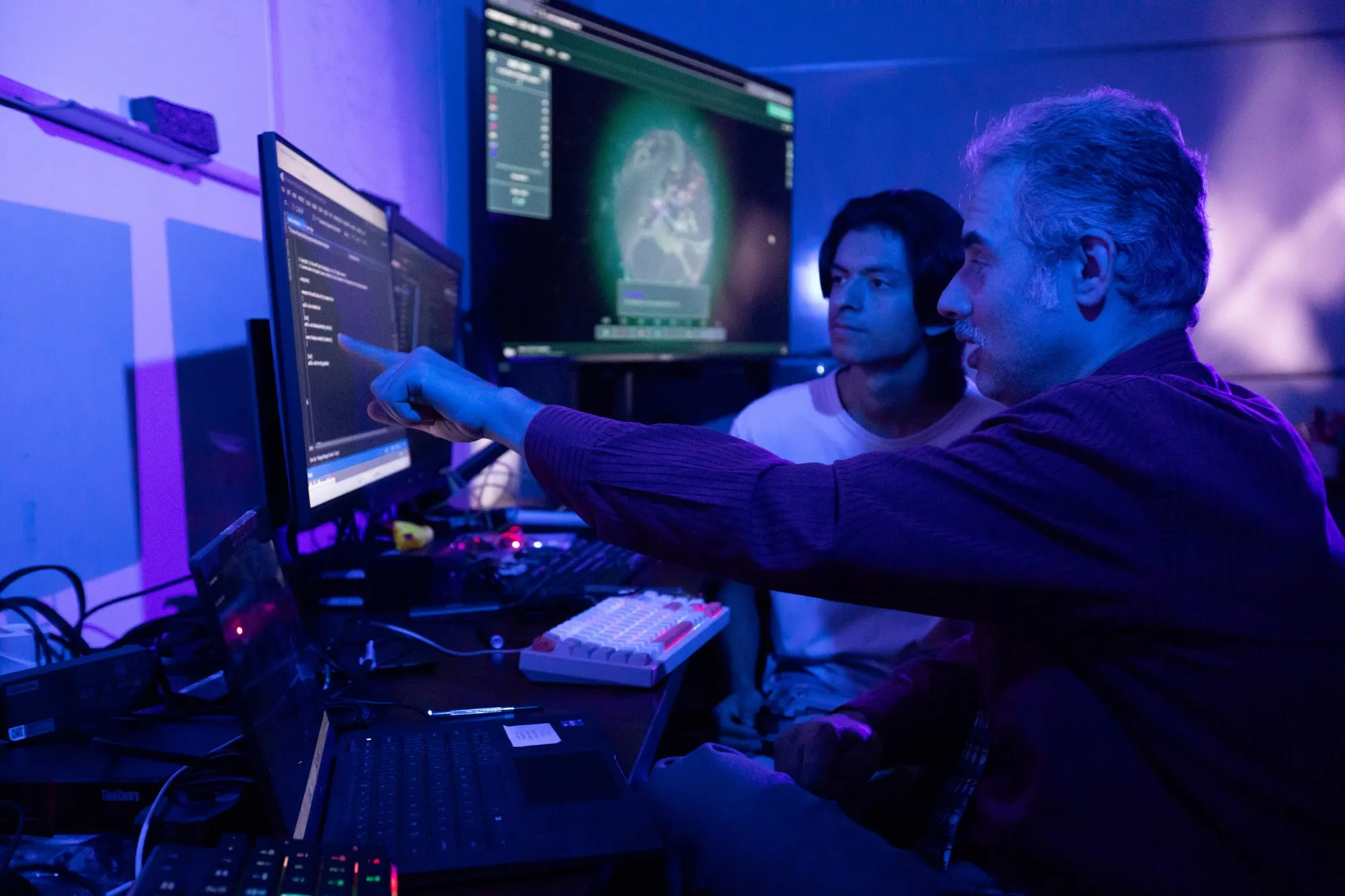
The cybersecurity program at Cal State Fullerton, which the National Security Agency designated this year as a National Center of Academic Excellence in Cyber Defense, has expanded to prepare more students for careers in fields that increasingly require cybersecurity expertise.
Read more Supreme Court Justice Sonia Sotomayor joins Santa Ana school’s Purple Unity wall
For several years, CSUF has offered a Bachelor of Science in computer science with a concentration in cybersecurity. It’s now added a minor in cybersecurity, so that students working toward a degree in other areas can add cybersecurity expertise to their skill sets.
The demand for cybersecurity expertise is high, says Mikail Gofman, Cal State Fullerton professor of computer science and director of CSUF’s Center for Cybersecurity. There are more than 500,000 cybersecurity jobs currently open, according to Cybersecurity.org, a career website for students.
Courses covering cryptography, web security, cloud security and network security are offered, as well as other areas encompassed by these subjects.
The new minor is valuable for students majoring in criminal justice, law, political science and engineering, among many other programs. “Chances are whatever you’re doing, there is probably a cybersecurity application,” Gofman said. “And even if students are successful in those other areas, cybersecurity can make them even better at it.”
Urgency for cybersecurity expertise is partly due to AI, Gofman said. “Cybersecurity is no longer a field that uses AI tools, but it has become an AI-driven field,” he said. AI can orchestrate increasingly sophisticated attacks that affect individuals, businesses, governments and institutions such as universities and healthcare systems.
Phishing campaigns, for example, have become much more targeted and deceptive with AI technology. “Nowadays, AI can craft flawless phishing emails that are not just linguistically correct but also mimic the style of the person or business they’re trying to impersonate,” Gofman said.
AI is trained with real emails written by real people, he said. “But it’s even deeper than that — a lot of phishing campaigns are largely automated with the use of AI,” he said. “AI crafts the email, finds out who to send it to, sends it, monitors how many hits it gets and automatically revises the email to see if it can get a better hit.” Voices and faces can be mimicked using AI to the extent that a familiar friend or colleague on a Zoom call could be an AI-generated replica.
Even wider cyber threats loom. “As organizations focus on AI risks, experts warn they are blindsided by quantum computing’s threat to online security,” Gofman said. “Quantum computers could soon break standard encryption, exposing banking, healthcare and critical infrastructure. Although resilient ‘quantum-proof’ algorithms now exist, updating legacy systems requires massive investments — and studies show most organizations are currently underfunding these essential upgrades.”
Read more Trump’s pick for Navy secretary likely to face Iran war questions during confirmation hearing
Groups behind these threats are generally referred to as “attackers” and those working to fight them are “defenders,” said Gofman, adding that attackers have the advantage of being able to adapt more quickly than defenders.
“Whenever defenders want to use a new AI defensive technology, they have to go through procurement processes, ensure it is compliant with all kinds of regulations, and they have to follow management procedures. So, attackers tend to be ahead of defenders.”
Cal State Fullerton’s designation as a National Center of Academic Excellence in Cyber Defense demonstrates the university’s ability to train students as qualified, well-rounded cybersecurity professionals.
As part of training, Gofman’s students get outside-the-classroom, real-world experience assisting local businesses and nonprofits. “We have established the Orange County Cyber Innovation Clinic where students get practical interdisciplinary training in technical, business and regulatory aspects of cybersecurity,” Gofman said. “Then they gain experiential learning by helping small businesses and nonprofits that can’t afford proper cybersecurity with their security needs.”
The Orange County Cyber Innovation Clinic conducts regular training workshops for older adults on cybersecurity hygiene. “Senior citizens are some of the most-targeted individuals,” Gofman said. “There is a good reason for that, because they’re the ones who have the most life savings and at the same time are some of the most vulnerable.”
Cybersecurity students help seniors to secure their devices and to recognize scams. “A popular scam attack is: You get a call from somebody who sounds like one of your kids or your spouse, panicking in their perfect voice saying something to the effect of ‘I’m in trouble, send me money’ or ‘I’ve been kidnapped,’” Gofman said.
In a partnership with Farmers and Merchants Bank, students have held workshops for more than 13 nonprofits, teaching employees about some of the threats and defenses affecting small businesses and nonprofits.
This kind of hands-on experience is a major part of Cal State Fullerton’s cybersecurity program because employers increasingly want cybersecurity professionals who’ve already worked in the field and can hit the ground running.
Read more Most afterschool programs offer STEM learning, but rural students lack access