
With the recent meltdown of Gov. Gavin Newsom’s effort to reform wildfire liability, Rosemead-based Edison International is pushing for him to call a special session for lawmakers to again take up the issue.
Read more A stronger-than-normal El Nino alarms scientists over Galápagos wildlife and forests
Caroline Choi, an executive vice president for Edison International and its subsidiary, Southern California Edison, said this week that the need for reform was urgent enough to warrant the governor to take action before the new legislative session begins in December.
“We haven’t given up on a special session,” Choi said. “We’re still pushing for that. We think it’s important, not just for credit ratings for the utilities, but truly for the state to comprehensively address wildfire risk … .That’s why we believe it’s so urgent that action be taken before the end of the year.”
- Also see: Collapse of SB 492 gives lawmakers more time. Will it lead to wildfire reform everyone will agree on?
Newsom’s office did not return a request for comment.
Credit rating firms months earlier predicted dire consequences for power companies — a potential increase in borrowing costs and subsequently, electricity rates — if the reforms weren’t made this year.
For months, Newsom negotiated behind closed doors with lawmakers and stakeholders on a wide-ranging plan to reform who pays damages in a catastrophic wildfire. His plan was diluted into a compromise bill so unpopular that it was killed in the Assembly without a vote.
A special session now would be bucking up against the midterms, the holidays and Newsom’s travels in preparation for a potential presidential campaign.
More than that, many Eaton and Pacific Palisades fire survivors believe current lawmakers want to wait for a new governor and another batch of legislators to take up the reform debate.
“There’s no appetite in the Legislature for this bill. There’s no financial emergency to justify (a special session),” said Joy Chen, executive director of the Every Fire Survivors Network, representing thousands of survivors.
State Sen. Sasha Renee Perez, whose 25th District includes the Eaton fire area, said she is hesitant to revisit wildfire liability reform too soon.
“Frankly, I think there’s more time that’s needed to fully vet this issue,” Perez said. “It’s our responsibility to make sure we’re acting in the best interest of California.”
- Also see: State wildfire reform deal dies at last-minute amid pushback from Edison, PG&E
Newsom’s original plan would have stopped insurance companies from suing utilities to recoup claims paid to survivors. It also would have capped attorney contingency fees and limited which survivors could collect for smoke damage — all in the name of preserving a state fund designed to keep investor-owned utilities from going bankrupt.
Chen’s group and others labeled the plan a bail-out for power companies Edison, Pacific Gas & Electric and San Diego Gas & Electric.
Whether the reform debate goes to a special session or gets punted to the next regular session, the issues would be the same: utilities say it would be disastrous for ratepayers if the companies get forced into bankruptcy for starting catastrophic wildfires; insurance companies say their rates will go up if they can’t recoup their claims and fire survivors say they must be made whole by the entities that caused the crises.
Edison executive Choi said the utility will focus its efforts on “educating” the lawmakers and stakeholders and dispelling what Edison believes is the “bailout” myth.
Read more Racketeering conspiracy trial against Chinese tech giant Huawei begins in New York
“We did see misinformation out there about what the framework would have done,” Choi said. “The reforms (Newsom) talked about to make changes to the current system that would impact trial attorneys and insurance companies were intended to help the survivors. And if we continue to focus on that aspect, hopefully we can overcome the resistance from the special interests that would like to preserve the status quo.”
- Also see: ‘Compromise’ state wildfire bill pleases victims but falls short of full structural reform
Choi said Edison’s intent is to preserve the state wildfire fund — which is paid by utility shareholders and customers — for survivors and not for insurance companies and attorneys. The fund was created with $21 billion in 2019. Another $18 billion was later approved by legislators.
“We should stay focused on that and try to preserve the wildfire fund for those people. If we can educate legislators around that in particular, keeping that front of mind, we can reach .. a proposal that would satisfy that,” she said.
Chen, from the survivors group, isn’t buying it.
“The entire framework is: how do we shift liability away from these two companies (Edison and PG&E) that keep causing wildfires?,” she said.
She stressed that Edison’s education campaign was actually ”lobbying” and pointed to a Consumer Watchdog report that said $19.3 million in utility campaign contributions was reported in 2025-26 with another $11.8 million in lobbying expenditures.
Perez said that it was hard to believe the utilities were acting in the best interests of fire survivors when one proposal was to cap the amount survivors could collect for pain and suffering.
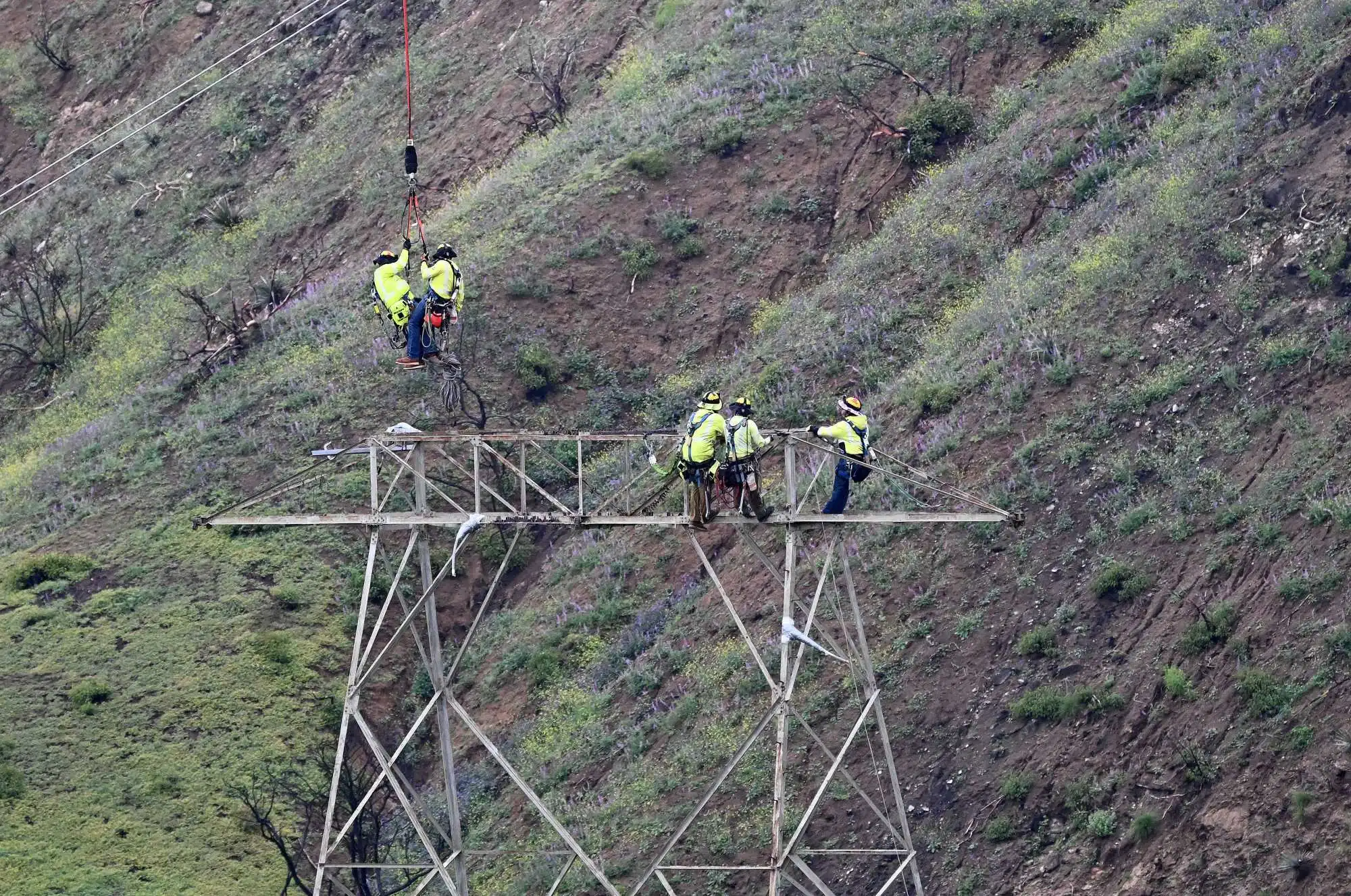
The Eaton fire, which claimed 19 lives and destroyed more than 9,000 structures, was caused by arcing from a long dormant SCE transmission tower that became reactivated in the high winds.
There are many factors that turn utility-caused fires into catastrophes: high winds, low humidity, fuel supply, Choi said. Even with a state fund to draw from, Edison’s own share of the bill could be as much as $4.5 billion if the utility is found by regulators to have acted imprudently.
“Those who would say that the utilities don’t have an incentive to operate safely, don’t know the utility business, because the utilities have every incentive everyday to operate our system safely,” Choi said. “We have every incentive to operate our system prudently, not perfectly, prudently.”
The word “prudently” is key. State regulators can penalize a utility that did not act “prudently” in maintaining its equipment and starting a wildfire.
Choi added the various iterations of Newsom’s reform plan ultimately fell flat and underwhelmed investors, hitting Edison’s stock value.
“No one was jumping up and down about the framework that the governor released, let’s be clear,” Choi said. “Of course we never saw bill language that reflected that framework. The bill that we did see, it fell so short of that framework, I think that’s why you saw significant reaction from utility investors. That confidence has not been restored and likely won’t be restored until there is action that is comprehensive in nature and reflects the understanding of the ongoing risks.”
Despite that lack of investor confidence, Choi said she didn’t see any rate hikes in the near future and SCE would not be cutting back on as much as $7.6 billion in budgeted capital improvements. PG&E recently announced that it is reducing its capital improvements by $2 billion because of an increase in borrowing costs.
Read more Hurricane Marie damaged LA, OC beaches. Super El Niño could be worse, experts say