
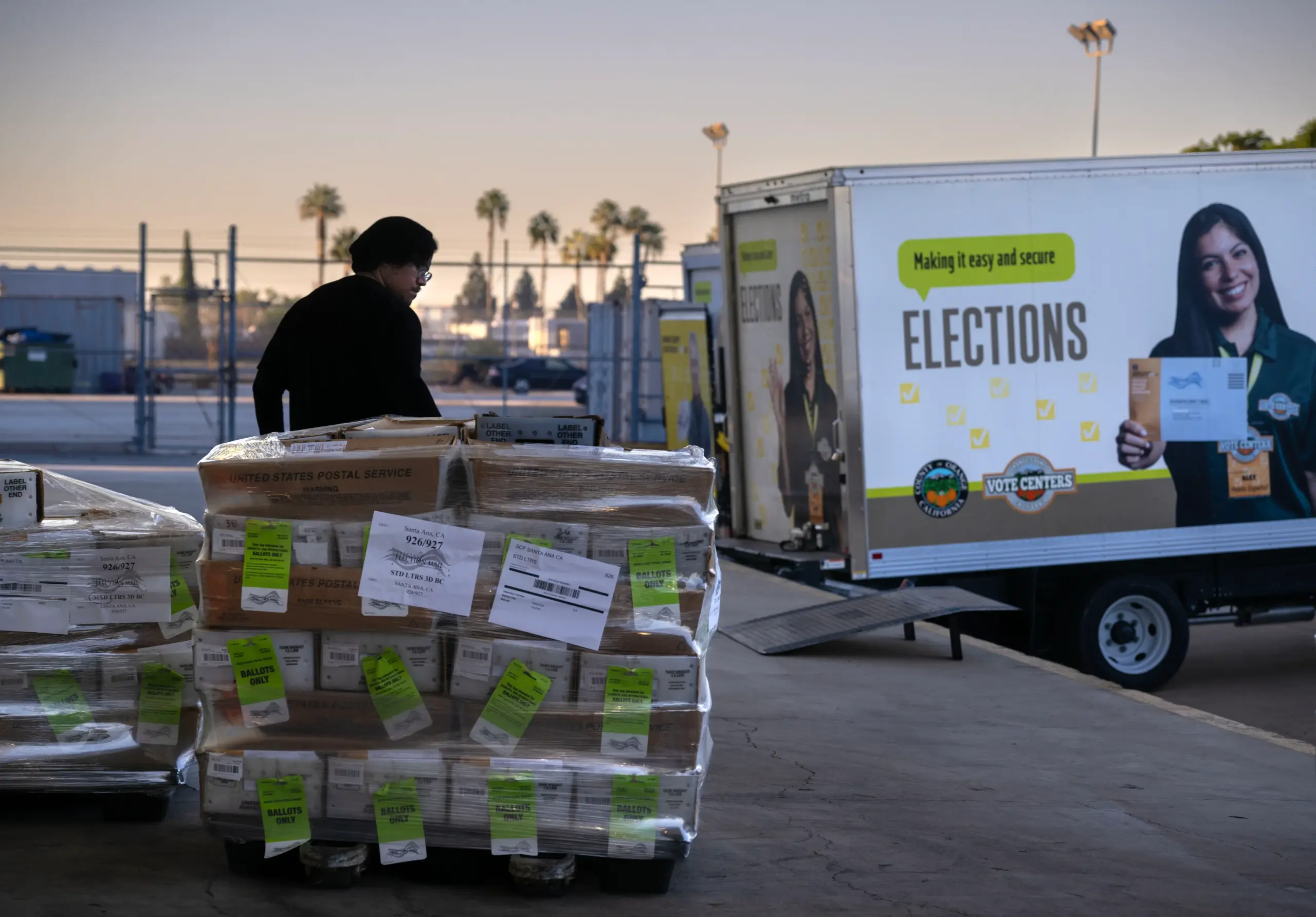
The final stretch of voting in the 2026 midterm elections is here — and if the lengthy ballots are any indication, a lot is at stake in Southern California this election season.
Read more Data center health worries animate midterm campaigns
From a settled-down gubernatorial race after the June primary to more than a dozen measures that could change how certain Californians are taxed, how elections are conducted or how more people could find help to buy a home, there’s much to watch when polls close Tuesday at 8 p.m. — and in the coming days as the later votes are tallied.
Here’s a quick reminder of some of the top stories driving the midterm elections across California and even more locally.
Top of the ticket
However the governor’s race between former U.S. Health and Human Services Secretary Xavier Becerra and former Fox News commentator Steve Hilton shakes out, there will be a notch in the history books.
Becerra, should the Democrat win, would be the first elected Latino governor in California’s history — and the first to serve since Romualdo Pacheco, the lieutenant governor who took over the office in 1875 after then-Gov. Newton Booth resigned to take a U.S. Senate seat.
Meanwhile, Hilton, a Republican, would be the third foreign-born governor since California officially became a U.S. state. He would follow John Downey, who served from 1860-1862 and was born in Ireland, and Arnold Schwarzenegger, who served from 2003-2011 and was born in Austria.
Both candidates have spent the days leading up to the election barnstorming around the state, but particularly in Southern California.
Becerra held multiple rallies on Sunday, including appearing in Orange County with Gov. Gavin Newsom and Rep. Dave Min, D-Irvine, and a later rally in Los Angeles that included Newsom, U.S. Sens. Alex Padilla and Adam Schiff, and former Vice President Kamala Harris.
Hilton held a rally along Pacific Coast Highway on Sunday, an effort to highlight his proposals for helping the Pacific Palisades after the 2025 wildfires.
On election night, Hilton plans to be in Garden Grove and Becerra in Sacramento, according to their teams.
Tax battle in limbo
A first-in-the-nation proposal to levy a one-time tax on billionaires before California voters has split Democrats this election cycle. Should voters approve Proposition 40, a one-time 5% tax would be imposed on people with a net worth of more than $1 billion, billed as an effort to alleviate federal healthcare funding cuts.
Unlike those traditional Republican-versus-Democrat fights voters tend to see on the ballot, this one has split even Democrats and progressive groups.
Case in point: It’s not that often that you see Newsom, California’s Planned Parenthood and the state Republican party on the same side of the issue.
Supporters say the funding is much needed, and underscore that it is just a single tax. Opponents, however, worry this will drive some of the wealthiest Californians, and the money they already contribute to the state’s taxes, out of the state.
Read more Approval of a cheap version of HIV-prevention shot lenacapavir raises hopes in low-income countries
Supporters of the measure include the California Democratic Party, SEIU-United Healthcare Workers West and Sen. Bernie Sanders, I-Vermont.
Opponents include the California Republican Party, Newsom, Planned Parenthood and the California Teachers Association.
The issue also doesn’t end with Proposition 40.
Two other competing tax measures are also before voters this midterm that could invalidate the tax on billionaires.
Should either Proposition 41 or Proposition 42 pass and receive more yes votes than Proposition 40, it would essentially block the billionaire tax, even if voters approved it. Nearly $400 million has already been spent on the three measures.
Proposition 41 would require a pre-election audit of programs that would receive funding from a voter-approved special tax and require recurring audits on taxes enacted after Jan. 1, 2026. It would also prevent special taxes from being exempt from the state spending cap.
Proposition 42 would prohibit taxes enacted after Jan. 1, 2026 from being imposed on retirement holdings, individually owned assets and other forms of personal savings.
The redistricting reshuffle
Yes, the primary election in June was the first election for California’s new congressional districts after voters last year approved a partisan redistricting plan.
But the general election is really the first real look at how California’s congressional landscape will take shape next year after many districts were changed, created or even eliminated.
A year ago, California voters overwhelmingly approved a redistricting plan meant to make several House seats across the state more easily winnable for Democrats. The effort was a counter to similar plans in states led by Republican governors who wanted to do just that for GOP candidates.
Redistricting meant Orange County has increased its congressional representation from six lawmakers to eight. It created a new district along the boundary of Los Angeles and Orange counties. And it made a couple seats in the region more competitive.
That includes California’s 48th Congressional District, which spans Riverside and San Diego counties. What was once a relatively Republican district is now considered just “leaning” in favor of Democrats, according to the nonpartisan Cook Political Report analysis, after it picked up deep-blue Palm Springs.
Another close matchup is California’s 40th Congressional District in Orange and Riverside counties. But this is not one of those closely watched districts as the national battle over which party will control the House next year brews; a Republican will represent these communities either way. Instead, it’s been a volatile and tight matchup between two GOP incumbents, Ken Calvert and Young Kim, since redistricting drew them into the same seat.
Read more Washington state resident dies from bird flu following exposure to infected cattle
The Associated Press contributed to this report.