
By MELISSA GOLDIN
Asked about the trade war with Canada on Wednesday, President Donald Trump falsely claimed that U.S. banks are not allowed to do business with its neighbor to the north.
Read more Volkswagen board approves cutting 50,000 more jobs and closing 4 plants
The allegation came during a meeting with U.S. travel executives in the Oval Office, after a reporter asked Trump whether there are plans for renewed trade talks between the two countries.
Experts say that although they may face restrictions, U.S. banks are not forbidden from operating in Canada.
Here’s a closer look at the facts.
TRUMP: “They have their banks here, Bank of Canada, all of their big banks — big, beautiful banks. I think they have six or seven major banks here. We don’t have our banks there. You know why? They don’t allow it.”
THE FACTS: There are currently 15 U.S.-based banks operating out of Canada, either as branches or subsidiaries, according to a spokesperson for the Canadian Bankers Association. Certain restrictions can make it difficult for U.S. banks to compete north of the border, experts say, but they are free to enter the market. There are eight Canadian banks operating in the U.S., according to the Federal Reserve’s most recent data. The Bank of Canada is not one of them — it is Canada’s central bank, equivalent to the Federal Reserve in the U.S., not a commercial enterprise.
“I think some confusion arises from the differences between the U.S. and Canadian regulatory systems,” said James Thompson, a professor of finance at the University of Waterloo in Canada’s Ontario province. “U.S. banks are certainly permitted to operate in Canada, but how they choose to enter the Canadian market affects what they can do.”
There are three categories of banks in Canada — Schedule I, Schedule II and Schedule III. Canadian-owned banks are Schedule I. There are six major Schedule I banks whose combined assets eclipse those of the 28 smaller banks in the country.
Foreign entities can choose to operate as either Schedule II or Schedule III banks. Schedule II banks are foreign-owned subsidiaries incorporated in Canada that fall under essentially the same banking framework as banks owned domestically. Schedule III banks are branches of foreign banks that are not incorporated in Canada and therefore face regulatory restrictions such as high deposit minimums. Most U.S.-owned banks operate in Canada as Schedule III institutions.
Read more UCLA football preview: Defense seeks controlled aggression
 The portrait of King Charles III on the new Canadian $20 note is seen under a magnifying glass at its unveiling event in Ottawa, on Thursday, Sept. 3, 2026. (Justin Tang/The Canadian Press via AP)
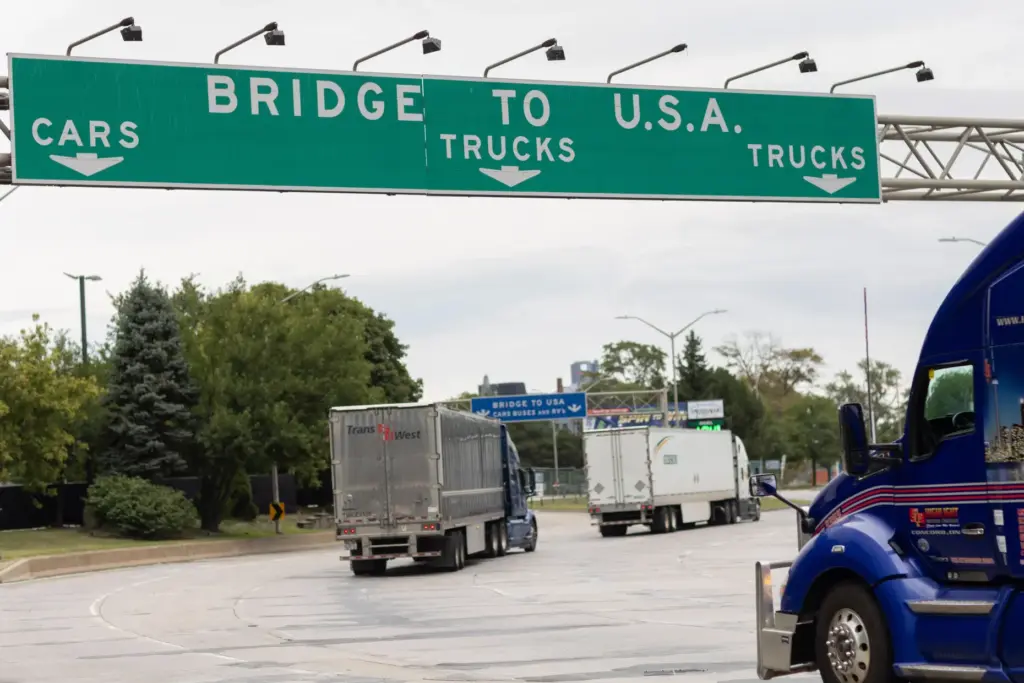 Transport trucks cross the Ambassador Bridge into the United States of America, in Windsor, Ontario, Canada, Saturday, Aug. 22, 2026. (Dax Melmer/The Canadian Press via AP)
 President Donald Trump speaks to reporters in the Oval Office of the White House during a meeting with travel executives, Wednesday, Sept. 2, 2026, in Washington. (AP Photo/Jacquelyn Martin)
Nathalie Bergeron, a spokesperson for the Canadian Bankers Association, said that U.S.-based bank branches and subsidiaries operating in Canada have combined assets of approximately $124.6 billion in Canadian dollars (US$904 million) — more than half of all assets held by foreign bank subsidiaries and branches.
“These banks specialize in a range of financial services, including corporate and commercial lending, treasury services, credit card products, investment banking and mortgage financing,” she said. “They serve not only customers with cross-border business activities, but also Canada’s domestic retail market.”
Among the U.S. banks doing business in Canada are J.P. Morgan Chase Bank, Citibank, Bank of America, Capital One, and Wells Fargo.
Both Schedule II and Schedule III banks face restrictions due to Canadian banking regulations. Jeremy Kronick, a financial and monetary policy expert who is president and CEO of the Canadian C.D. Howe Institute think tank, explained that Schedule III banks cannot accept deposits below $150,000 (US$72,529). This means most people won’t be able to use them as their retail bank. He added that since Schedule II banks are separate legal entities from their foreign parent company, they need their own local capital and liquidity structures — an inefficient option from the bank’s perspective.
Such restrictions may be the reason the majority of U.S.-owned banks choose not to do business over the border. There are more than 3,700 domestically-owned commercial banks in the U.S., according to the Federal Reserve, compared to the 15 with a presence in Canada.
“Canada is a relatively small market, and incumbent Canadian banks are already very large institutions with established brands, extensive branch networks and longstanding customer relationships,” said Thompson. “For a U.S. bank contemplating entry, building the infrastructure necessary to compete for Canadian retail customers would be expensive, while initially capturing only a small share of an already relatively small market.”
Read more LA’s Bass, Raman pick up big endorsements in mayoral race
The White House did not immediately respond to a request for comment.
Find AP Fact Checks here: https://apnews.com/APFactCheck.