
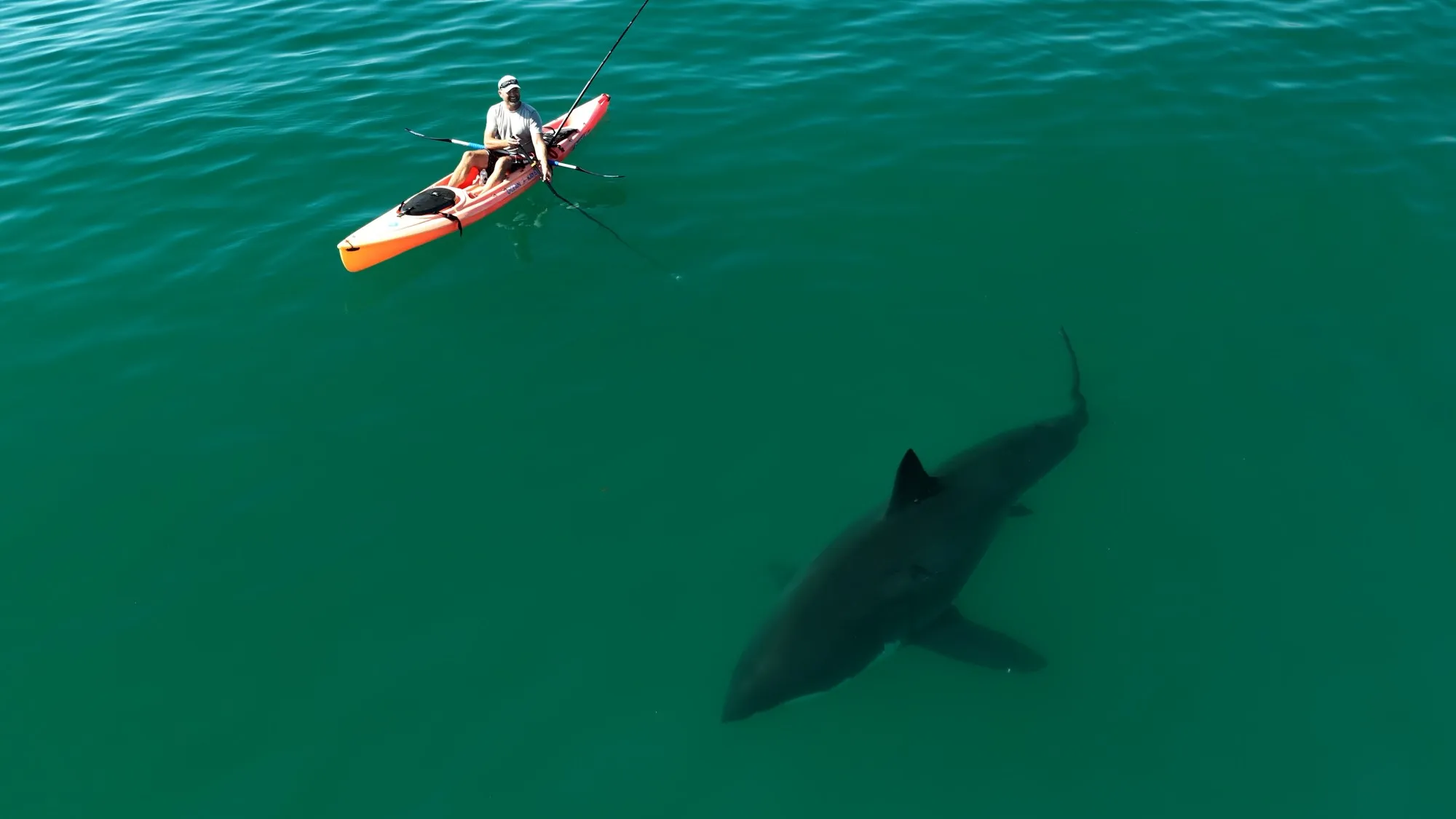
Carlos Gauna watches the water closely, fascinated by the shark scene unfolding in the sea.
Read more Alexander: Will Dodgers break out of their annual late-season slump soon?
His drone is locked onto a great white shark, filming the apex predator’s every move.
“It’s a feisty one right here, trying to bite a buoy,” he said, posted up on an undisclosed beach north of Malibu, the drone camera buzzing above as he gave a play-by-play of the shark’s movements. “He’s trying to get the kelp from the buoy … very interesting. He’s dislodged the kelp and now he’s playing with the kelp. He’s been doing this for 20 minutes. His (pectoral) fins are down, so he’s super excited. So cool.”
Gauna has filmed hundreds, maybe thousands of great white sharks across Southern California, and still their every movement, every action, fascinates him.
 Videographer Carlos Gauna has found a passion for filming sharks across Southern California and beyond, often helping researchers learn more about the species. (Courtesy of Gauna/The Malibu Artist)
He will be showcasing his footage and joining a panel of shark experts, researchers and survivors at 3 p.m. on Saturday, Sept. 5, for a panel discussion, “Great White Sharks, Science, Safety and Survival,” at Sports Basement Long Beach. Cal State Long Beach Shark Lab Director Chris Lowe is also participating.
The event, hosted by the nonprofit Shark Stewards, is a fundraiser benefiting shark conservation and marine protection, as well as raising money toward the group’s endangered shark campaign and shark academy youth education program.
The event is also timed to celebrate the Shark Stewards’ 20th anniversary, and 10 years since Maria Korcsmaros, a shark-bite survivor turned passionate shark advocate, was attacked off Newport Beach.
“We are bringing together a powerful community of scientists, advocates, and artists to educate the public on the importance of white sharks in California’s coastal ecosystems,” said David McGuire, founder and director of Shark Stewards. “This event is an opportunity to learn about the realities of shark interactions, the current emergency shark safety regulations, and how we can protect and coexist with these perfect apex predators for generations to come.”
Gauna’s passion for documenting sharks was sparked at Point Dume near Malibu in 2019 while he was out filming gray whales.
He ran out of batteries and pulled his drone back to the shore. Just then, a great white appeared, chasing a sea lion.
“I blew my only chance at ever filming a great white,” he wrote on a social media post at the time.
Little did Gauna know, he’d rack up thousands of hours of footage in the next six years.
The 46-year-old had a corporate job, but in 2021 he quit to focus his energy, and his lens, full-time on finding great whites.
“I’m dedicated 100% to sharks, every single day,” he said. “I’m pretty lucky; I love the creatures. I do what I love every day.”
Under the moniker The Malibu Artist, with more than 300,000 subscribers on YouTube, his videos often go viral — some getting millions of views.
The videos are more than just sharks swimming; they document behaviors such as feasting on sea lions, interacting with dolphins and swimming close to humans who are surfing or swimming. Gauna said he never discloses the location of the videos for fear the sharks may be hunted and killed.
His footage has caught the attention of major networks; his videos have been shown on the BBC and Shark Week. He’s been sent to film sharks in Brazil, South Africa and, his favorite place so far, the Guadalupe Islands.
Read more Kamala Harris, Hillary Clinton, Oprah Winfrey and others pay tribute to Gloria Steinem
“If you enjoy what you do, it will show in your work,” he said. “And I love sharks, and I’m passionate about it.”
His footage is intended for research, teaming with experts such as the researchers at the Shark Lab, or helping to write scientific papers, like one he did after filming a newborn great white, thought to be the youngest-ever documented.
“That shark could have been a few hours to less than a day old, it still had the white layer on it,” he said. “It was pretty incredible.”
“Having the drone, it’s not just a toy. It’s actually a really good research tool,” Gauna said. “It takes a lot of time to find sharks and to understand their behaviors.”
Gauna said many of his earlier assumptions about sharks have changed based on the thousands of hours he has observed them.
He now notices when they change behavior and what it could mean, knowing that a tilt of a fin or a rapid pace may mean something interesting is about to happen.
“If fins go down or drop when interested or aroused, it helps me anticipate a shot and plan accordingly,” he said. “If there’s something that makes the sharks feel threatened, or they need an exit plan, you can definitely see that by watching their (pectoral) fins.”
Young sharks are clumsy, even cute, he said, as they learn how to adapt in their aquatic home.
Gauna hopes to one day capture footage of sharks mating, he added, something that has never been documented.
The first time he saw a shark near a human was in 2020.
“I used to freak out,” he said. “That was because of my preconceived notions of how they are around people. That’s not to say I don’t still get nervous.”
What he’s come to learn: Sharks are “indifferent” to humans the majority of the time.
“I truly believe they understand what a human is and a human is not food. I really do think that,” Gauna said. “They get a bad rap because they make an attack. But you have to look at the whole context and water conditions that people don’t consider when there’s a negative encounter.”
Gauna doesn’t claim to be an expert and tries to not draw any conclusions in his footage, but after thousands of hours watching sharks, he does have insight into their behavior, he said.
He’s seen sharks, for example, use their dorsal fin to investigate objects, moving it horizontally, a behavior more associated with mammals.
One question he’d like to know: Can they experience joy, the way dolphins do?
“I totally believe they can,” he said.
He’s seen them eating a dolphin, but also seen them swimming — maybe even playing — alongside the marine mammals. He’s seen sharks breaching, jumping out of the water, possibly to chase bait or get parasites off their body.
But maybe, just maybe, they are doing it for fun.
While he’s living out his dream of being a nature photographer documenting sharks, Gauna said he always remembers he’s entering their home.
Read more ICE whistleblower warned of ‘unprecedented lowering of standards’ during hiring spree
“The second you get your toes wet,” he said, “you’re in their home.”