
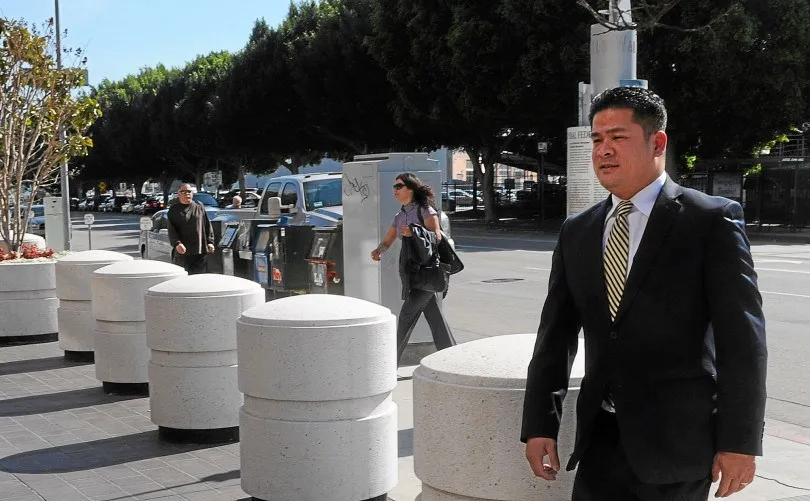
A former Rosemead councilmember who admitted to taking $38,000 in bribes while last in office is attempting a comeback, and this time has endorsements from most of the City Council, including those responsible for his ouster in 2009.
Read more Cost-saving Medicaid meal deliveries threatened by cuts, policy uncertainty
John Tran is one of four candidates battling for three open seats in November. Tran was convicted of a felony count of attempted witness tampering by corrupt persuasion and a felony count of making false statements to the FBI in 2013.
Rosemead’s city clerk, Ericka Hernandez, previously blocked Tran from running in 2018 after determining he was ineligible because of his conviction. This time around, she is allowing him to appear on the ballot.
“For this election cycle, after reviewing the matter, I determined it was not appropriate for me, as the Elections Official, to render a legal determination to deny Mr. Tran’s eligibility based on Elections Code Section 20, as it is not clear on its face that he is ineligible,” Hernandez said in an email.
The Election Code in question states that a person is not eligible for elected office if the person has been “convicted of a felony involving accepting, or giving, or offering to give, any bribe, the embezzlement of public money, extortion or theft of public money, perjury or conspiracy to commit any of those crimes.”
Hernandez did not respond to follow-up questions asking if she sought or received a formal legal opinion on Tran’s eligibility to seek office. The city attorney did not review it and deferred the decision to the city clerk, according to Councilmember Margaret Clark.
In an interview, Tran said he believes he should have been allowed to run in 2018, but that he chose not to challenge the matter at the time. This year, he filed his paperwork early to give the city clerk more time to make the call, he said.
“My position has always been that I’m eligible,” he said.
Charges downgraded
Tran originally pleaded guilty to a bribery charge in 2012 and admitted he took $38,000 from 2005 to 2007 from a developer seeking permits to build an office building in the city. The developer went to the FBI after Tran lost his reelection bid in 2009. Her project never received approval from the city.
Tran withdrew his guilty plea in December 2012 after his attorney claimed they had uncovered information that damaged the credibility of the FBI’s informant. A federal grand jury issued additional charges of extortion and attempted witness tampering a few months later.
The witness tampering charge came about after Tran asked the developer to lie to the federal grand jury by denying having paid him any money, according to the FBI. Tran reportedly falsely told FBI agents the developer only gave him $1,000 to $2,000 in campaign contributions.
An affidavit by an FBI agent alleged Tran threatened to have the informant killed. At one point, the former Rosemead mayor was facing up to 115 years in prison.
Tran eventually agreed to a different plea deal, in which the bribery and extortion charges were dropped. He was sentenced to 21 months in federal prison in July 2014 on the attempted witness tampering and false statement charges and served about 16 of those months.
“At the end of the day, the only reason why we’re here is because the defendant accepted bribes,” Assistant U.S. Attorney Lawrence Middleton said at Tran’s sentencing.
The judge ordered Tran to pay $38,000 in restitution as part of his sentence.
Life at low point
Tran said he was at “rock bottom” at the time.
The sentence required him to participate in substance abuse and gambling addiction treatment programs after his release from prison. Tran also lost his real estate sales license over the conviction, but it was in 2022, records showed.
“I deeply regret the mistakes I’ve made and I’ve taken full responsibility for those decisions,” Tran said. “Having paid my debt to society, I am a better person today and I’m asking for a second chance.”
Tran did not leave the city after his conviction and chose to continue to raise his family in the community, he said.
“The moment that Margaret Clark decided to not seek re-election, I was approached by community members and community leaders and asked if I was interested in running for her seat,” Tran said. “I’m looking for redemption, I’m looking for an opportunity to serve again.”
Law murky
Whether Tran is eligible to hold public office isn’t clear. The California Constitution prohibits “persons convicted of bribery, perjury, forgery, malfeasance in office or other high crimes” from holding elected positions. Malfeasance in office, which is not a defined offense under California’s Penal Code, was most recently interpreted by an appellate court as a conviction that “evidences moral corruption and dishonesty.”
Elections Code Section 20, codified in 2012, states that someone who is convicted of a felony “involving” bribery is ineligible. There is, however, little case law to determine whether admitting to taking a bribe, but not actually being convicted of bribery, is enough to disqualify someone.
Read more The drug used in Tennessee’s failed execution has come under past scrutiny
Tran’s sentencing included three years of supervised release, in which he was specifically barred from running for public office without permission from his probation officer, which strongly suggests he could legally run again once that period ended in March 2018.
Because the city is not questioning Tran’s eligibility, a challenge would need to come from a registered voter through potentially expensive litigation.
A voter could have challenged Tran’s eligibility last month and potentially had him removed from the Nov. 3 ballot before any were printed, but that window has now passed. A similar process recently played out in the City of Commerce when a former mayor successfully sued to block a termed-out councilmember from running again.
Frederic Woocher, whose firm Strumwasser & Woocher represented the former mayor in Commerce, said a voter can still sue within 30 days of the declaration of the results of the election — if Tran wins — and attempt to argue Tran wasn’t eligible in the first place. Such challenges are rare, though, and wouldn’t necessarily help any of the other candidates in the race.
“If the candidate is declared ineligible, the second-place winner does not automatically take the office,” Woocher said. “Instead, the office is deemed to be vacant, and that generally means that the seat can be filled either by appointment of the city council or by holding a new, special election.”
Support from incumbents
Councilmember Sandra Armenta and Steven Ly, the two incumbents running for reelection this November, are endorsing Tran. Both joined the City Council after winning in the 2009 election that ousted him.
Tran sued over that razor-close race and ultimately lost to Armenta by a single vote in the final tally. Armenta did not respond to a request to comment.
Ly, however, said he is fully comfortable with Tran taking office again.
“I’ve seen John spend the last 20 years repairing his reputation, focusing on his family, focusing on his community, focusing on himself,” Ly said. “I do believe he is a better person now than he was 20 years ago.”
Resident Katrina Sornoso, who volunteered for Ly and Armenta’s campaigns, said the 2009 election was largely a referendum on Tran — who was mayor at the time — even though he wouldn’t be charged until years later.
“We all just felt he was not the right person to lead our city,” Sornoso said. “When the charges came out, we saw we did the right thing.”
Sornoso and other residents were shocked when he qualified to run this year, she said. There wasn’t much pushback when Tran was appointed to the Traffic Commission in 2024, and Sornoso blamed complacency in a city where incumbents often coast to easy victories.
She described the endorsements of Tran as a stab in the back.
“I don’t think any of us dreamed they would go as far as allowing him to run again,” she said. “We probably should have spoke out sooner, and, again, that’s on us.”
‘People can change’
Clark, who regularly butted heads with Tran prior to his ouster, voted against his appointment to the commission, but said she now is endorsing him as her potential successor.
“I’m the reason he got off (the council), I knew there were things going on,” she said. Still, Clark is willing to give him another chance, saying she believes he has proven himself over the years.
“I’m a Christian and I believe people can change,” she said. “Otherwise, we’d all be in trouble.”
Clark, a conservative Republican, threw her support behind Tran in part because she strongly disagrees with the politics of the only new challenger in the race, Diana Lam.
Lam has received endorsements from several local Democrats, labor groups and the Los Angeles County Democratic Party. Reached by phone, Lam offered a careful response when asked about her thoughts on Tran’s candidacy.
“I’m running for Rosemead City Council because I really want to bring a fresh perspective to City Hall,” she said. “What I hear from voters at their doors is that they want leaders they can trust and that is what my focus is on.”
Read more Heat-trapping gas once frozen in Arctic ground is slowly leaking and warming the planet